
Euler's Eyes
2026-10-14
Sophie Germain's legacy
Algebra is nothing but written geometry; geometry is nothing but drawn algebra.
— Sophie Germain, General Considerations on the State of the Sciences and Letters (1833)
Sophie Germain worked almost always alone, without a degree, a post or students. She had no access to the lectures, journals or discussions through which the mathematicians of her time learned from one another, and this shows in her work: highly original ideas, sometimes with gaps a teacher would have pointed out in time. Even so, she left her name in two fields that barely touch, number theory and the theory of elasticity.
A name missing from the tower
When the Eiffel Tower opened in 1889, Gustave Eiffel engraved on it the names of 72 French scientists and engineers. Many had worked on elasticity, like Navier, Poisson and Cauchy, and the tower itself could only be calculated thanks to that theory. Sophie Germain’s name is not there. In 1913 the historian H. J. Mozans drew attention to the absence: the person who had helped found the theory that made the tower possible had been forgotten, he said, because she was a woman.
What remained
- Number theory. Sophie Germain’s theorem was the first general result on Fermat’s Last Theorem. Her manuscripts, studied only in 2010, show a much more ambitious plan than was thought.
- Sophie Germain primes. The primes $p$ with $2p+1$ prime took her name and today protect secure internet connections, as safe primes.
- Algebra. The identity $a^4+4b^4=(a^2+2b^2+2ab)(a^2+2b^2-2ab)$ is a classic factoring tool.
- Elasticity. The equation of vibrating plates, which won the 1816 prize, is the basis of the plate theory engineers still use.
- Geometry. Mean curvature, which she used to measure the bending of a surface, is in soap bubbles, minimal surfaces and cell membranes.
- Philosophy. The General Considerations on the State of the Sciences and Letters, published by her nephew after her death, argue for the unity of the sciences and the arts. Auguste Comte praised them.
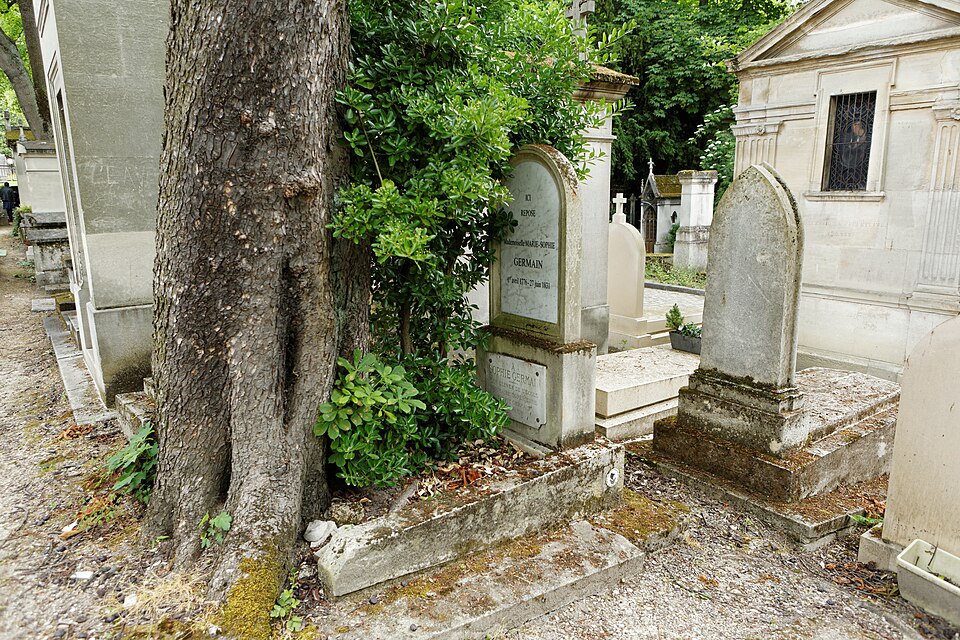
Tributes
Paris has a rue Sophie-Germain, in the 14th arrondissement, and a school named after her, the Lycée Sophie-Germain, in the Marais district. Since 2003 the French Academy of Sciences has awarded the Sophie Germain Prize every year, one of the most important in French mathematics.
To remember
- Sophie Germain lived from 1776 to 1831, in Paris. She taught herself mathematics, against her parents’ wishes.
- She signed as Monsieur Le Blanc in her letters to Lagrange, in 1794, and to Gauss, from 1804.
- The congruence $a\equiv b\pmod m$ says that $a$ and $b$ leave the same remainder on division by $m$.
- If $p$ and $2p+1$ are prime, then in the first case of Fermat the equation $x^p+y^p=z^p$ has no solution.
- The primes $p$ with $2p+1$ prime bear her name. There are ten below 100.
- $a^4+4b^4$ always factors into two products.
- In 1816 she won the Academy prize for the theory of vibrating plates, whose equation has fourth derivatives.
- The mean curvature of a surface is the average of the principal curvatures: $H=\frac{\kappa_1+\kappa_2}{2}$.
Exercise: Sophie was born in 1776. What is the least number of squares that add up to this year?
$1776=16\cdot111$ and $111=8\cdot13+7$, so $1776=4^2\,(8\cdot13+7)$ has Legendre’s form $4^a(8b+7)$ and is not a sum of three squares. By Lagrange’s theorem, it is a sum of four, for example $1776=40^2+12^2+4^2+4^2=1600+144+16+16$.
Exercise: Sophie died in 1831. Is this number prime? Is it a Sophie Germain prime?
$1831$ is not divisible by any prime up to $\sqrt{1831}\approx42.8$, so it is prime. But $2\cdot1831+1=3663=3\cdot1221$ is not prime. So $1831$ is prime, but not a Sophie Germain prime.
Sources: biography of Sophie Germain, MacTutor · H. J. Mozans, Woman in Science (1913) · Dora Musielak, Prime Mystery: The Life and Mathematics of Sophie Germain (2015).
All Sophie Germain topics · ← Mean curvature: how much a surface bends · Image credits →