
Euler's Eyes
2026-10-11
The notion of "being between"
“B is between A and C.” Euclid used this idea in almost every demonstration—without ever explaining it.
Who discovered
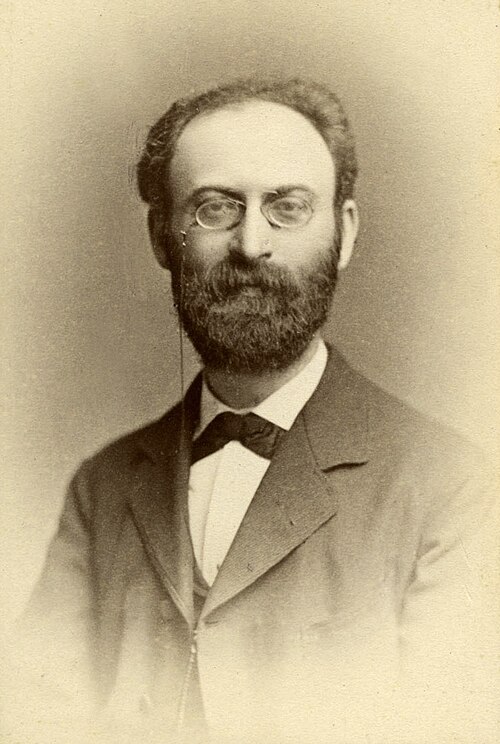
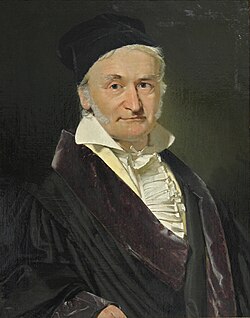
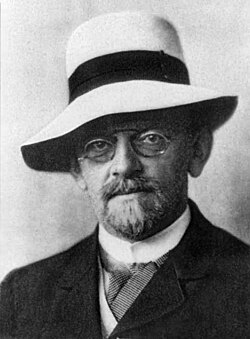
The first to transform “being between” into axioms was the German Moritz Pasch (1843–1930), professor in Giessen, in the book Lições de Geometria Moderna, by 1882. Before him, Carl Friedrich Gauss had already observed, in a letter from 1832, that words like “between” would need to be clarified in a complete exposition of geometry. David Hilbert incorporated Pasch’s ideas in 1899, in the so-called axioms of order.
The story
For two thousand years no one missed this definition, because the drawing resolved it: just look at the figure to see which point is in the middle. The problem appears when you want a proof that does not depend on the figure. There are famous “proofs”, such as that every triangle is isosceles, which seem correct and only fail because a point was drawn on the wrong side of another. The axioms of order prevent this type of mistake.
Pasch argued that a demonstration should remain valid even for those who have never seen the figure. This requirement changed the way geometry was written and paved the way for Hilbert’s work.
In everyday life
- Queues. Knowing who is between you and the cashier tells you how many people are left.
- Metro stations. On a straight train line, if station B is between A and C, whoever goes from A to C must pass through B.
- Kilometers of a highway. The km 120 is between the km 100 and the km 150; The order of the landmarks allows you to locate an accident or an exit.
- Progress bar. A video’s marker is always between the beginning and end, and its position indicates how much is left.
Sources: Moritz Pasch (MacTutor) · Hilbert (MacTutor).
Theory and constructions
PostuladoPostulates of the notion being between
Whatever the points $A$, $B$ and $P$:
- if $P$ is between $A$ and $B$, then $A$, $B$ and $P$ are collinear;
- if $P$ is between $A$ and $B$, then $A$, $B$ and $P$ are distinct two by two;
- if $P$ is between $A$ and $B$, then $A$ is not between $P$ and $B$, nor is $B$ between $A$ and $P$;
- if $A$ is distinct from $B$, then there is a point $P$ that is between $A$ and $B$.
The last postulate has a curious consequence: between $A$ and $P$ there is another point, between that and $A$ another, and so on. Between two distinct points there are infinite points.