
Euler's Eyes
2022-10-03
FUVEST 2021 – 2nd phase: Mathematics solved
Source: FUVEST 2021, 2nd phase, 2nd day (Mathematics test), questions M01 to M05. Official proof available in the FUVEST collection. FUVEST does not publish a template for the 2nd phase; The resolutions below are ours.
Question 1: Parking Surveillance
A rectangular parking lot has dimensions of 40 m by 100 m, where security cameras have been installed that cover specific areas. The problem involves calculating areas and percentages.
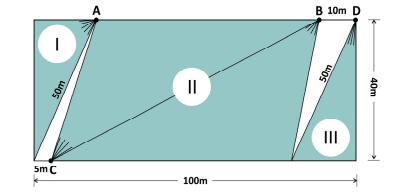
The owner installed 4 security cameras distributed as shown in the figure. The cameras cover the following regions:
- Region I: area covered by camera A.
- Region II: areas covered by cameras B and C.
- Region III: area covered by camera D.
a) Determine the area of region I.
Region I is a right-angled triangle with a hypotenuse of 50 m (the segment indicated in the figure) and a leg of 40 m (the width of the parking lot). It is a triangle of the type 3, 4, 5 (30, 40, 50), so the other side measures 30 m.
Region I is a triangle with a base of 30 m and a height of 40 m. The formula for the area of a triangle is:
$$ A = \frac{\text{base} \cdot \text{altura}}{2} $$Replacing the values:
$$ A_\text{I} = \frac{30 \cdot 40}{2} = 600 \text{m}^2 $$Region III is also a triangle, with a base of 30 m and a height of 40 m. We use the same formula:
$$A_\text{III} = \frac{\text{base} \cdot \text{altura}}{2}$$Replacing the values:
$$A_\text{III} = \frac{30 \cdot 40}{2} = 600 \text{m}^2$$b) Determine the area of region II.
Region II is the central part of the parking lot that is not covered by regions I and III. We can calculate it indirectly:
$$ A_\text{II} = A_\text{total} - (A_\text{trapézio I} + A_\text{trapézio III}) $$The total parking area is:
$$ A_\text{total} = 100 \cdot 40 = 4000 \text{m}^2 $$We replace the values:
$$ A_\text{II} = 4000 - \left(\frac{(5+30)\times 40}{2} + \frac{(10+30)\times 40}{2}\right) = 4000 - (700+800) = 2500 \text{m}^2 $$c) What percentage of the parking area is not monitored by any camera?
The unsurveilled area is the difference between the total area and the sum of the areas covered by the cameras ($A_\text{I} + A_\text{II} + A_\text{III}$):
$$ A_\text{não} = (A_\text{triângulo não I} + A_\text{triângulo não III}) = \frac{5\times 40}{2} + \frac{10\times 40}{2}= 300 \text{m}^2 $$The percentage of unguarded area in relation to the total area is:
$$ \text{Porcentagem não vigiada} = \frac{A_\text{não}}{A_\text{total}} \cdot 100 $$We replace the values:
$$ \text{Porcentagem não vigiada} = \frac{300}{4000} \cdot 100 = 7,5\% $$Question 2:
The points on the Cartesian plane $ P_1 = (3, 3) $, $ P_2 = (5, 1) $, $ P_3 = (3, -1) $ and $ P_4 = (-2, 5) $ are given. Solve:
- Determine the equation of the line that passes through $ P_3 $ and is parallel to the line that passes through $ P_1 $ and $ P_4 $.
- Determine the equation of the circle that passes through the points $ P_1 $, $ P_2 $ and $ P_3 $.
- With $ \mathcal{C} $ being the circumference of the item (2) and $ Q $ being the point of intersection of $ \mathcal{C} $ with the axis $ x $, which is closest to the origin, determine the equation of the tangent line to $ \mathcal{C} $ in $ Q $.
(a) Equation of the line that passes through $ P_3 $ and is parallel to the line that passes through $ P_1 $ and $ P_4 $
-
The slope ($ m $) of the line that passes through $ P_1(3, 3) $ and $ P_4(-2, 5) $ is:
$$ m = \frac{y_2 - y_1}{x_2 - x_1} = \frac{5 - 3}{-2 - 3} = -\frac{2}{5} $$ -
The equation of the straight line that passes through $ P_3(3, -1) $ and has $ m = -\frac{2}{5} $ is given by:
$$ y - y_0 = m(x - x_0) $$Replacing $ x_0 = 3 $, $ y_0 = -1 $, and $ m = -\frac{2}{5} $:
$$ y - (-1) = -\frac{2}{5}(x - 3) $$
$$ y + 1 = -\frac{2}{5}x + \frac{6}{5} $$
$$ y = -\frac{2}{5}x + \frac{6}{5} - 1 = -\frac{2}{5}x + \frac{1}{5} $$Checking: for $ x = 3 $, $ y = -\frac{6}{5} + \frac{1}{5} = -1 $, which is the point $ P_3 $.
Response: $ y = -\frac{2}{5}x + \frac{1}{5} $, i.e. $ 2x + 5y - 1 = 0 $
(b) Equation of the circle that passes through $ P_1(3, 3) $, $ P_2(5, 1) $, $ P_3(3, -1) $
The general equation of the circle is:
$$ x^2 + y^2 + Dx + Ey + F = 0 $$-
We substitute the coordinates of the points to form a system of equations:
-
For $ P_1(3, 3) $:
$$ 9 + 9 + 3D + 3E + F = 0 \quad \Rightarrow \quad 18 + 3D + 3E + F = 0 \quad (1) $$ -
For $ P_2(5, 1) $:
$$ 25 + 1 + 5D + E + F = 0 \quad \Rightarrow \quad 26 + 5D + E + F = 0 \quad (2) $$ -
For $ P_3(3, -1) $:
$$ 9 + 1 + 3D - E + F = 0 \quad \Rightarrow \quad 10 + 3D - E + F = 0 \quad (3) $$
-
-
We solve the system:
-
Subtracting (1) from (2):
$$ 8 + 2D - 2E = 0 \quad \Rightarrow \quad D - E = -4 \quad (4) $$ -
Subtracting (1) from (3):
$$ -8 - 4E = 0 \quad \Rightarrow \quad E = -2 \quad (5) $$ -
We replace $ E = -2 $ in (4):
$$ D + 2 = -4 \quad \Rightarrow \quad D = -6 $$ -
We replace $ D = -6 $ and $ E = -2 $ in (1):
$$ 18 - 18 - 6 + F = 0 \quad \Rightarrow \quad F = 6 $$
-
-
The circle equation is:
$$x^2 + y^2 - 6x - 2y + 6 = 0$$
$$x^2 + y^2 - 6x - 2y + 6 {\color{red}{+4}}= 0 {\color{red}{+4}}$$
$$x^2 + y^2 - 6x - 2y + 9+1= 4$$
$$(x-3)^2 + (y-1)^2= 4$$
Response: $ (x-3)^2 + (y-1)^2= 4 $
(c) Equation of the tangent line to the circle at the point closest to the origin
-
Intersection of the circle with the axis $ x $: We substitute $ y = 0 $ in the equation:
$$ x^2 - 6x + 6 = 0 $$We resolve:
$$ \Delta = (-6)^2 - 4(1)(6) = 36 - 24 = 12 $$
$$ x = \frac{6 \pm \sqrt{12}}{2} = 3 \pm \sqrt{3} $$The closest point to the origin is:
$$ Q = (3 - \sqrt{3}, 0) $$ -
Slope of the tangent line: The circle has a center at $ (3, 1) $. The angular coefficient of the radius that connects the center to the point $ Q $ is:
$$ m_\text{raio} = \frac{y_2 - y_1}{x_2 - x_1} = \frac{0 - 1}{(3 - \sqrt{3}) - 3} = \frac{-1}{-\sqrt{3}} = \frac{1}{\sqrt{3}} $$The angular coefficient of the tangent (perpendicular to the radius) is:
$$ m_\text{tangente} = -\sqrt{3} $$ -
Equation of the tangent line: We substitute $ Q = (3 - \sqrt{3}, 0) $ and $ m_\text{tangente} = -\sqrt{3} $ in the straight line formula:
$$ y - y_0 = m(x - x_0) $$
$$ y = -\sqrt{3}x + 3\sqrt{3} - 3 $$
Response: $ y = -\sqrt{3}x + 3\sqrt{3} - 3 $
Question 3:
The linear system is given:
- Determine all values of $ p $ and $ q $ so that the system is possible and indeterminate (has more than one solution).
- Determine all values of $ p $ and $ q $ so that the system has a solution $ (x, y) $ with $ x = 0 $.
- Determine all values of $ p $ and $ q $ so that the system has no solution.
(a) Possible and indeterminate system
A linear system is possible and indeterminate if the two equations are linearly dependent, that is, one is a multiple of the other. This happens when:
$$ \frac{p}{2} = \frac{q}{3} = \frac{2}{5} $$We calculate $ p $ and $ q $ based on this proportion:
-
From relation $ \frac{p}{2} = \frac{q}{3} $, we have:
$$ q = \frac{3}{2}p $$ -
From relation $ \frac{p}{2} = \frac{2}{5} $, we have:
$$ p = \frac{4}{5} $$ -
We replace $ p $ in $ q = \frac{3}{2}p $:
$$ q = \frac{3}{2} \cdot \frac{4}{5} = \frac{6}{5} $$
Answer to item (a): For the system to be possible and indeterminate, $ p = \frac{4}{5} $ and $ q = \frac{6}{5} $.
(b) Solution with $ x = 0 $
If $ x = 0 $, we substitute into both equations:
In the second equation, we substitute $ y = \frac{5}{3} $:
$$ q \cdot \frac{5}{3} = 2 \quad \Rightarrow \quad q = \frac{6}{5} $$Here, $ p $ can take on any value, as $ x = 0 $ does not depend on $ p $.
Answer to item (b): For the system to have a solution $ (x, y) $ with $ x = 0 $, $ q = \frac{6}{5} $ and $ p $ can be any real number.
(c) System without solution
The system will be impossible (without solution) when the equations are inconsistent, that is, the coefficients of $ x $ and $ y $ are proportional, but the independent terms are not. This happens when:
$$ \frac{p}{2} = \frac{q}{3} \neq \frac{2}{5} $$-
From relation $ \frac{p}{2} = \frac{q}{3} $, we have:
$$ q = \frac{3}{2}p $$ -
To ensure inconsistency, $ \frac{p}{2} \neq \frac{2}{5} $, that is:
$$ p \neq \frac{4}{5} $$
Item response (c): So that the system has no solution, $ q = \frac{3}{2}p $ and $ p \neq \frac{4}{5} $.
Question 4
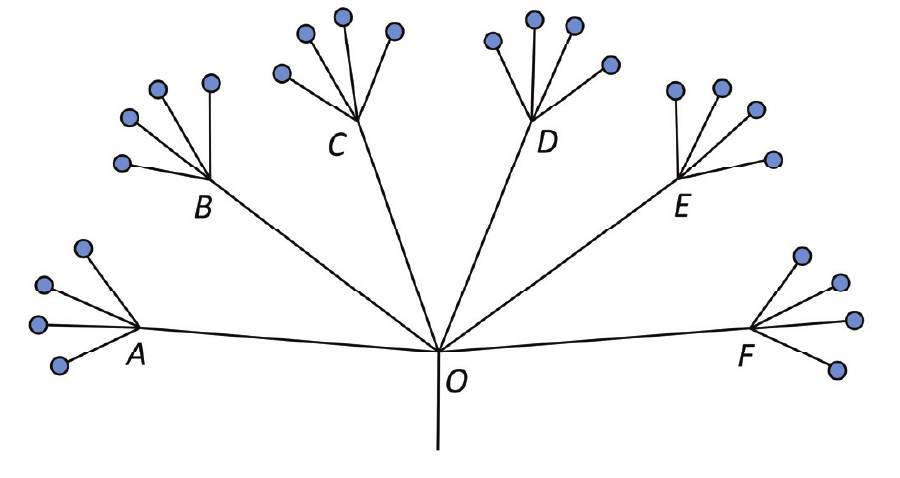
An industrial park with 24 industries was structured so that its sewage system had the structure shown in the figure. An inspection service at point $ O $ detected a prohibited substance that could have come from either industry with equal probability. To prosecute irregular industries, the service decided on the following strategy: use 6 test kits on samples collected at points $ A, B, C, D, E $ and $ F $, on the first day and, on the second day, do the same at the exits of all industries in the groups identified as contaminated on the first day. One of the scenarios examined by the inspection service was that there were exactly four irregular industries.
a) How many are the possible ways for exactly four irregular industries to be distributed among the 24 industries in the park?
b) What is the probability, if there are exactly four irregular industries, that the total expenditure on testing kits over the two days is 22?
c) What is the probability, if there are exactly four irregular industries, that the total expenditure on testing kits used on the two days will be 14 or less?
How the kits are spent. According to the figure, each point $ A, \dots, F $ receives sewage from 4 industries, forming 6 groups of 4. On the first day there are always 6 kits. On the second day, each contaminated group costs 4 kits (one per industry in the group). If $ k $ groups are contaminated:
$$ \text{Total de kits} = 6 + 4k $$(a) Ways to distribute 4 irregular industries
Just choose 4 from 24 industries, regardless of the order:
$$ \binom{24}{4} = \frac{24 \cdot 23 \cdot 22 \cdot 21}{4 \cdot 3 \cdot 2 \cdot 1} = 10\thinspace 626 $$Answer (a): $ 10\thinspace 626 $ shapes.
(b) Total expenditure of 22 kits
$$ 6 + 4k = 22 \quad \Rightarrow \quad k = 4 $$In other words, the 4 irregular industries are in 4 different groups, one in each group. To count:
- choose the 4 contaminated groups among 6: $ \binom{6}{4} = 15 $;
- in each of these groups, choose which of the 4 industries is the irregular one: $ 4 \cdot 4 \cdot 4 \cdot 4 = 4^4 = 256 $.
Response (b): $ \dfrac{640}{1\thinspace 771} \approx 36{,}1\% $.
(c) Total spend of 14 kits or less
$$ 6 + 4k \leq 14 \quad \Rightarrow \quad k \leq 2 $$As there are irregular industries, $ k \geq 1 $. We count the two cases:
-
$ k = 1 $ (the 4 irregulars in the same group): we choose the group, and the entire group is irregular:
$$ \binom{6}{1} \cdot \binom{4}{4} = 6 \cdot 1 = 6 $$ -
$ k = 2 $ (the 4 irregulars spread across exactly 2 groups): we choose the 2 groups, $ \binom{6}{2} = 15 $. Among the 8 industries in these groups, we chose 4, $ \binom{8}{4} = 70 $, but we discounted the 2 cases in which 4 are all in a single group (these are in the $ k = 1 $ case):
$$ 15 \cdot (70 - 2) = 15 \cdot 68 = 1\thinspace 020 $$
Response (c): $ \dfrac{171}{1\thinspace 771} \approx 9{,}7\% $.
Conference: case $ k = 3 $ has $ \binom{6}{3} \cdot 3 \cdot \binom{4}{2} \cdot 4 \cdot 4 = 20 \cdot 288 = 5\thinspace 760 $ distributions. Adding all cases, $ 6 + 1\thinspace 020 + 5\thinspace 760 + 3\thinspace 840 = 10\thinspace 626 $, which is the total of item (a).
Question 5
The perimeter of a plane figure is the length of its contour. The diameter of a flat figure is the greatest distance between two points on the contour of that figure. Calculate the ratio between the perimeter and diameter in each of the plane figures in the following cases:
a) A rectangle with sides measuring 3 and 4.
b) The obtuse triangle $ ABC $ shown in Figure 1.
c) The colored region within the circle of radius $ r $ shown in Figure 2.
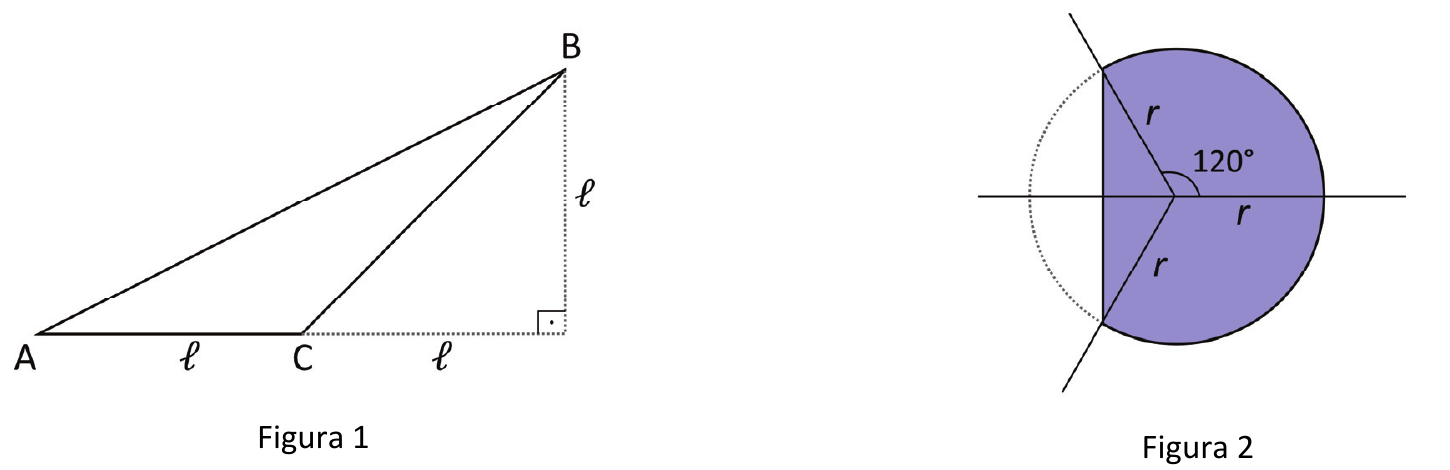
(a) Rectangle with sides measuring 3 and 4
- Rectangle perimeter: $$ P = 2 \cdot (3 + 4) = 14 $$
- Diameter of the rectangle (diagonal, calculated by the Pythagorean Theorem): $$ D = \sqrt{3^2 + 4^2} = \sqrt{9 + 16} = 5 $$
- Reason: $$ \frac{P}{D} = \frac{14}{5} = 2{,}8 $$
Answer (a): The ratio of the perimeter to the diameter of the rectangle is $ 2{,}8 $.
(b) Obtuse angle triangle $ \triangle ABC $
Let $ H $ be the foot of the height relative to $ B $ (the vertex of the right angle in the figure), with $ CH = BH = \ell $.
- $\Delta CHB$
$$(BC) = \ell\sqrt{2}$$
- $\Delta AHB$
$$(AB) = \ell\sqrt{5}$$
-
Triangle perimeter:
$$ P = AB + BC + CA = \ell\sqrt{5} + \ell\sqrt{2} + \ell $$ -
Triangle diameter (largest distance between two vertices):
- $ AB = \ell\sqrt{5} $ is the longest side of the triangle, therefore $ D = AB = \ell\sqrt{5} $.
-
Reason:
$$ \frac{P}{D} = \frac{\ell\sqrt{5} + \ell\sqrt{2} + \ell}{\ell\sqrt{5}} = \frac{\sqrt{5} + \sqrt{10} + 5}{5} $$
Answer (b): The ratio between the perimeter and the diameter of the triangle is $ \frac{\sqrt{5} + \sqrt{10} + 5}{5} $.
(c) Colored region within the circle of radius $ r $
-
Perimeter of colored region:
- The outline of the colored region is formed by an arc and a chord (the vertical segment).
- The rope cuts an arc of $ 120^\circ $ (the dashed line) outside the circle. The colored arc measures $ 360^\circ - 120^\circ = 240^\circ $: $$ \text{arco} = \frac{240^\circ}{360^\circ} \cdot 2\pi r = \frac{4\pi r}{3} $$
-
Corda (law of cosines in the triangle formed by the two radii and the chord):
$$ (AB)^2 = r^2+ r^2 - 2 \cdot r \cdot r \cdot \cos 120^\circ $$
The perimeter is given by:
$$P = \frac{4\pi r}{3} + r\sqrt{3}$$-
Diameter: the region contains two diametrically opposite points on the circle (for example, the bottom end of the chord and the point on the arc opposite it), so the greatest distance is $ D = 2r $.
-
Reason:
$$ \frac{P}{D} = \frac{\frac{4\pi r}{3} + r\sqrt{3}}{2r} = \frac{4\pi + 3\sqrt{3}}{6} $$
Response (c): The ratio of the perimeter to the diameter of the colored region is $ \frac{4\pi + 3\sqrt{3}}{6}$.