
Euler's Eyes
2026-10-15
Briggs and base-10 logarithms
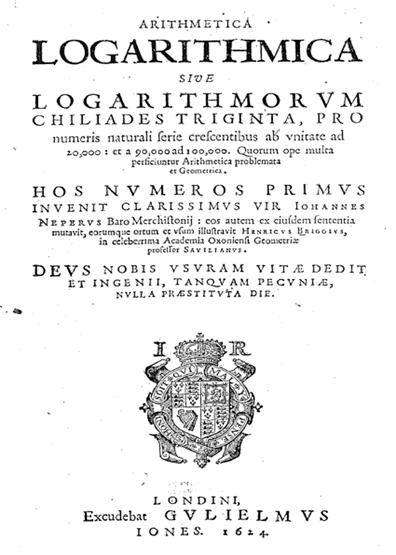
These numbers were first invented by the most illustrious John Napier, Baron of Merchiston; they were then changed, following his own opinion, by Henry Briggs.
— Title page of Henry Briggs's Arithmetica logarithmica (1624)
Henry Briggs was professor of geometry at Gresham College in London and one of the greatest calculators in England. In March 1615 he wrote to a friend that Napier had set his “head and hands a work” with his new logarithms, and that he hoped to meet him that summer. He did. In the conversation at Merchiston the two agreed that the tables would be far more practical with two changes: the logarithm of 1 would be 0, and that of 10 would be 1.
Base-10 logarithms
With this choice, the logarithm of $x$ is the exponent to which 10 must be raised to obtain $x$:
$$\log x=y\iff10^y=x.$$And the rule of the progressions holds without any awkward factor:
$$\log(ab)=\log a+\log b,\qquad\log\frac ab=\log a-\log b,\qquad\log a^n=n\log a.$$Computing log 2
How did Briggs compute these numbers? A simple trick gives a good idea. We know that
$$2^{10}=1024\approx1000=10^3.$$Taking logarithms, $10\log2\approx3$, that is, $\log2\approx0.3$. To improve, we use what is left over: $2^{10}=10^3\times1.024$, so
$$\log2=\frac{3+\log1.024}{10}.$$For numbers very close to 1, $\log(1+h)\approx0.4343\,h$. With $h=0.024$, $\log1.024\approx0.0104$, and so $\log2\approx0.30104$. The true value is $0.30103$. Others follow for free: $\log4=2\log2\approx0.60206$, $\log8\approx0.90309$ and $\log5=\log10-\log2\approx0.69897$.
Briggs went much further. He took 54 successive square roots of 10, each to more than 30 decimal places, until he reached a number so close to 1 that its logarithm, $1/2^{54}$, could be compared directly with how much it exceeded 1. It was a monstrous task, and he did it by hand.
Characteristic and mantissa
The great advantage of base 10 is that moving the decimal point only changes the integer part of the logarithm:
$$\log2=0.30103,\quad\log20=1.30103,\quad\log200=2.30103,\quad\log2000=3.30103.$$The integer part, the characteristic, tells how many digits the number has. The decimal part, the mantissa, is the same for all. So a table of the mantissas of the numbers from 1 to 10 is enough, and it serves for any number.
The tables
In 1617, the year of Napier’s death, Briggs published the logarithms of 1 to 1000, to 14 decimal places. In 1624, in the Arithmetica logarithmica, he published those of 1 to 20,000 and of 90,000 to 100,000, also to 14 places. The Dutchman Adriaan Vlacq filled in the missing ones in 1628. Base-10 tables were used by astronomers, navigators, engineers and students until the 1970s.
Exercise: with log 2 ≈ 0.30103 and log 3 ≈ 0.47712, compute log 6, log 1.5 and log 72.
$\log6=\log2+\log3\approx0.77815$. $\log1.5=\log3-\log2\approx0.17609$. $72=8\times9=2^3\times3^2$, so $\log72=3\log2+2\log3\approx0.90309+0.95424=1.85733$. The characteristic 1 says that 72 has two digits.
Exercise: use logarithms to estimate 2⁶⁴, the number of grains on the chessboard of the legend.
$\log2^{64}=64\log2\approx64\times0.30103=19.26592$. The characteristic 19 says the number has 20 digits, and the mantissa $0.26592$ corresponds to $10^{0.26592}\approx1.845$. So $2^{64}\approx1.845\times10^{19}$. The exact value is $18{,}446{,}744{,}073{,}709{,}551{,}616$.
Sources: Henry Briggs, Arithmetica logarithmica (London, 1624) · Ian Bruce, “The agony and the ecstasy: the development of logarithms by Henry Briggs”, The Mathematical Gazette 86 (2002) · Julian Havil, John Napier: Life, Logarithms, and Legacy (2014).
All topics on John Napier · ← Napier’s two points: the definition of the logarithm · Napier’s bones: multiplying with rods →