
Euler's Eyes
2026-10-11
Congruence of triangles
When are two triangles “copies” of each other? There is no need to check the six elements: three well chosen ones are enough.
Who discovered
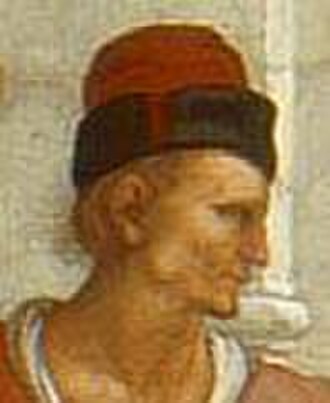
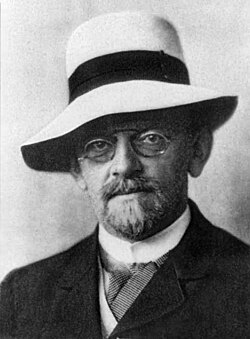
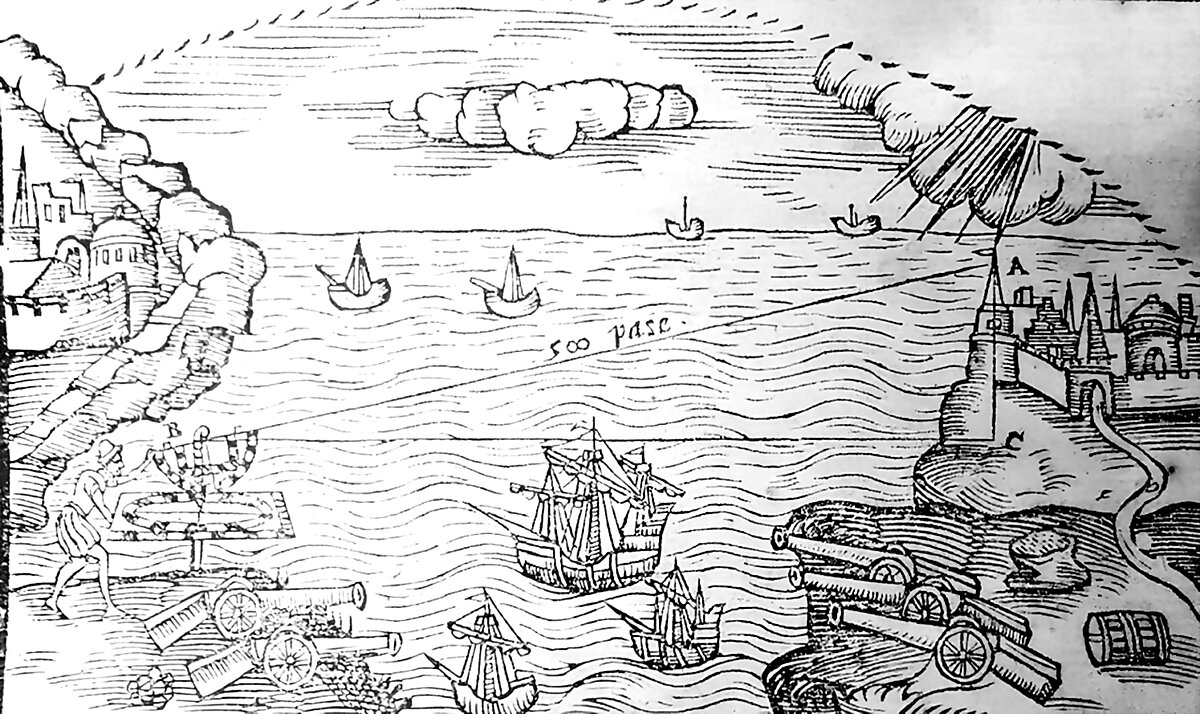
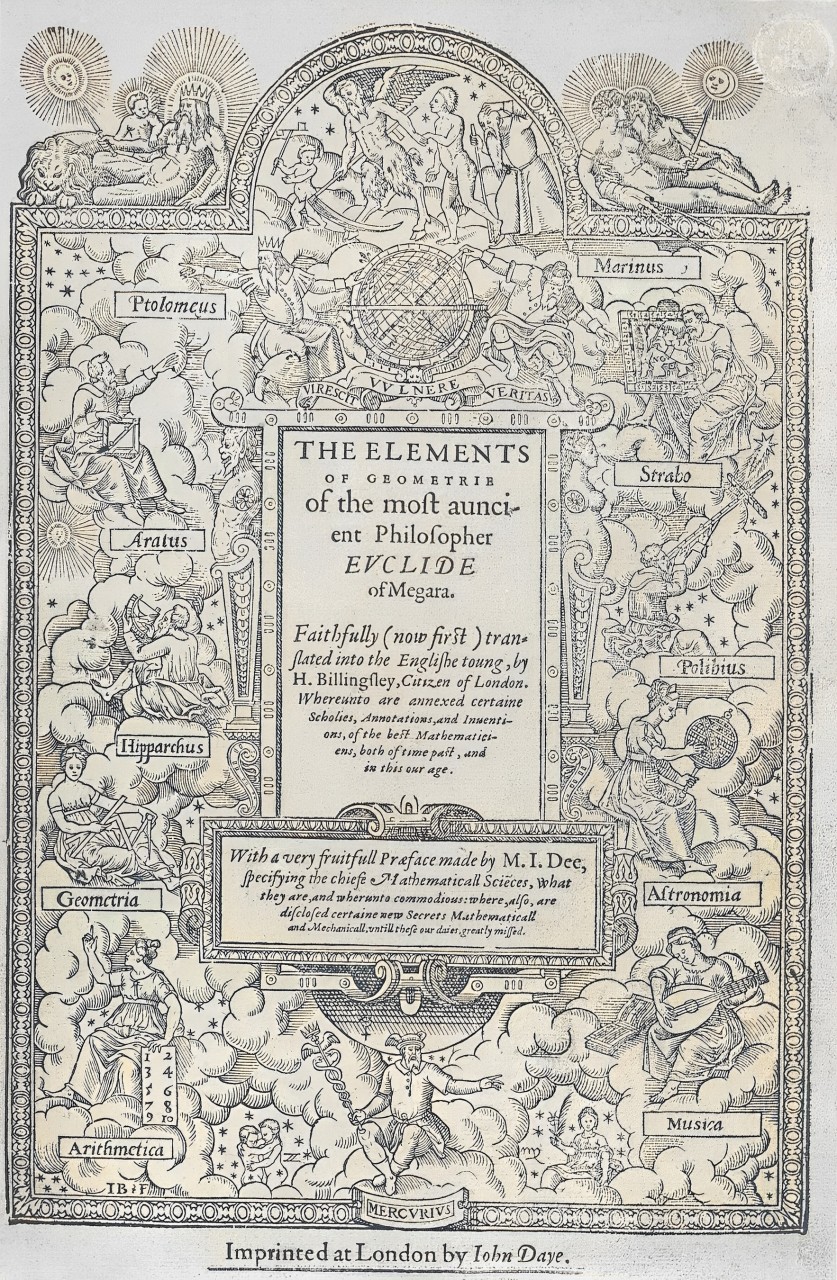
The oldest author-named criterion is ALA (one side and two adjacent angles). Proclus, citing Eudemus of Rhodes, says that Thales of Miletus (6th century BC) used it to calculate the distance of ships at sea. The demonstration of the cases LAL (proposition I.4), LLL (I.8) and ALA (I.26) is in The Elements of Euclid (c. 300 BC). In 1899, David Hilbert showed that the LAL case needs to be accepted as an axiom.

The story
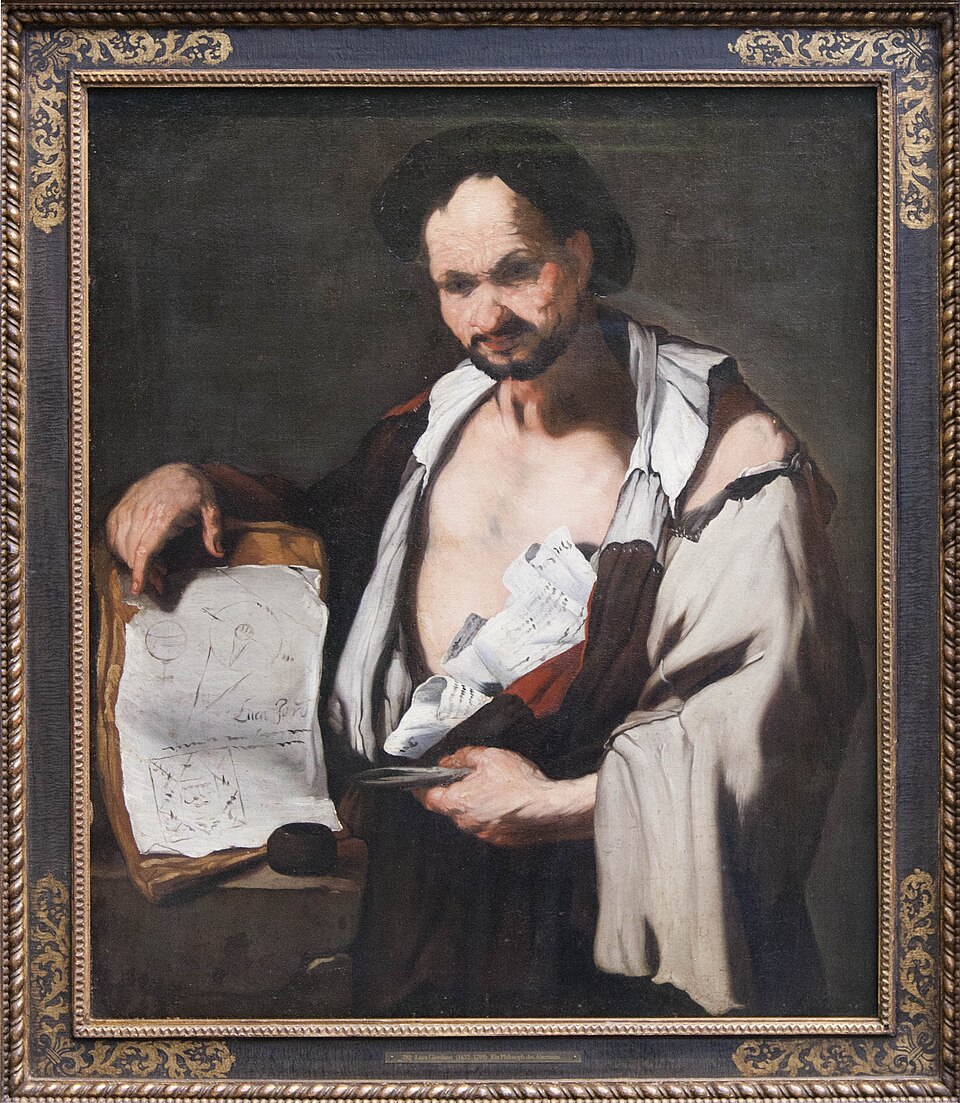
To prove the LAL case, Euclid “moves” one triangle and places it on top of another — the so-called superposition method. Since Antiquity, commentators have noted that no postulate authorizes this movement. Many accepted the proof; others, such as the Renaissance mathematician Jacques Peletier (1557), criticized it.
Hilbert closed the discussion: in his axiomatics, a version of the LAL case is one of the congruence axioms, and from it the ALA and LLL cases are demonstrated. This is why in this book the LAL is a postulate and the other cases are theorems.
In everyday life
- Triangle does not deform. In the LLL case, once the three sides are fixed, the triangle is determined. That’s why a shelf with a French hand (a diagonal bar) doesn’t give way, and a gate without a diagonal bends.
- Measure what cannot be reached. Like Thales with ships: by measuring one side and two angles on land, a congruent triangle is constructed where it can be measured.
- Series production. Parts cut with the same template are congruent and can be interchanged.
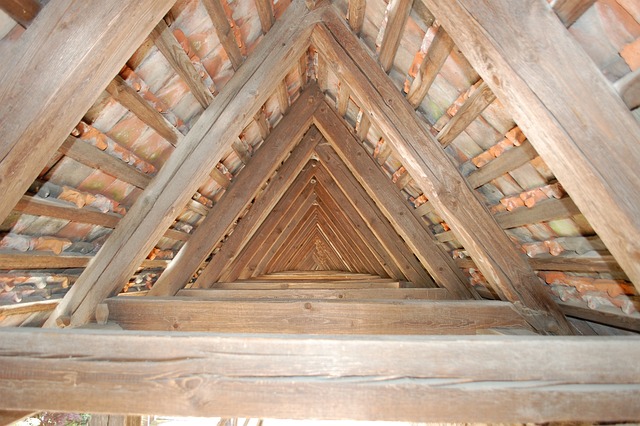
- Symmetry. The two halves of a roof shear (the triangular frame) are congruent triangles, which balances the weight.
Sources: Tales (MacTutor) · Elements, proposition I.4 · Elements, proposition I.26 · Hilbert (MacTutor).
Theory and constructions


DefiniçãoCongruent triangles
A triangle is congruent to another if, and only if, it is possible to establish a correspondence between its vertices so that the sides are orderly congruent and the angles are orderly congruent:
$$\triangle ABC \equiv \triangle A^{\prime}B^{\prime}C^{\prime} \iff \begin{cases} \overline{AB} \equiv \overline{A^{\prime}B^{\prime}},\ \overline{AC} \equiv \overline{A^{\prime}C^{\prime}},\ \overline{BC} \equiv \overline{B^{\prime}C^{\prime}} \\ \hat{A} \equiv \hat{A}^{\prime},\ \hat{B} \equiv \hat{B}^{\prime},\ \hat{C} \equiv \hat{C}^{\prime} \end{cases}$$The congruence of triangles is reflexive, symmetric and transitive.
The definition requires six congruencies. But there are minimum conditions, with just three elements, that already guarantee the others: they are the cases (or criteria) of congruence. Choose a case in the figure and see why three dice are enough — and why “LLA” is not enough.
Postulado1st case — LAL
If two triangles have neatly congruent two sides and the enclosed angle, then they are congruent.
$$\overline{AB} \equiv \overline{A^{\prime}B^{\prime}},\ \hat{A} \equiv \hat{A}^{\prime},\ \overline{AC} \equiv \overline{A^{\prime}C^{\prime}} \ \Longrightarrow\ \triangle ABC \equiv \triangle A^{\prime}B^{\prime}C^{\prime}$$The LAL case is a postulate. The other cases are proved from it.
Teoremaisosceles triangle theorem
If a triangle has two congruent sides, then the angles opposite those sides are congruent. In other words: all isosceles triangle is isoangle (has congruent base angles).
$$\overline{AB} \equiv \overline{AC} \ \Longrightarrow\ \hat{B} \equiv \hat{C}$$Demo
- The idea is to compare the triangle with itself “flipped”: we associate $A$, $B$, $C$ to $A$, $C$, $B$.
- $\overline{AB} \equiv \overline{AC}$ (hypothesis), $B\hat{A}C \equiv C\hat{A}B$ (it is the same angle) and $\overline{AC} \equiv \overline{AB}$ (hypothesis).
- In the LAL case, $\triangle ABC \equiv \triangle ACB$.
- From this congruence, the angle in $B$ of the first corresponds to the angle in $C$ of the second: $\hat{B} \equiv \hat{C}$.
Teorema2nd case — ALA
If two triangles have an orderly congruent one side and the two angles adjacent to it, then they are congruent.
$$\hat{B} \equiv \hat{B}^{\prime},\ \overline{BC} \equiv \overline{B^{\prime}C^{\prime}},\ \hat{C} \equiv \hat{C}^{\prime} \ \Longrightarrow\ \triangle ABC \equiv \triangle A^{\prime}B^{\prime}C^{\prime}$$Demonstration (falling back to LAL)
- Just prove that $\overline{BA} \equiv \overline{B^{\prime}A^{\prime}}$, as then it is worth LAL.
- By transporting segments, we take $X$ on the ray $\overrightarrow{B^{\prime}A^{\prime}}$ with $\overline{B^{\prime}X} \equiv \overline{BA}$.
- By LAL ($\overline{BA} \equiv \overline{B^{\prime}X}$, $\hat{B} \equiv \hat{B}^{\prime}$, $\overline{BC} \equiv \overline{B^{\prime}C^{\prime}}$), $\triangle ABC \equiv \triangle XB^{\prime}C^{\prime}$, then $B\hat{C}A \equiv B^{\prime}\hat{C^{\prime}}X$.
- But, hypothetically, $B\hat{C}A \equiv B^{\prime}\hat{C^{\prime}}A^{\prime}$. By transporting angles, the rays $\overrightarrow{C^{\prime}X}$ and $\overrightarrow{C^{\prime}A^{\prime}}$ coincide, and both cut $\overrightarrow{B^{\prime}A^{\prime}}$ at a single point: $X = A^{\prime}$.
- Then $\overline{B^{\prime}A^{\prime}} \equiv \overline{BA}$ and, for LAL, $\triangle ABC \equiv \triangle A^{\prime}B^{\prime}C^{\prime}$.
With the ALA case we prove the reciprocal of the isosceles triangle theorem: if a triangle has two congruent angles, then it is isosceles. (Compare $\triangle ABC$ with $\triangle ACB$, as before.)
Teorema3rd case — LLL
If two triangles have neatly congruent three sides, then they are congruent.
View the LLL case demo
We transport the angle $C\hat{A}B$ and the segment $\overline{AC}$ to obtain a point $X$ with $X\hat{A^{\prime}}B^{\prime} \equiv C\hat{A}B$ and $\overline{A^{\prime}X} \equiv \overline{AC}$, with $X$ in the opposite half-plane to that of $C^{\prime}$ in relation to the straight line $A^{\prime}B^{\prime}$. By LAL, $\triangle ABC \equiv \triangle A^{\prime}B^{\prime}X$, and then $\overline{XB^{\prime}} \equiv \overline{CB} \equiv \overline{C^{\prime}B^{\prime}}$.
Thus, the triangles $A^{\prime}C^{\prime}X$ and $B^{\prime}C^{\prime}X$ are isosceles with base $\overline{C^{\prime}X}$, and their base angles are congruent. Adding or subtracting these angles (according to the line $C^{\prime}X$ cutting $\overline{A^{\prime}B^{\prime}}$ inside or outside), we obtain $A^{\prime}\hat{C^{\prime}}B^{\prime} \equiv A^{\prime}\hat{X}B^{\prime}$. By LAL, $\triangle A^{\prime}B^{\prime}C^{\prime} \equiv \triangle A^{\prime}B^{\prime}X \equiv \triangle ABC$.

Existence of the midpoint and angle bisector
With the cases of congruence, we prove two existences promised in the previous chapters.
TeoremaExistence of the midpoint
Given $\overline{AB}$, we construct $C\hat{A}B \equiv D\hat{B}A$ and $\overline{AC} \equiv \overline{DB}$, with $C$ and $D$ in opposite half-planes with respect to the line $AB$. The segment $\overline{CD}$ cuts $\overline{AB}$ at a point $M$. Then:
$\triangle CAB \equiv \triangle DBA$ (LAL) $\Rightarrow$ $\triangle CAD \equiv \triangle DBC$ (LLL) $\Rightarrow$ $\triangle AMD \equiv \triangle BMC$ (ALA), and then $\overline{AM} \equiv \overline{BM}$: $M$ is the midpoint of $\overline{AB}$.
TeoremaExistence of angle bisector
Given $a\hat{O}b$, we take $A, A^{\prime}$ into $\overrightarrow{Oa}$ and $B, B^{\prime}$ into $\overrightarrow{Ob}$ with $\overline{OA} \equiv \overline{OB}$, $\overline{OA^{\prime}} \equiv \overline{OB^{\prime}}$ and $OA^{\prime} > OA$. Let $C$ be the meeting of $\overline{AB^{\prime}}$ with $\overline{A^{\prime}B}$. Then $\triangle AOB^{\prime} \equiv \triangle BOA^{\prime}$ (LAL), $\triangle ACA^{\prime} \equiv \triangle BCB^{\prime}$ (ALA) and $\triangle OAC \equiv \triangle OBC$ (LLL or LAL). Therefore $A\hat{O}C \equiv B\hat{O}C$: $\overrightarrow{OC}$ is angle bisector.
Median and internal angle bisector
DefiniçãoMedian and internal angle bisector of a triangle
- Median is the segment with ends at a vertex and at the midpoint of the opposite side. If $M_a$ is the midpoint of $\overline{BC}$, $\overline{AM_a}$ is the median relative to the side $\overline{BC}$ (or the vertex $A$).
- angle bisector internal is the segment, with ends at a vertex and on the opposite side, that divides the angle of that vertex into two congruent angles. If $S_a \in \overline{BC}$ and $S_a\hat{A}B \equiv S_a\hat{A}C$, $\overline{AS_a}$ is the angle bisector relative to the $\overline{BC}$ side.
Outside angle
TeoremaExterior angle theorem
Given $\triangle ABC$, with $\overrightarrow{CX}$ being the ray opposite $\overrightarrow{CB}$, the angle $e = A\hat{C}X$ is the external angle adjacent to $\hat{C}$ (and not adjacent to $\hat{A}$ and $\hat{B}$). It is the adjacent supplementary of $\hat{C}$, and:
An exterior angle of a triangle is greater than any of the interior angles not adjacent to it: $e > \hat{A}$ and $e > \hat{B}$.
Demo
- Let $M$ be the midpoint of $\overline{AC}$ and $P$ be the point of the ray $\overrightarrow{BM}$ with $\overline{BM} \equiv \overline{MP}$.
- $\overline{AM} \equiv \overline{MC}$, $A\hat{M}B \equiv C\hat{M}P$ (o.p.v.) and $\overline{BM} \equiv \overline{MP}$: for LAL, $\triangle BAM \equiv \triangle PCM$, therefore $B\hat{A}M \equiv P\hat{C}M$ (1).
- As $P$ is internal to angle $e = A\hat{C}X$, we have $e > P\hat{C}M$ (2).
- From (1) and (2): $e > \hat{A}$.
- Taking the midpoint of $\overline{BC}$ and using angles opposite the vertex, it is proved in the same way as $e > \hat{B}$.
Teorema4th case — LAAₒ
If two triangles have orderly congruent a side, an adjacent angle, and the angle opposite that side, then they are congruent.
$$\overline{BC} \equiv \overline{B^{\prime}C^{\prime}},\ \hat{B} \equiv \hat{B}^{\prime},\ \hat{A} \equiv \hat{A}^{\prime} \ \Longrightarrow\ \triangle ABC \equiv \triangle A^{\prime}B^{\prime}C^{\prime}$$View the LAAₒ case demo
There are three possibilities: $AB = A^{\prime}B^{\prime}$, $AB < A^{\prime}B^{\prime}$ or $AB > A^{\prime}B^{\prime}$. In the first case, LAL goes and that’s it.
If $AB < A^{\prime}B^{\prime}$, we take $D$ on the ray $\overrightarrow{BA}$ with $\overline{BD} \equiv \overline{A^{\prime}B^{\prime}}$. By LAL, $\triangle DBC \equiv \triangle A^{\prime}B^{\prime}C^{\prime}$, then $\hat{D} \equiv \hat{A}^{\prime} \equiv \hat{A}$. But $\hat{A}$ is an external angle of $\triangle ADC$, not adjacent to $\hat{D}$; by the exterior angle theorem, $\hat{A} > \hat{D}$ — nonsense. The case $AB > A^{\prime}B^{\prime}$ is analogous, with $D$ between $A$ and $B$. The first possibility remains.
TeoremaSpecial case — right triangles
If two right-angled triangles have orderly congruent one side and the hypotenuse, then they are congruent.
View the special case demonstration
Let $\hat{A}$ and $\hat{A}^{\prime}$ be straight, $\overline{AB} \equiv \overline{A^{\prime}B^{\prime}}$ and $\overline{BC} \equiv \overline{B^{\prime}C^{\prime}}$. We take $D$ on the ray opposite $\overrightarrow{A^{\prime}C^{\prime}}$ with $\overline{A^{\prime}D} \equiv \overline{AC}$. By LAL, $\triangle ABC \equiv \triangle A^{\prime}B^{\prime}D$, then $\overline{B^{\prime}D} \equiv \overline{BC} \equiv \overline{B^{\prime}C^{\prime}}$ and $\hat{D} \equiv \hat{C}$. $\triangle B^{\prime}C^{\prime}D$ is isosceles from base $\overline{C^{\prime}D}$, then $\hat{C}^{\prime} \equiv \hat{D} \equiv \hat{C}$. With $\overline{BC} \equiv \overline{B^{\prime}C^{\prime}}$, $\hat{C} \equiv \hat{C}^{\prime}$ and $\hat{A} \equiv \hat{A}^{\prime}$, the LAAₒ case concludes.
ResumoCongruence cases
| Case | Congruent elements | Status |
|---|---|---|
| LAL | two sides and the angle between them | postulate |
| ALLAH | one side and two adjacent angles | theorem |
| LLL | the three sides | theorem |
| LAAₒ | one side, one adjacent angle and the opposite angle | theorem |
| special | side and hypotenuse (right triangles) | theorem |
| LLA, AAA | — | does not guarantee congruence |