
Euler's Eyes
2026-10-15
The unknown: a place for what is being sought
An unknown is, literally, something in-cognita, not known. But it is not just anything: it is a definite number that we do not yet know. The equation $x+3=7$ does not speak of all numbers; it speaks of one, and the task is to find out which.
Names for what is not known
For a long time the unknown had the name of a word, not of a letter.
- Around the year 250, Diophantus of Alexandria, in the Arithmetica, called the unknown arithmós, “the number”, and abbreviated it with a sign like a final sigma, $\varsigma$. He also had abbreviations for the square of the unknown, $\Delta^{\Upsilon}$ (dýnamis, power), and for its cube, $K^{\Upsilon}$ (kýbos).
- In Baghdad, around 820, al-Khwarizmi called it shay’, thing, and its square māl, wealth. He wrote everything out in words, without any symbol.
- In the fifteenth and sixteenth centuries the Italians translated shay’ as cosa, and the German algebraists who copied the Italians were nicknamed cossists. In 1544 Michael Stifel still used different signs for the thing, its square and its cube:

In these signs, the square and the cube of the thing do not look like the thing. It is a sterile notation, in the sense of this book: to know that the cube times the square gives the fifth power, one had to memorise a table. When Descartes wrote $x$, $x^2$, $x^3$, the rule $x^3\cdot x^2=x^5$ became visible in the exponents. Chapter 1 tells this passage in more detail, in the text from rhetoric to symbol.
A page of Diophantus
In 1621 the Frenchman Claude-Gaspard Bachet published Diophantus’s Arithmetica in Greek, with a Latin translation alongside. This is the page of problem II.8: to divide a given square into two squares.
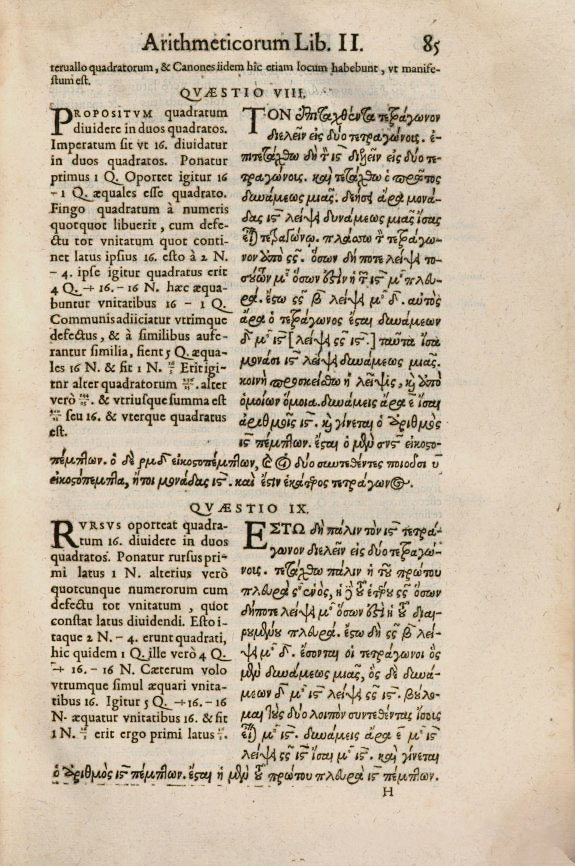
In Bachet’s Latin, the unknown is N, for numerus, and its square is Q, for quadratus: “Ponatur primus 1 Q”, let the first square be $1Q$. In today’s language, to divide $16$ into two squares, Diophantus takes the first as $x^2$ and the second as $16-x^2$, and chooses a form for the side of the second, $2x-4$. The condition is
$$16-x^2=(2x-4)^2=4x^2-16x+16,$$and hence $5x^2=16x$, that is, $x=\frac{16}5$. The two squares are $\frac{256}{25}$ and $\frac{144}{25}$, which add up to $\frac{400}{25}=16$. It was next to this problem that Fermat wrote that, for cubes and higher powers, the division is impossible.
The unknown as an index
In Peirce’s language (see chapter 2), the unknown works as an index: it points to an object that exists but has not yet been seen, like a finger pointing at a closed door. The $x$ does not describe the number; it only reserves its place. What says which number it is are the conditions the equation imposes.
That is why an equation is, at bottom, a question: “which number has this property?”. And the possible answers vary:
| Equation | Answers |
|---|---|
| $x+3=7$ | just one: $4$ |
| $x^2=9$ | two: $3$ and $-3$ |
| $x^2=-1$ | none among the real numbers |
| $x+1=x+1$ | all: it is an identity, not a question |
| $x=x+1$ | none: it is a contradiction |
In the last two rows the letter stops being an unknown. In $x+1=x+1$ the $x$ is arbitrary; in $x=x+1$ there is nothing to look for. The same writing, $\square=\square$, can be a question, a law or an absurdity.
Exercise: redo Diophantus's problem with another side
Divide $16$ into two squares taking the side of the second as $3x-4$. The condition is $16-x^2=(3x-4)^2=9x^2-24x+16$, so $10x^2=24x$ and $x=\frac{12}5$. The squares are $\frac{144}{25}$ and $16-\frac{144}{25}=\frac{256}{25}$, the same as before, in the other order. Diophantus knew that the choice of side is free: each choice gives a solution, and there are infinitely many.
Exercise: unknown or not?
In which of these sentences is $x$ an unknown? (a) $2x+1=7$. (b) $2(x+1)=2x+2$. (c) $x^2+1=0$, in the real numbers.
In (a), yes: only $x=3$ will do. In (b), no: the equality holds for every $x$, it is an identity. In (c), the sentence has the form of a question, but the answer is “no real number”: the unknown points to a door that, in the reals, opens onto nothing. In the complex numbers it opens onto $i$ and $-i$.
Chapter index · ← One letter, five roles · Letters that generalise: from 3 + 5 = 5 + 3 to a + b = b + a →