
Euler's Eyes
2026-10-19
Argand's plane: the imaginary number that found a place
Since the sixteenth century, the Italian algebraists had known that, to solve certain cubic equations, one had to pass through square roots of negative numbers, even when the final answer was a real number. They used $\sqrt{-1}$ uncomfortably. Descartes called such numbers imaginary, and the name stuck. Leibniz described them as “an amphibian between being and non-being”.
The problem was semiotic. $\sqrt{-1}$ was a piece of writing that obeyed the rules of algebra but pointed to nothing that could be seen or measured. A real number has a place on the line; $\sqrt{-1}$ had no place at all.
A place for the imaginary
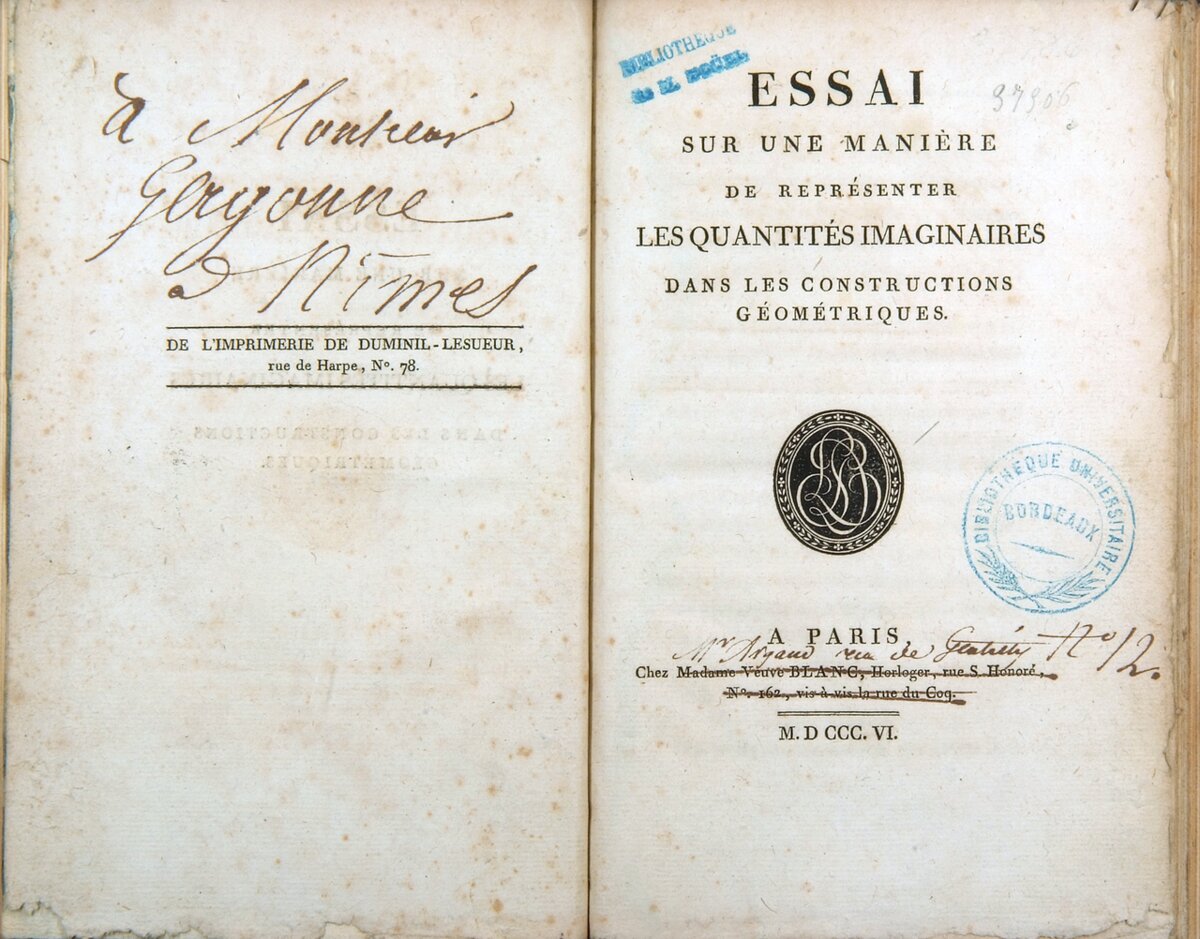
The answer came from two amateurs. In 1797 the Norwegian surveyor Caspar Wessel presented to the Danish Academy a paper that nobody read for a century. In 1806 the Swiss Jean-Robert Argand, a bookkeeper living in Paris, published at his own expense, and unsigned, a small essay with the same idea: put the imaginary numbers on a line perpendicular to the real one.
The number $a+bi$ becomes the point $(a,b)$: $a$ units horizontally, $b$ vertically. The number $1$ lies to the right of the origin; $-1$ to the left; $i$ above; $-i$ below. What was writing without an object gained a place. And with the place came the meaning.
Multiplying by i is turning
See what happens when you multiply by $i$:
$$1\xrightarrow{\times i}i\xrightarrow{\times i}-1\xrightarrow{\times i}-i\xrightarrow{\times i}1.$$In the plane, the four points are right, up, left and down: each multiplication by $i$ turns a quarter turn, $90°$, anticlockwise. And this holds for any number: $i(a+bi)=-b+ai$, which is the point $(a,b)$ turned by $90°$ about the origin.
Now the equality that seemed absurd,
$$i^2=-1,$$comes to say something obvious: two quarter turns make a half turn, and a half turn takes $1$ to $-1$. The symbol is still the same, but it is no longer a mystery. It is the same phenomenon that chapter 2 studied with Duval: the conversion into another register, the geometric one, revealed what the algebraic register was hiding.
Multiplying is turning and stretching
The drawing also explains multiplication in general. Every complex number has a modulus, its distance from the origin, and an argument, its angle with the real axis. And the rule is:
To multiply two complex numbers, multiply the moduli and add the angles.
A multiplication becomes a turn followed by a stretch. In 1831 Gauss gave the idea the prestige it lacked, used the word complex and began drawing the numbers in the plane. After that, the writing $\sqrt{-1}$ lost its fearsomeness, and complex numbers became the language of electricity, of waves and of quantum mechanics.
Exercise: (1 + i)² without calculating
Use the drawing to calculate $(1+i)^2$ and then check with algebra.
$1+i$ has modulus $\sqrt2$ and angle $45°$. Squared, the modulus becomes $(\sqrt2)^2=2$ and the angle becomes $90°$: it is the point $2$ units above the origin, $2i$. With algebra: $(1+i)^2=1+2i+i^2=1+2i-1=2i$.
Exercise: (1 + i)⁸
Calculate $(1+i)^8$.
The angle becomes $8\cdot45°=360°$, a full turn, and the modulus becomes $(\sqrt2)^8=2^4=16$. So $(1+i)^8=16$, a positive real number. With algebra, you would have to expand an eighth-degree binomial; with the drawing, you just count turns.
Chapter index · ← The scale of a chart: when the drawing lies · Graphs and maps: the drawing in which only connections matter →