
Euler's Eyes
2022-06-01
Introduction to natural numbers
Count, group and discover

Tap, count and check
Click on each object once to mark what you have already counted. Change the quantity to create another collection; choose zero to see an empty collection.

Check out the discovery
Both records indicate the same quantity. Numerals allow you to write large quantities with few symbols.
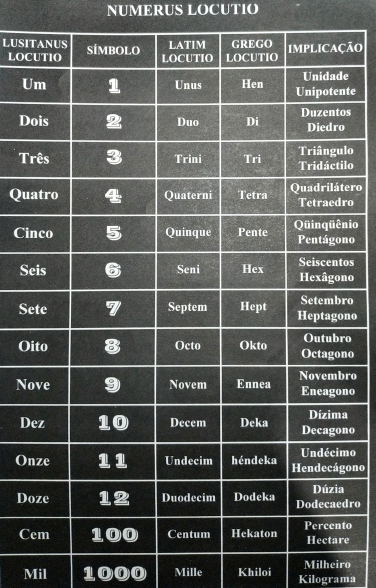
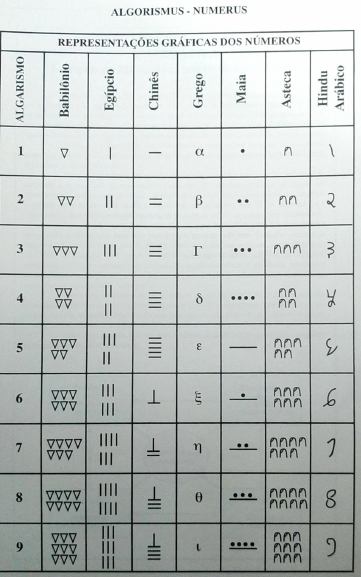
Natural numbers were the first to appear in the history of mathematics. More precisely in Egypt, Mesopotamia and China, where they represented with lines. The Egyptian, for example, used I, II, III, etc.
The following figure shows the emergence of the natural number and the evolution of the natural number.
| Greek Latin writing | Several |
|---|---|
|
|
From the second table, we noticed that the number that went down in history was the Arabic 1, 2, 3, 4 and so on.
In mathematics, the importance of natural numbers is that we can count. In fact, the word calculation (stones) is a term that refers to the process of counting. The disease called kidney stones are basically small stones that appear inside our body. Observe below the figure of a kidney stone from the website Clínica Marina Baitello.

From the counting we learned at school, we can notice 5 “beads”, that is, 5 kidney stones.
Help us build the math website. Donate as much as you can.

Roman Numerals
Roman numbers were important for history, but not very fruitful for calculations. Below we watch a video from Portal Impa.
Arabic Numbers
After years of discussions about which notation would be best to represent the numbers, the chosen one was Arabic Arabic. Egyptian, Mesopotamian and Chinese numbers are more visually intuitive. However, they are very laborious to represent, in addition to the problem of operations such as adding (addition) and removing (subtraction).
Note how intuitive the Egyptian number is, compared to the Arabic one:
1 equal to I
2 equal to II
Symbols are widely used in mathematics, but at that time there were no addition (+) and subtraction (-) symbols. Today these symbols are known, so we will use them without loss of generality.
I + II = III
I plus II equals III
1 + 2 = 3
The applications of natural numbers are present in our daily lives, for example, in a football game, we need natural numbers to represent the players and the scores. In short, counting is important for this sport.
| Score | Hour/minute time |
|---|---|

|

|
Imagine our daily lives without natural numbers. Impa teachers made a video available to learn how to represent Indo-Arabic numbers.
Set of natural numbers
The first set of numbers to appear in history:
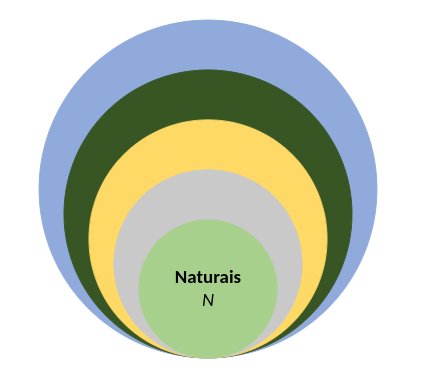
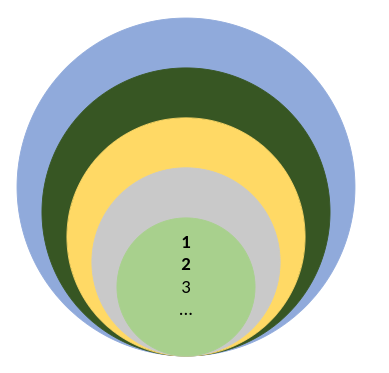
These numbers are represented by \(\mathbb{N}=\{1, 2, 3, 4 ,5 ,6 ,7, 8, 9, 10, \dots\}\). Notice how it is represented in the set:
Count
Counting methods are a concept used to represent natural numbers and have been used since before Christ.
Counting means enumerating, which can be understood as relating natural numbers successively.
In the context of natural numbers, we will use the Arabic numeral system, which is a number system used today.
1, 2, 3, 4, 5, 6, 7, 8, 9, 10, 11, 12, 13, 14, 15, 16, 17, 18, 19, 20, 21, 22, 23, 24, 25, 26, 27, 28, 29, 30, 31, 32, 33, 34, 35, 36, 37, 38, 39, 40, 41, 42, 43, 44, 45, 46, 47, 48, 49, 50, 51, 52, 53, 54, 55, 56, 57, 58, 59, 60, 61, 62, 63, 64, 65, 66, 67, 68, 69, 70, 71, 72, 73, 74, 75, 76, 77, 78, 79, 80, 81, 82, 83, 84, 85, 86, 87, 88, 89, 90, 91, 92, 93, 94, 95, 96, 97, 98, 99, 100, 101, 102, 103, 104, 105, 106, 107, 108, 109, 110, 111, 112, 113, 114, 115, 116, 117, 118, 119, 120, 121, 122, 123, 124, 125, 126, 127, 128, 129, 130, 131, 132, 133, 134, 135, 136, 137, 138, 139, 140, 141, 142, 143, 144, 145, 146, 147, 148, 149, 150, 151, 152, 153, 154, 155, 156, 157, 158, 159, 160, 161, 162, 163, 164, 165, 166, 167, 168, 169, 170, 171, 172, 173, 174, 175, 176, 177, 178, 179, 180, 181, 182, 183, 184, 185, 186, 187, 188, 189, 190, 191, 192, 193, 194, 195, 196, 197, 198, 199, 200, 201, 202, 203, 204, 205, 206, 207, 208, 209, 210, 211, 212, 213, 214, 215, 216, 217, 218, 219, 220, 221, 222, 223, 224, 225, 226, 227, 228, 229, 230, 231, 232, 233, 234, 235, 236, 237, 238, 239, 240, 241, 242, 243, 244, 245, 246, 247, 248, 249, 250, ...
This is the basics for representing natural numbers and for teaching the first grade of elementary school.