
Euler's Eyes
2024-07-18
Circumference ratio in regular polygons
In previous posts we talked about Stewart’s theorem, here we will talk about the circumference relationship in regular polygons. The relationship between circles and regular polygons is a fascinating and complex topic in geometry. Regular polygons are geometric figures with congruent sides and angles, and the circle can be seen as a limiting case of a regular polygon with an infinite number of sides.
When a regular polygon is inscribed in a circle, each of its vertices touches the circle, and the center of the polygon coincides with the center of the circle. This allows precise relationships to be established between the radius of the circle and the dimensions of the polygon, such as the side and apothem (the distance from the center to a side).

For example, in the case of a square inscribed in a circle, the diameters of the circle are equal to the diagonals of the square, and by applying the Pythagorean Theorem, one can find the relationship between the side of the square and the radius of the circle. For a regular inscribed hexagon, the side of the hexagon is equal to the radius of the circle, as each side of the hexagon is equal to one of the radii extending from the center to a vertex.
History
One of the first and most influential mathematicians to contribute to this field was Euclid, whose work “The Elements” established many of the axioms and theorems used to understand the properties of regular polygons inscribed and circumscribed in circles. His work on the division of a circle into congruent arcs and the formation of regular polygons from these arcs is still fundamental to the study of geometry.
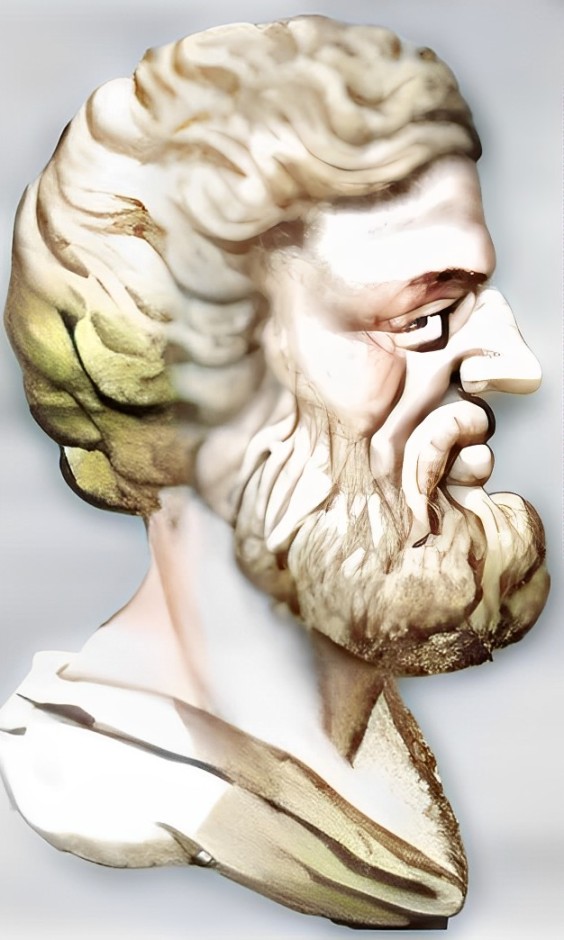
Another notable mathematician is Apollonius of Perga, known for his work on conic sections, which also contributed to the understanding of the relationships between polygons and circles. His study of the properties of ellipses, parabolas, and hyperbolas helped develop the theory linking polygonal shapes to their circumscribed circles.
| Contribution | Apollonius of Perga |
|---|---|

|
|
In the Islamic world, mathematicians such as Al-Biruni and Omar Khayyam also made significant contributions. Al-Biruni developed methods for calculating areas and volumes, including those of regular polygons, while Omar Khayyam worked on classifying and solving cubic equations, which has direct implications for the geometry of polygons.

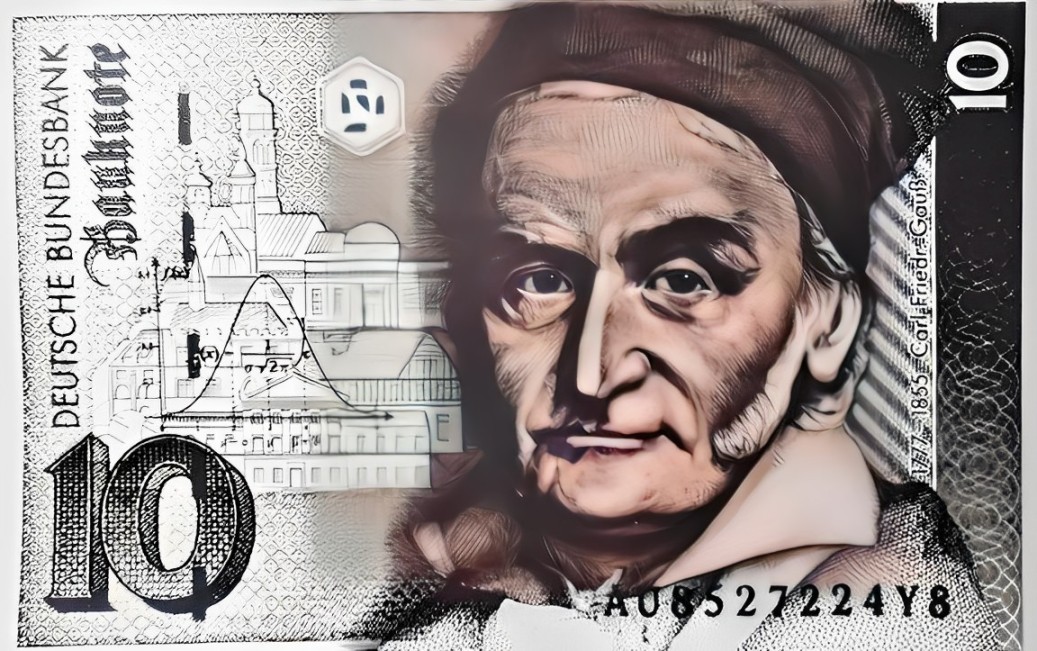
In the modern era, Carl Friedrich Gauss, known as the “prince of mathematicians”, made discoveries that profoundly influenced geometry. His regular polygon theorem proved that a regular n-sided polygon can be constructed with straightedge and compass if the number n is the product of a power of 2 and any distinct Fermat primes.
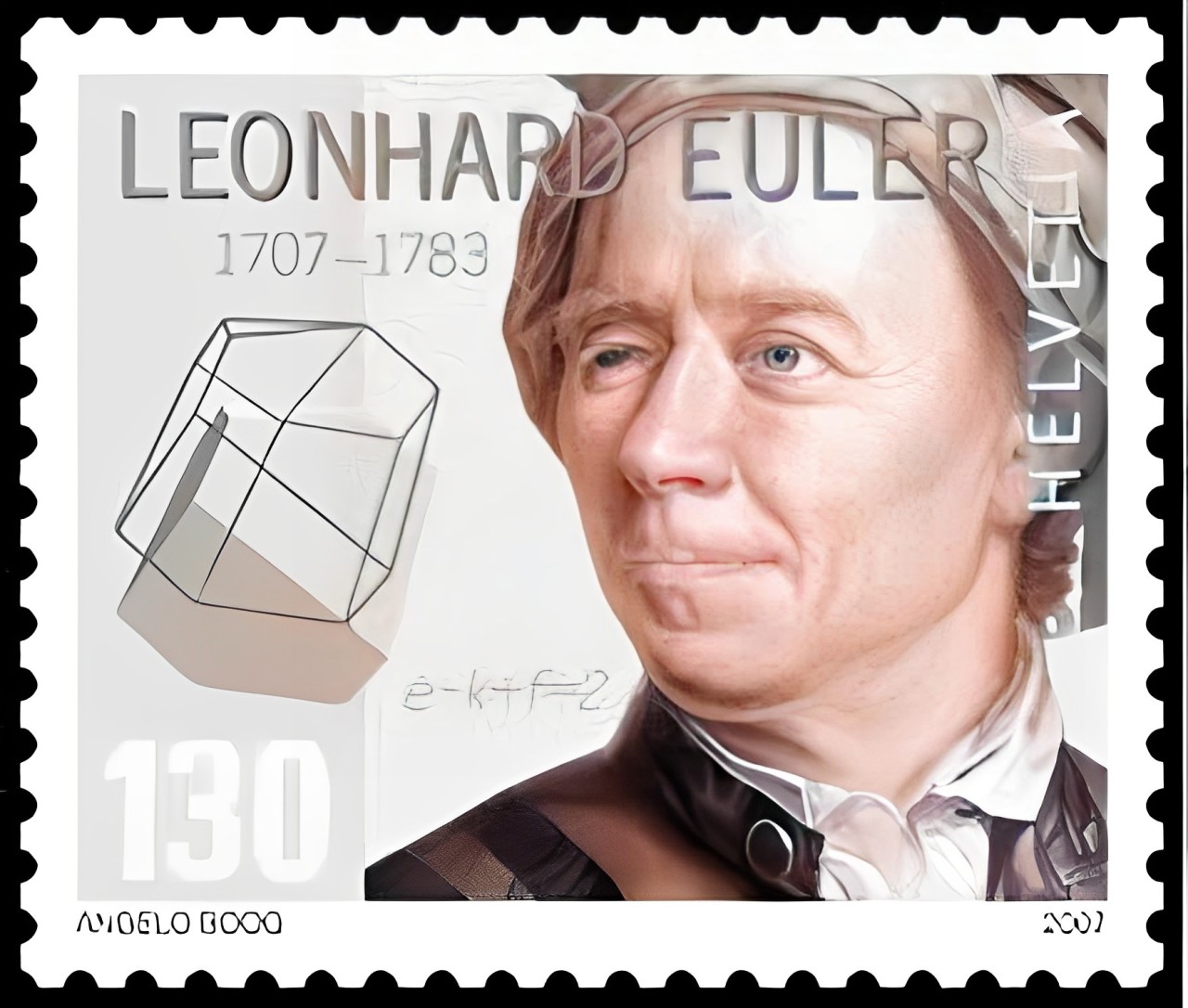
Leonhard Euler, with his famous theorem V-E+F=2 (where V is the number of vertices, E the number of edges and F the number of faces of a polyhedron), also contributed to the understanding of the relationships between different geometric dimensions, which has applications in the analysis of regular polygons and their relationships with circles.
These are just a few of the many mathematicians who have shaped our understanding of geometric relationships. His contributions continue to influence contemporary mathematics and inspire new generations of mathematicians to explore the depths of geometry.
Applications in everyday life
Circumscribed regular polygons are those whose sides touch an internal circle. This unique property allows engineers and architects to use these shapes to optimize space and ensure uniform distribution of forces in their constructions, thus ensuring the stability and safety of structures.

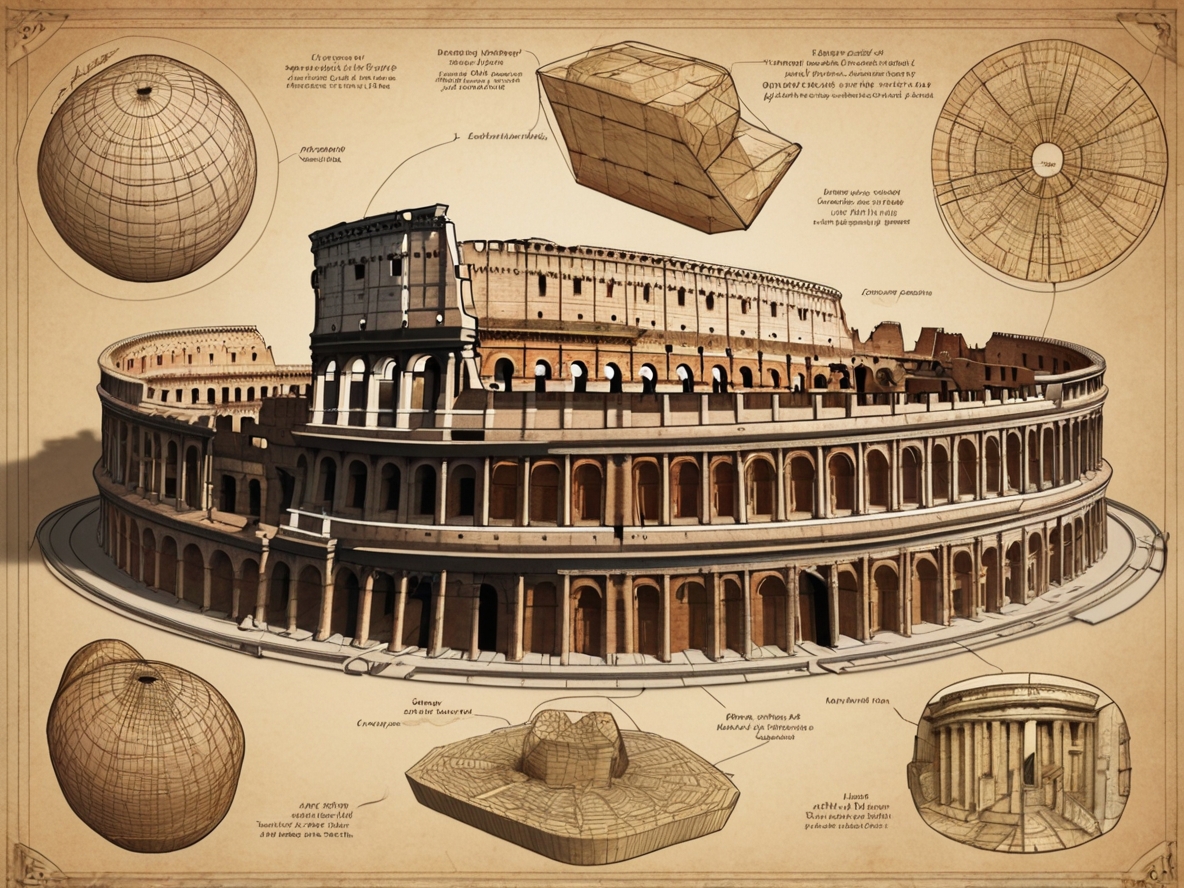
Since Ancient Rome, engineers have used circumscribed polygons to design durable buildings. Today, this practice remains relevant, demonstrating the timelessness and importance of mathematical knowledge. Understanding these concepts is crucial to solving practical problems that require precision and efficiency, especially in engineering and architecture.
A classic example of the application of these principles can be seen in the calculation of measurements of regular polygons, such as side and apothem, with the help of a circle. These measurements are determined according to the radius of the inscribed circumference, facilitating the design of structures such as bridges, towers and buildings with complex geometric shapes.
Furthermore, the precise mathematical relationship between the side of the polygon and the radius of the inscribed circle is fundamental for the accurate calculation of perimeters and areas, providing powerful tools for the design of safe and efficient buildings. For example, polygons with a greater number of sides tend to approximate circular shape, which is beneficial in designs where smoothness of shape is desirable.
These mathematical relationships are not just theoretical; they have direct implications for everyday life. For example, when designing wheels, gears or even arranging furniture in a circular space, the principles of circumscribed polygons are applied to achieve optimal results.
Concepts
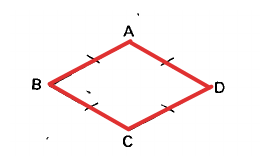
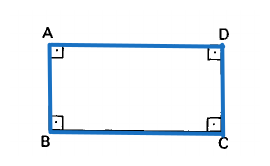
A polygon that has congruent sides is equilateral and if it has congruent angles, it is equiangular.
| equilateral quadrilateral | equiangular quadrilateral |
|---|---|
|
|
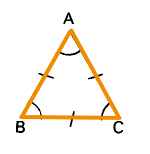
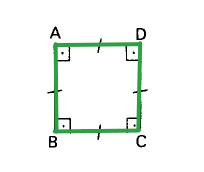
Definition: a convex polygon is regular if, and only if, it has all congruent sides (equilateral) and all congruent angles (equiangular).
| Regular triangle (equilateral) | Regular quadrilateral (square) |
|---|---|
|
|
Properties
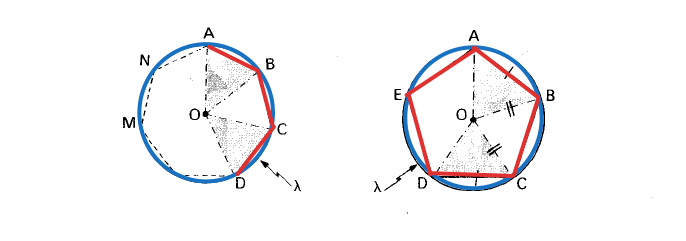
Theorem: When we divide a circle into $n$, with $n$ greater than or equal to 3, congruent arcs. Therefore:
- All chords determined by two consecutive division points, joined together, form a regular polygon with $n$ sides inscribed in the circle.
- The tangents drawn by the division points determine a regular polygon with $n$ sides circumscribed to the circumference.
Demo:
Case 1:
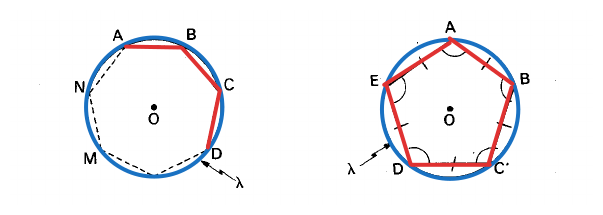
Let $A$, $B$, $C$, $D$, $\dots$, $M$ and $N$ be the $n$ division points of the circle $\lambda$. The polygon $ABCD\dots MN$ is inscribed in the circle.
In this way, the arcs are congruent:
$$\stackrel{\frown}{AB} \equiv \stackrel{\frown}{BC}\equiv \stackrel{\frown}{CD} \equiv \stackrel{\frown}{DE} \equiv \dots \equiv \stackrel{\frown}{MN} \equiv \stackrel{\frown}{NA}$$As a consequence:
$$\overline{AB} \equiv \overline{BC}\equiv \overline{CD} \equiv \overline{DE} \equiv \dots \equiv \overline{MN} \equiv \overline{NA}$$In fact, as in the same circle, congruent arcs are the same as congruent chords from previous posts.
Furthermore, the angles $\hat{A}$, $\hat{B}$, $\hat{C}$, $\hat{D}$, $\dots$, $\hat{M}$ and $\hat{N}$ are congruent, due to the fact that each of them is inscribed in $\lambda$. It is worth remembering that these angles have half the measure of $(n-2)$ of the congruent arcs into which the circle was divided.
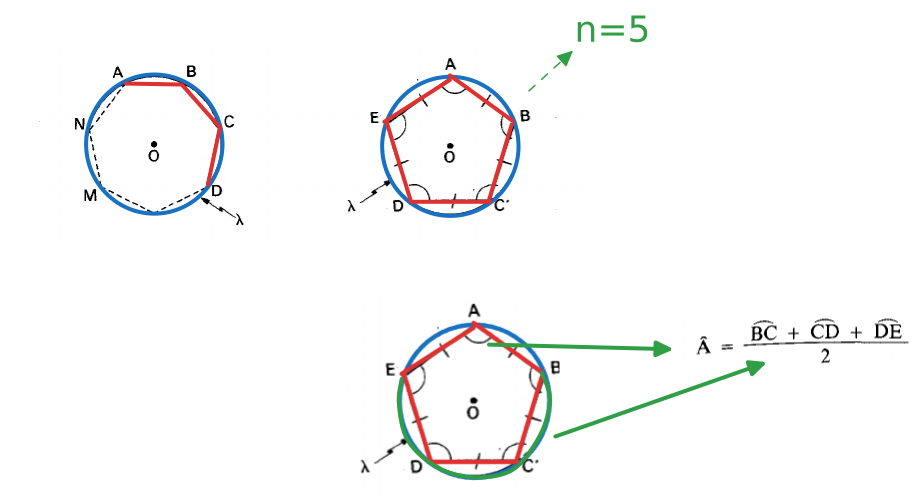
In the case of the pentagon, we have:
$$\hat{A} = \frac{\stackrel{\frown}{BC}+ \stackrel{\frown}{CD} + \stackrel{\frown}{DE}}{2}$$$$\hat{B} = \frac{\stackrel{\frown}{CD}+ \stackrel{\frown}{DE} + \stackrel{\frown}{EA}}{2}$$
$$\hat{C} = \frac{\stackrel{\frown}{DE}+ \stackrel{\frown}{EA} + \stackrel{\frown}{AB}}{2}$$
$$\hat{D} = \frac{\stackrel{\frown}{EA}+ \stackrel{\frown}{AB} + \stackrel{\frown}{BC}}{2}$$
$$\hat{E} = \frac{\stackrel{\frown}{AB}+ \stackrel{\frown}{BC} + \stackrel{\frown}{CD}}{2}$$
From the congruence of the sides of the polygons and the congruence of the angles of the polygons, we have that the polygon $ABCD\dots MN$ is regular with $n$ sides and inscribed in the circle $\lambda$.
Case 2:
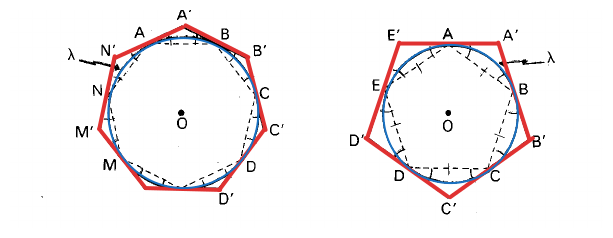
From the divisions of the points $A$, $B$, $C$, $D$, $\dots$, $M$ and $N$, we draw tangent lines to the circle $\lambda$ and obtain the polygon $A'$, $B'$, $C'$, $D'$, $\dots$, $M'$ and $N'$ of $n$ sides circumscribed by the circumference $\lambda$.
The triangles starting from the tangent lines to the circle are isosceles triangles.
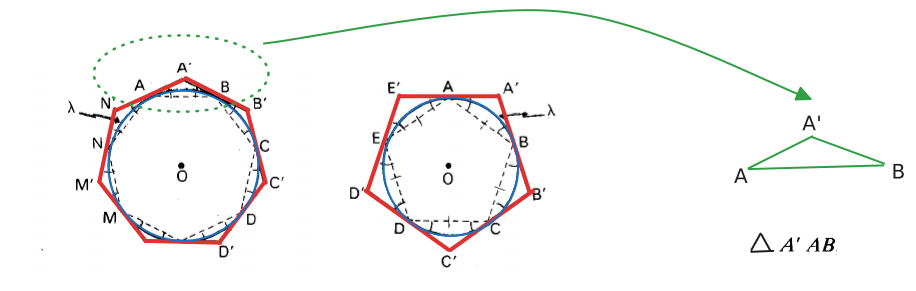
By congruence of triangles $ALA$ and given that the polygon $ABCD\dots MN$ is regular (part 1), and congruent sides of these triangles, we have that the angles are congruent and sides congruent, in symbols:
$$\hat{A'} \equiv \hat{B'}\equiv \hat{C'} \equiv \hat{D'} \equiv \dots \equiv \hat{M'} \equiv \hat{N'}$$e
$$\overline{A' B'} \equiv \overline{B' C'}\equiv \overline{C' D'} \equiv \overline{D' E'} \equiv \dots \equiv \overline{M' N'} \equiv \overline{N' A'}$$From these two results, we conclude that the polygon $ABCD\dots MN$ is regular with $n$ sides and inscribed in the circle $\lambda$.
$\blacksquare$
Inscribable regular polygon
Every regular polygon is inscribed in a circle
or
Given a regular polygon, there is a single circle that passes through its vertices.
Demo:
$\blacksquare$
Circumscribable regular polygon
Every regular polygon is circumscribable in a circle
or
Given a regular polygon, there is a single circle inscribed in the polygon.
Demo:
$\blacksquare$
Considerations
Mathematics is a universal language that allows us to understand the world around us, and the relationship between regular polygons and circles is a perfect example of how simple principles can lead to profound discoveries and vast applications. Whether you’re a student, a professional, or simply curious about geometry, there’s always something new and interesting to learn about this intriguing topic. Here a small contribution was made to “Circumference ratio in regular polygons, wait for the next posts.