
Euler's Eyes
2026-10-10
Descartes and the problem of cannons
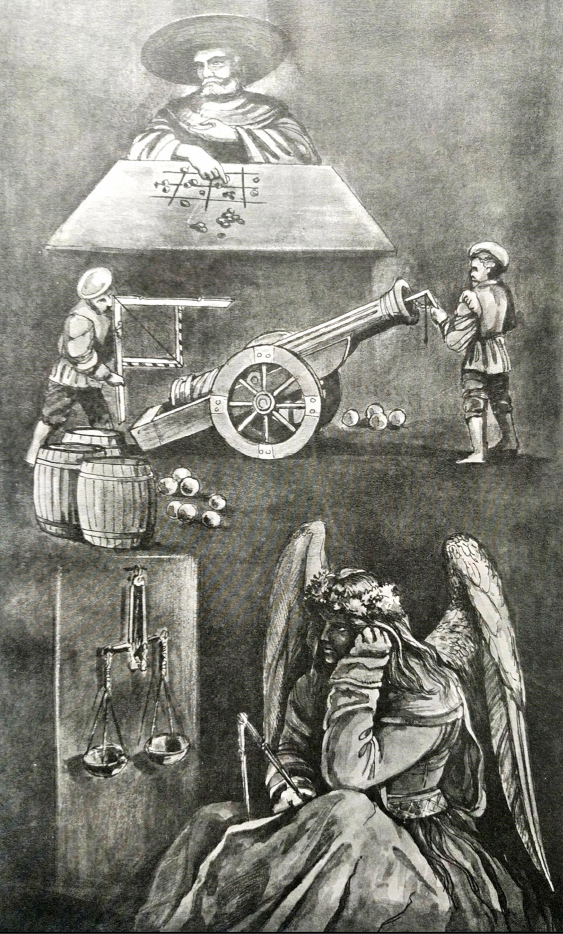
Descartes experienced war up close. In 1618 he served as a volunteer in the army of Maurice of Nassau and, according to his first biographer, Adrien Baillet, he was in 1628 at the siege of La Rochelle, led by Cardinal Richelieu. On the battlefields, a practical problem occupied the artillerymen: with what angle tilt the cannon to hit a target at a certain distance?
It is a relationship between two numbers: the distance to the target (what the gunner “hears”) and the angle of the gun. (what he “says”). Galileo showed in 1638 that, without air resistance, the bullet describes a parabola, and the range $R$ depends on the angle $\theta$ and the exit speed $v$:
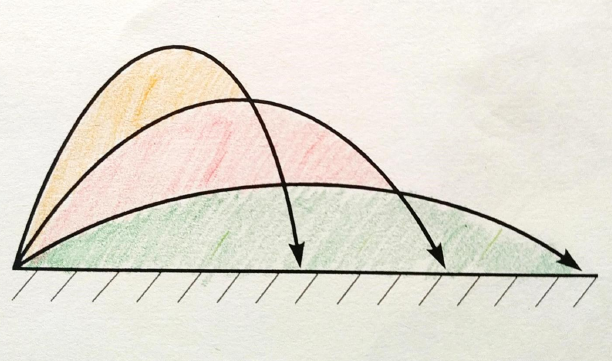
With a bullet leaving at 100 m/s:
| Angle | 15° | 30° | 45° | 60° | 75° |
|---|---|---|---|---|---|
| Range | 510 m | 884 m | 1020 m | 884 m | 510 m |
Notice two things. Range is a function of angle: each angle gives a unique range. But the the opposite way doesn’t work like that: to hit a target at 900 meters two angles are used, about 30,9° and 59,1°. In today’s language, the function is not injective.
All topics by René Descartes · ← A reading of the Cogito: listening and speaking · The word “function” →