
Euler's Eyes
2026-09-26
FUVEST 2026 – 1st phase: Mathematics solved
Source: FUVEST – test V1 and template of the General Knowledge Test (1st phase), applied in 23/11/2025. Files in FUVEST collection 2026.
The 1st phase of FUVEST 2026 had 90 multiple choice questions from all disciplines. This post brings mathematics questions. The numbering used here is that of Proof V1; in versions V2, V3 and V4 the same issues appear in another order (the official template includes the correspondence table).
Template
| Question | Subject | Template |
|---|---|---|
| 3 | Logical reasoning: election with tiebreaker | Canceled |
| 4 | Logarithms: Shannon entropy | A |
| 6 | Spatial geometry: regular pyramid | E |
| 7 | Trigonometry: double arc equation | D |
| 18 | Exponential function and logarithms | E |
| 30 | Spatial geometry: cylinder volume | B |
| 36 | Trigonometry in the right triangle | E |
| 37 | Analytical geometry: circle equation | A |
| 55 | Perfect numbers, primes and progressions | B |
| 74 | Function graph transformations | D |
Question 3: How many votes guarantee the election?
Question canceled by FUVEST. In the official answer sheet, question 3 from Test V1 appears with an asterisk (nullified). FUVEST did not disclose the reason for the cancellation.
Statement
In an election for a council composed of 5 members, there are 7 candidates registered and a total of 35 voters. The 5 candidates with the most votes are elected, the tiebreaker being age, that is, if there is only one place for two candidates who tied in number of votes, the oldest candidate is elected and the younger, no. Aleph, who is the youngest among all the candidates, is analyzing how many votes he needs to guarantee his election.
Knowing that each voter has the right to vote for only one candidate and that, Generally, in these elections, one or two of the voters do not show up to vote, it can be stated:
- A) If one or two voters do not show up, Aleph will be elected if he has at least 5 votes.
- B) Aleph will not be elected with 5 votes, even if one or two voters do not show up.
- C) If two voters do not appear, Aleph will need to receive 5 votes to be elected. But, if just one voter does not show up, 5 votes do not guarantee their election.
- D) In the event that two voters do not show up, Aleph needs one of those elected to have received 6 or more votes so that he can be elected with just 4 votes.
- E) In the event that only one of the voters does not appear, Aleph needs two of those elected to have received 6 or more votes so that he can be elected with just 4 votes.
Comment
As the question was annulled, there is no official alternative. Even so, it is worth exercise to understand the central idea, assuming that each voter present votes for any candidate.
1. When is Aleph left out? Aleph loses all tiebreakers (it’s the most new). So, with $v$ votes, he is left out exactly when 5 of the others 6 candidateshave $v$ votes or more.
2. How many votes guarantee the place? If $T$ is the total number of votes, for 5 rivals have at least $v$ votes each $5v + v \le T$, that is, $6v \le T$. With one or two voters absent, $T = 34$ or $T = 33$:
- with $v = 5$: $6 \cdot 5 = 30 \le 33$, then it is possible that 5 rivals have 5 votes or more, and 5 votes do not guarantee the election;
- with $v = 6$: $6 \cdot 6 = 36 > 34$, then 6 votes guarantee the election.
In other words, 5 votes are sometimes enough and sometimes not; 6 votes are always enough.
FUVEST did not inform which part of the statement or alternatives led to the cancellation, so we don’t venture a reason.
Question 4: Shannon entropy with logarithms
Statement
The concept of entropy permeates several areas of knowledge and was introduced in Information Theory by Claude Shannon, who developed a way to calculate the entropy $E$ of a system, namely
$$E = -\sum_i P_i(x)\log_2 P_i(x)$$where $P_i(x)$ is the probability of the i-th result for the variable $x$.
For example, consider a sequence with two colored letters A, the first blue and the second red (AA). If these two letters were placed in a ballot box, the probability of withdrawing without Note, the blue letter, as in the original sequence, is $\frac{1}{2}$. Return to letter to the ballot box and draw again. The probability of coming out red is again $\frac{1}{2}$, and in this case we have:
$$E = -\sum_i P_i(x)\log_2 P_i(x) = -\left(\frac{1}{2}\log_2\frac{1}{2} + \frac{1}{2}\log_2\frac{1}{2}\right) = 1$$For a sequence with 4 letters A, the first two blue and the last two red (AAAA), By placing them in an urn and drawing one, the probability of coming up blue is $\frac{1}{2}$. The letter is returned and drawn again. The probability of second letter drawn is blue, as in the original sequence, it is again $\frac{1}{2}$. Proceeding in this way for the two red letters, we have:
$$E = -\sum_i P_i(x)\log_2 P_i(x) = -\left(\frac{1}{2}\log_2\frac{1}{2} + \frac{1}{2}\log_2\frac{1}{2} + \frac{1}{2}\log_2\frac{1}{2} + \frac{1}{2}\log_2\frac{1}{2}\right) = 2$$Based on this information, what is the value of entropy $E$, in the case of a sequence with 4 letters A, the first 3 being blue and the last red (AAAA)?
- A) $5 - \frac{9}{4}\log_2 3$
- B) $\frac{1}{2} - \frac{5}{2}\log_2 3$
- C) $\frac{3}{2}$
- D) $\frac{9}{4}\log_2 3$
- E) $3$
Resolution
In the examples, the sum has one term for each letter in the sequence, and each term uses the probability to draw the color of that letter.
1. Odds. On the ballot box there are 3 blue letters and 1 red:
$$P(\text{azul}) = \frac{3}{4}, \qquad P(\text{vermelha}) = \frac{1}{4}$$2. Assembling the sum. There are three terms with $\frac{3}{4}$ (the three blue ones) and one term with $\frac{1}{4}$ (in red):
$$E = -\left(3 \cdot \frac{3}{4}\log_2\frac{3}{4} + \frac{1}{4}\log_2\frac{1}{4}\right)$$3. Simplifying logarithms. By the quotient property,
$$\log_2\frac{3}{4} = \log_2 3 - \log_2 4 = \log_2 3 - 2, \qquad \log_2\frac{1}{4} = -2$$4. Calculating.
$$E = -\left(\frac{9}{4}(\log_2 3 - 2) + \frac{1}{4}\cdot(-2)\right) = -\frac{9}{4}\log_2 3 + \frac{9}{2} + \frac{1}{2} = 5 - \frac{9}{4}\log_2 3$$Checking numerically: $5 - \frac{9}{4}\cdot 1{,}585 \approx 1{,}43$, a value between 0 and 2, which makes sense (the sequence is “less mixed” than the two blue and two red, which has entropy 2).
Answer: alternative A ($5 - \frac{9}{4}\log_2 3$).
Beware of the catch: alternative D ($\frac{9}{4}\log_2 3 \approx 3{,}57$) appears when you forget the minus sign and the term $-2$ of $\log_2\frac{3}{4}$. Note that it gives an entropy greater than 2, which does not sense here.
To review, see Properties of Logarithms.
Question 6: Pyramid trail and ramp
Statement
For a field activity aimed at valuing historical and cultural, geography teachers took their students to a geographic monuments. They visited a replica of a regular base pyramid square with apex at 18 meters high in relation to the center of the base. The faces of the pyramid face north, south, east and west. To access the apex of the pyramid, the students needed to walk along a pedestrian trail and climb the ramp located on the north face. The trail comprises the west, south, east and half of the north side of the square. This ramp is located exactly at the middle of the face, that is, it is the apothem of the pyramid.
Knowing that the volume of the pyramid is 864 m³, approximately how many meters did the students have to go through to get to the top of the pyramid?
- A) 36
- B) 41
- C) 48
- D) 54
- E) 61
Resolution
1. Side of the base. The volume of the pyramid is one-third the area of the base times the height. With a square base of side $\ell$ and height 18 m:
$$864 = \frac{1}{3}\cdot \ell^2 \cdot 18 = 6\ell^2 \quad\Rightarrow\quad \ell^2 = 144 \quad\Rightarrow\quad \ell = 12 \text{ m}$$2. Trail length. Three full sides (west, south and east) plus half on the north side:
$$3 \cdot 12 + 6 = 42 \text{ m}$$3. Length of the ramp (apothem of the pyramid). The apothem $g$ connects the vertex to the midpoint on one side of the base. It is the hypotenuse of the right triangle formed by the height (18 m) and by the distance from the center of the base to the middle of the side ($\frac{\ell}{2} = 6$ m):
$$g^2 = 18^2 + 6^2 = 324 + 36 = 360 \quad\Rightarrow\quad g = \sqrt{360} \approx 18{,}97 \text{ m}$$4. Total.
$$42 + 18{,}97 \approx 60{,}97 \approx 61 \text{ m}$$Answer: alternative E (61).
For review, see Pythagorean Theorem.
Question 7: Where did the student go wrong in the trigonometric equation?
Statement
Consider the trigonometric equation
$$\operatorname{sen}\frac{\pi}{2} + \operatorname{sen} x = \operatorname{sen}(2x) - \cos\pi$$to $x \in \mathbb{R}, \quad 0 \le x < 2\pi$.
A student solved this equation as follows:
The resolution presented by the student is wrong, as he
- A) considered that $\cos\pi$ is worth 1.
- B) did not consider the infinite turns in the trigonometric cycle for the answer.
- C) considered that $\operatorname{sen}\frac{\pi}{2}$ is worth 1.
- D) did not correctly use the sine of the sum of two arcs.
- E) presented two answers and not just one.
Resolution
Let’s check it line by line.
1. Second line. $\operatorname{sen}\frac{\pi}{2} = 1$ and $\cos\pi = -1$, then $-\cos\pi = +1$. The line $1 + \operatorname{sen} x = \operatorname{sen}(2x) + 1$ is right (this already rules out A and C).
2. Third line. Canceling the 1 on both sides: $\operatorname{sen} x = \operatorname{sen}(2x)$. You’re also right.
3. Fourth line: here is the error. The student changed $\operatorname{sen}(2x)$ by $2\operatorname{sen} x$, but the sine does not “pass the 2 out.” As $2x = x + x$, the sum sine formula gives
$$\operatorname{sen}(2x) = \operatorname{sen}(x + x) = \operatorname{sen} x\cos x + \cos x\operatorname{sen} x = 2\operatorname{sen} x\cos x$$4. The correct resolution.
$$\operatorname{sen} x = 2\operatorname{sen} x\cos x \quad\Rightarrow\quad \operatorname{sen} x \cdot (2\cos x - 1) = 0$$Then $\operatorname{sen} x = 0$ (gives $x = 0$ or $x = \pi$) or $\cos x = \frac{1}{2}$ (gives $x = \frac{\pi}{3}$ or $x = \frac{5\pi}{3}$). O student lost the last two solutions.
The other alternatives are also useless: the statement restricts $0 \le x < 2\pi$, then it was not necessary to consider “infinite turns” (B), and the equation actually has more than one solution (E).
Answer: alternative D (did not correctly use the sine of the sum of two arcs).
Question 18: When does the application exceed 300 thousand users?
Statement
A technology startup is developing a new app and sees that the number of users is growing, by thousands, after $t$ weeks of launch, according to the function:
$$M(t) = 200 \times (1{,}1)^t$$With this, the startup team wants to know: what is the period, in weeks, in which the number of users exceeds 300 thousand?
- A) Between 0 and 1 week.
- B) Between 1 and 3 weeks.
- C) Between 2 and 4 weeks.
- D) Between 3 and 4 weeks.
- E) Between 4 and 6 weeks.
Note and adopt: $\log 3 \cong 0{,}4771$; $\log 5 \cong 0{,}6990$ and $\log 11 \cong 1{,}0414$
Resolution
1. Setting up the inequality. $M(t)$ is in thousands, so 300 thousand corresponds to $M(t) = 300$:
$$200 \cdot (1{,}1)^t > 300 \quad\Rightarrow\quad (1{,}1)^t > 1{,}5$$2. Applying logarithm (base 10, on both sides; as the log is increasing, the meaning of inequality remains):
$$t \cdot \log 1{,}1 > \log 1{,}5 \quad\Rightarrow\quad t > \frac{\log 1{,}5}{\log 1{,}1}$$3. Calculating the logarithms with the given values.
- $\log 1{,}1 = \log\frac{11}{10} = \log 11 - 1 = 0{,}0414$
- $\log 2 = \log\frac{10}{5} = 1 - \log 5 = 0{,}3010$
- $\log 1{,}5 = \log\frac{3}{2} = \log 3 - \log 2 = 0{,}4771 - 0{,}3010 = 0{,}1761$
4. Result.
$$t > \frac{0{,}1761}{0{,}0414} \approx 4{,}25$$The number of users passes 300 thousand after about 4,25 weeks, i.e. between 4 and 6 weeks.
Answer: alternative E (between 4 and 6 weeks).
To review, see Properties of Logarithms.
Question 30: Shortest height of the aluminum can
Statement
Brazil is the world leader in aluminum recycling, reaching numbers close to 99% of cans recycled in the year 2021. These cans, already used for soft drinks, beers, energy drinks, now they are also starting to bring mineral water inside.
Consider that a company wants to fill 350 mL of water in an aluminum can cylindrical shape and that, for practical reasons such as material handling and cost, the diameter of the base of this can must be between 5 cm and 8 cm.
Approximately, in centimeters, what is the smallest possible height of the can?
- A) 5
- B) 7
- C) 13
- D) 18
- E) 28
Resolution
1. Cylinder volume. As $1 \text{ mL} = 1 \text{ cm}^3$, the can must have volume $350 \text{ cm}^3$:
$$V = \pi r^2 h = 350 \quad\Rightarrow\quad h = \frac{350}{\pi r^2}$$2. When is the height minimum? For a fixed volume, the greater the radius, smaller the height. Then we use the largest diameter allowed, 8 cm, that is, $r = 4$ cm.
3. Calculating.
$$h = \frac{350}{\pi \cdot 16} \approx \frac{350}{50{,}27} \approx 6{,}96 \text{ cm} \approx 7 \text{ cm}$$Answer: alternative B (7 cm).
Be careful with the catch: alternative D (18 cm) comes out when using the smallest diameter, 5 cm ($h = \frac{350}{\pi \cdot 2{,}5^2} \approx 17{,}8$). This is the largest possible height, not the smallest.
To review, see Circle Area.
Question 36: Difference in altitude with the Total Station
Statement
To calculate the difference in altitude (height) between two points A and B, located on the ground, a technician used a Total Station (ET), equipment used to measure the difference between levels of different points. He positioned the equipment, which is 1,6 m high, at a point M, equidistant horizontally from the points A and B, 40 m from each one, where the reading prisms (sights) are located, as shown in the following figure:
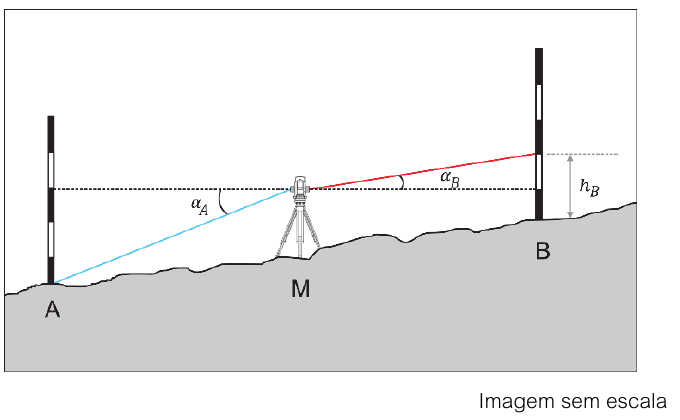
Assuming that the downward inclination angle, $\alpha_A$, is 7° and the angle upward slope, $\alpha_B$, is 5° and that the reading on the prism, $h_B$, at point B was 3,60 m, determine the difference in altitude (height), in meters, between points A and B.
- A) 1,60
- B) 2,80
- C) 3,16
- D) 3,96
- E) 4,80
Note and adopt: $\tan(5°) \cong 0{,}087$ and $\tan(7°) \cong 0{,}122$
Resolution
We take as a reference the horizontal line that passes through the device (the line dotted line in the figure). So the height of 1,6 m of the device doesn’t even count: it it just says where that line is.
1. Point A. The sight descends 7° to the foot of the sight, at point A, at 40 m in horizontal. In the right triangle formed:
$$\text{desnível até A} = 40 \cdot \tan 7° \approx 40 \cdot 0{,}122 = 4{,}88 \text{ m}$$Therefore, point A is 4,88 m below the horizontal line.
2. Point B. The sight rises 5° and reaches B’s sights at a point that is
$$40 \cdot \tan 5° \approx 40 \cdot 0{,}087 = 3{,}48 \text{ m}$$above the horizontal line. This same point is $h_B = 3{,}60$ m above the ground at B. Then the ground at B is $3{,}60 - 3{,}48 = 0{,}12$ m below the line horizontal.
3. Altitude difference.
$$4{,}88 - 0{,}12 = 4{,}76 \text{ m}$$With the approximate values from “Note and adopt” we obtain 4,76 m; using tangents with more decimal places ($\tan 7° \approx 0{,}1228$ and $\tan 5° \approx 0{,}0875$) we get about 4,81 m. In any case, the closest alternative is 4,80 m. Point B is the highest.
Answer: alternative E (4,80 m).
Be careful with the catch: alternative C (3,16) is $4{,}76 - 1{,}6$: leave discount the height of the device, which should not be included in the bill, because both targets start from the same point.
To review, see Right Triangles.
Question 37: Circumference tangent to the square (analytical geometry)
Statement
Engineers were mapping land for construction of a project with four cylindrical-shaped buildings distributed around a square with the square format. To construct the buildings, engineers demarcated the vertices of the square at points $A = (0,0)$, $B = (8,0)$, C and D, in a system of Cartesian coordinates where each unit corresponds to one meter.
Knowing that the edge of the circular section of each building touches each side of the square at its midpoint, what should be the equation for the circumference of the building which has a distance of 10 m from its center to the center of the square and which passes by the tangency point $P$, as shown in the figure?
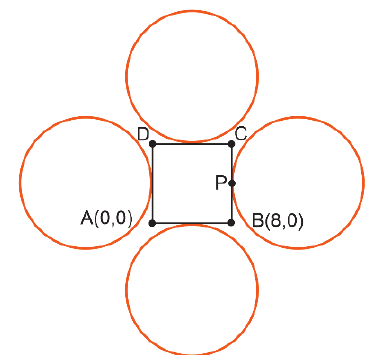
Image not to scale
- A) $(x - 14)^2 + (y - 4)^2 = 36$
- B) $(x - 18)^2 + (y - 4)^2 = 100$
- C) $(x - 8)^2 + (y - 24)^2 = 36$
- D) $x^2 + y^2 = 36$
- E) $(x - 4)^2 + (y - 24)^2 = 100$
Resolution
1. The square. With $A = (0,0)$ and $B = (8,0)$, the side measures 8, so $C = (8,8)$ and $D = (0,8)$. The center of the square is $O = (4,4)$.
2. The point of tangency. $P$ is the midpoint of $\overline{BC}$:
$$P = \left(\frac{8+8}{2}, \frac{0+8}{2}\right) = (8, 4)$$3. The center of the building. The circle touches the $BC$ (vertical) side in $P$, then the ray that arrives at $P$ is perpendicular to $BC$, that is, horizontal. O center is on the line $y = 4$, to the right of $P$. As it is 10 m from $O = (4,4)$:
$$\text{centro} = (4 + 10, 4) = (14, 4)$$4. The radius. Is the distance from the center to $P$: $r = 14 - 8 = 6$.
5. Equation.
$$(x - 14)^2 + (y - 4)^2 = 6^2 = 36$$Answer: alternative A ($(x - 14)^2 + (y - 4)^2 = 36$).
Beware of the gotcha: alternative B uses 10 as radius. But 10 m is the distance from the center of the building to the center of the square; the radius is just the part that goes from $P$ to the center of the building, $10 - 4 = 6$.
To review, see Cartesian Plane.
Question 55: Perfect numbers and Mersenne primes
Statement
There are curious numbers in mathematics. Perfect numbers are some of them. One number $n$ (to $n \in \mathbb{N}^*$) is perfect if and only if it is equal to the sum of its positive divisors (excluding itself). Relating perfect numbers and prime numbers, Euclid wrote a proposition in his famous book “Elements”: if $2^n - 1$ is a prime number, then $2^{n-1}(2^n - 1)$ is a perfect number.
Considering the above, it is correct to say:
- A) With the exception of $n = 1$, the 5 first terms of the sequence $(a_n) = (2^n - 1)$ are prime numbers.
- B) The terms of the geometric progression, whose first term is the first perfect number and whose ratio is 3, are even.
- C) The numbers 28 and 31 are perfect numbers.
- D) In Euclid’s proposition, for $n = 4$, we obtain that $2^n - 1$ is not prime, but that $2^{n-1}(2^n - 1)$ is perfect.
- E) The sequence formed by the difference of consecutive terms of $(a_n) = (2^n - 1)$ is an arithmetic progression of ratio 2.
Resolution
Let’s analyze each alternative.
A) False. The first 5 terms are $2^1 - 1 = 1$, $3$, $7$, $15$ and $31$. Even leaving aside the term of $n = 1$, the term $2^4 - 1 = 15 = 3 \cdot 5$ is not cousin.
B) True. The first perfect number is 6, because $1 + 2 + 3 = 6$. The PG of first term 6 and ratio 3 is
$$6, 18, 54, 162, \dots \qquad a_k = 6 \cdot 3^{k-1} = 2 \cdot 3^k$$Every term has the factor 2, so they are all even.
C) False. 28 is perfect ($1 + 2 + 4 + 7 + 14 = 28$), but 31 is prime: its only own divisor is 1, and $1 \neq 31$.
D) False. For $n = 4$: $2^4 - 1 = 15$ is not prime (that part is right), but $2^3 \cdot 15 = 120$ not is perfect: the sum of the divisors of 120, without it itself, is $360 - 120 = 240 \neq 120$.
E) False. The differences are $a_{n+1} - a_n = 2^{n+1} - 2^n = 2^n$, that is, $2, 4, 8, 16, \dots$: a geometric progression of ratio 2, not arithmetic.
Answer: alternative B.
Be careful with the catch: alternative D is misleading because the proposition of Euclid is the “if… then…” type. When $2^n - 1$ is not prime, it does not guarantee nothing, and in the case $n = 4$ the number 120 is in fact not perfect.
To review, see Prime numbers.
Question 74: Translations, reflections and dilations of graphs
Statement
Look at the following image:
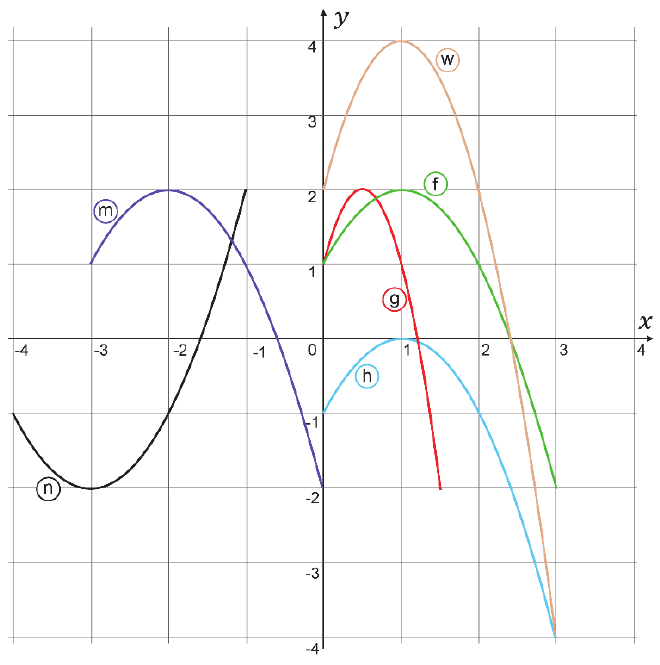
Based on the graphs of the functions presented in the image, it is correct to state that:
- A) $w(x) = 2h(x)$ e $n(x) = -f(x - 4)$
- B) $h(x) = f(x) - 2$ e $m(x) = f(x - 3)$
- C) $w(x) = 2f(x)$ e $g(x) = f(x/2)$
- D) $n(x) = -m(x + 1)$ e $g(x) = f(2x)$
- E) $m(x) = f(x + 3)$ e $h(x) = f(x) + 2$
Resolution
1. The reference function $f$. According to the graph, $f$ is a parabola with a vertex at $(1, 2)$ that passes through $(0, 1)$ and ends in $(3, -2)$. This gives
$$f(x) = 2 - (x - 1)^2, \quad 0 \le x \le 3$$(check: $f(0) = 2 - 1 = 1$ and $f(3) = 2 - 4 = -2$).
2. Reading the other curves.
- $h$ (light blue): same shape as $f$, with vertex at $(1, 0)$: it is $f$ descending 2 units, $h(x) = f(x) - 2$.
- $w$ (light orange): vertex in $(1, 4)$, $w(0) = 2$ and $w(3) = -4$, double each value of $f$: $w(x) = 2f(x)$.
- $g$ (red): vertex at $\left(\frac{1}{2}, 2\right)$, starts at $(0,1)$ and ends at $(1{,}5\text{; }-2)$: $f$ is “compressed” by half horizontally, $g(x) = f(2x)$.
- $m$ (purple): vertex in $(-2, 2)$, from $x = -3$ to $x = 0$: is $f$ shifted 3 units to the left, $m(x) = f(x + 3)$.
- $n$ (black): vertex in $(-3, -2)$, with the concavity upwards, from $x = -4$ to $x = -1$.
3. Testing alternative D. With $m(x) = 2 - (x + 2)^2$:
$$-m(x + 1) = -\left[2 - (x + 3)^2\right] = (x + 3)^2 - 2$$This parabola has a vertex in $(-3, -2)$ and is worth $-1$ in $x = -4$ and $2$ in $x = -1$, exactly like $n$. And we have already seen that $g(x) = f(2x)$. The two equalities of D are true.
4. Why others fail.
- A: $w = 2f$, not $2h$ (twice of $h$ would have vertex at $(1, 0)$).
- B: $h = f - 2$ is right, but $f(x - 3)$ shifts to the right; $m$ is on the left.
- C: $w = 2f$ is right, but $f(x/2)$ widens the graph; $g$ is narrower.
- E: $m = f(x + 3)$ is right, but $f + 2$ moves up the graph; $h$ is 2 units below.
Answer: alternative D.
Be careful with the catch: alternatives B, C and E have certain equality and another wrong. The classic signal changes: $f(x + 3)$ goes left and $f(2x)$ compresses the graph horizontally.
To review, see Function Concept.