We can only see a short distance ahead, but we can see plenty there that needs to be done.
— Alan Turing, “Computing Machinery and Intelligence” (1950)
Alan Turing (1912–1954) invented the computer before there was a computer. In 1936, to answer a question in logic, he imagined a paper machine that reads and writes symbols on a tape, and showed that it can carry out any calculation a human being can carry out by following rules. In the same paper he proved that there are questions no such machine can answer.
During the Second World War, at Bletchley Park, he helped break the Enigma, the cipher machine of the German navy. After the war he designed one of the first electronic computers, asked whether machines can think and explained, with equations, how a shapeless embryo acquires stripes and spots. He died at 41, two years after being convicted for being homosexual.
In this trail we tell Turing’s life and redo, with the calculations in full view, eight of his ideas.
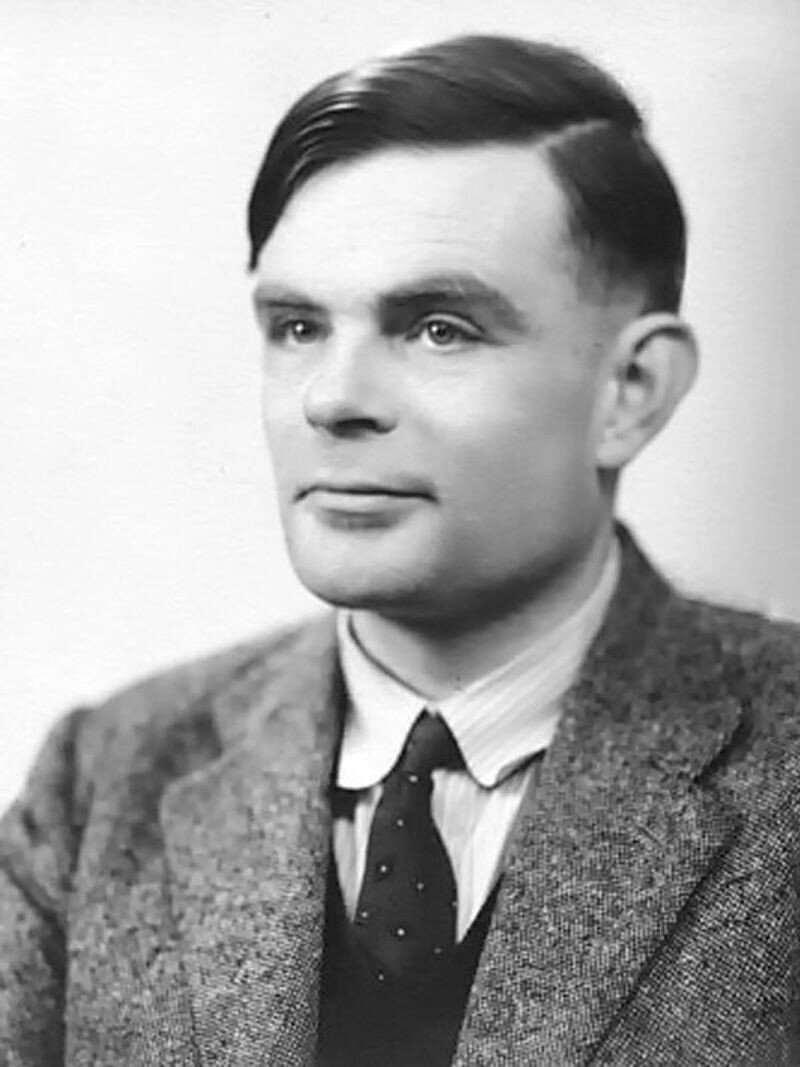
Who he was
Alan Mathison Turing
- Nascimento
- 23 June 1912, London
- Morte
- 7 June 1954, Wilmslow, England
- Origem
- United Kingdom
- Áreas
- Logic, computing, cryptanalysis, probability and mathematical biology
Reading guide
Biography
Discovery and proof
- The Turing machine: calculating with pencil, tape and rules
- The halting problem: the question no machine can answer
- Computable numbers: almost every number is impossible to calculate
- The universal machine: the program is data too
- The Enigma: 159 quintillion keys and one flaw
- Banburismus: weighing evidence in decibans
- The imitation game: can a machine think?
- Morphogenesis: the leopard’s spots in equations