
Euler's Eyes
2026-10-13
When place is the algorithm: multiplication and the rule of three
In the previous text we saw that the position of signs is part of a formula’s meaning: brackets, exponents and fraction bars show how the pieces fit together. There are whole procedures in which this idea is taken to the extreme: the place where each number is written is the algorithm itself. Whoever knows where to put the numbers already knows how to do the sum. The old texts on this site gathered three examples, from three different periods.
The Egyptians: multiplying by doubling
More than three and a half thousand years ago, Egyptian scribes multiplied without times tables. They used two columns: on the left, the powers of $2$, starting at $1$; on the right, one of the factors, doubled each time. To compute $21\times37$:
| doubles of 1 | doubles of 37 | |
|---|---|---|
| ✓ | $1$ | $37$ |
| $2$ | $74$ | |
| ✓ | $4$ | $148$ |
| $8$ | $296$ | |
| ✓ | $16$ | $592$ |
In the left-hand column you tick the rows that add up to $21$: $16+4+1=21$. In the right-hand one you add only the ticked rows: $592+148+37=777$. Done: $21\times37=777$.
It looks like magic, and the site’s old texts asked: “is this mysticism?”. It is not. The ticks in the left-hand column write $21$ in base 2:
$$21=1\cdot2^4+0\cdot2^3+1\cdot2^2+0\cdot2^1+1\cdot2^0=10101_2,$$and the calculation is just distributivity: $21\times37=(16+4+1)\times37$. The Egyptian scribes were doing binary arithmetic more than three thousand years before Leibniz wrote about it. Their table is a notation: the rows with ✓ and the rows without are the ones and the zeros.
Pacioli: multiplying in a window
In 1494 the Franciscan friar Luca Pacioli published in Venice the Summa de arithmetica, geometria, proportioni et proportionalità, an encyclopaedia of everything a merchant needed to know. Among the methods of multiplication he teaches one done in a grid cut by diagonals, and explains the name:
By gelosia we mean those lattices that are customarily put at the windows of houses where ladies live.
— Luca Pacioli, Summa de arithmetica (1494)
The gelosia was the wooden lattice that let one see the street without being seen. The layout of the sum resembled that grille:
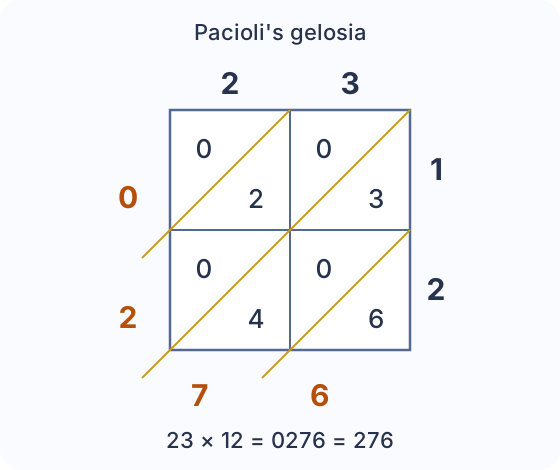
The digits of $23$ are written on top and those of $12$ on the right. Each cell receives the product of the two digits that cross it, with the tens above the diagonal and the ones below: $1\times2=02$, $1\times3=03$, $2\times2=04$, $2\times3=06$. Then you add along each diagonal strip, from bottom to top: $6$; $4+0+3=7$; $0+0+2=2$; $0$. The result is $0276$, that is, $23\times12=276$.
The secret is, once again, in the place. The diagonal strips of the gelosia are the decimal places: the first holds the ones, the second the tens, the third the hundreds. The grid does by itself what the school algorithm does with “carrying” and with shifting each line to the left. The site’s old texts showed the same sum in a table of places:
| Partial product | Hundreds | Tens | Ones |
|---|---|---|---|
| $20\times10$ | $2$ | $0$ | $0$ |
| $3\times10$ | $0$ | $3$ | $0$ |
| $20\times2$ | $0$ | $4$ | $0$ |
| $3\times2$ | $0$ | $0$ | $6$ |
| Total | $2$ | $7$ | $6$ |
The rule of three: the purchase in front, the question behind
The third example is the most famous. The rule of three was born in India, where Brahmagupta already described it in 628 under the name trairāśika, “the three quantities”, and reached Europe through Arabic books. It solves the commonest problem in trade: if so much costs so much, how much does so much cost? In arithmetic books from the fifteenth to the eighteenth century it had many names, which the old texts on this site gathered:
| Author | Year | Name |
|---|---|---|
| Treviso Arithmetic (anonymous) | 1478 | la regula de le tre cose, the rule of the three things |
| Johannes Widmann | 1489 | regula proportionum, the rule of proportions |
| Luca Pacioli | 1494 | regula trium, la regola ditta de 3 |
| Christoff Rudolff | 1525 | die Regel de Tri |
| Christopher Clavius | 1583 | regula mercatorum, the merchants’ rule |
| J. F. Lautenschlager | 1598 | gulden Regul, the golden rule |
| John Ward | 1771 | the golden rule |
“Golden rule” says a great deal: it was the most valuable rule a merchant’s apprentice could know. And it was taught as a recipe of positions. In his arithmetic book of 1598, Lautenschlager summed it up in rhyming verses to be learned by heart:
The purchase, the value and the question third: the value always stands in the middle, the purchase in front, the question behind. Multiply the number at the back by the one in the middle, divide the product by the one in front, and you will have the answer to your question.
— J. F. Lautenschlager, Arithmetic (1598), verses on the rule of three
In practice it went like this. “If $3$ ells of cloth cost $12$ florins, how much do $7$ ells cost?” The apprentice wrote, on one line:
$$\underbrace{3\ \text{ells}}_{\text{purchase}}\quad\underbrace{12\ \text{florins}}_{\text{value}}\quad\underbrace{7\ \text{ells}}_{\text{question}}$$and applied the recipe: $7\times12=84$, $84\div3=28$ florins. There was no need to understand proportions. It was enough to put each number in its place.
Today we write the same thing as an equality of ratios, with the unknown in plain sight:
$$\frac{3}{12}=\frac{7}{x}\quad\Longrightarrow\quad 3x=7\cdot12\quad\Longrightarrow\quad x=28.$$This way of writing began with William Oughtred, the man of the $\times$, who in 1631 already separated the two ratios of a proportion with the sign $::$, something like $3.12::7.x$. It replaces the recipe of positions with a relation. The difference shows up when the problem changes.
Where the recipe of positions fails
“Four bricklayers build a wall in $6$ days. In how many days will $3$ bricklayers build the same wall?” By Lautenschlager’s recipe, the purchase is $4$, the value is $6$ and the question is $3$: $3\times6\div4=4.5$ days. Fewer bricklayers finishing sooner? The recipe does not know what the numbers mean; it only knows where they are.
The problem involves inversely proportional quantities: with fewer people the work takes longer. What stays constant is the product “bricklayers times days”: $4\times6=3\times x$, so $x=8$ days. The old books had a second recipe, the “inverse rule of three”, with another order of positions, and the pupil had to guess which to use. Brazilian schools solve the same dilemma with another notation: two columns and two arrows, pointing the same way when the quantities grow together and opposite ways when one grows and the other shrinks. The arrow is a sign that carries exactly the information missing from Lautenschlager’s line.
This is what this book calls the difference between sterile and active notation. The recipe of positions works as long as the problem is always the same. Writing ratios, $\frac ab=\frac cx$, or the constant product, $a\cdot b=c\cdot x$, shows which relation is being assumed, and so keeps working when the problem changes.
Exercise: multiply like the Egyptians
Compute $13\times25$ by doubling. Left column: $1, 2, 4, 8$; right column: $25, 50, 100, 200$. Since $13=8+4+1$, add the rows for $8$, $4$ and $1$: $200+100+25=325$. In base $2$, $13=1101_2$: the ticks are the rows of the digits $1$.
Exercise: direct or inverse?
A car at $60$ km/h makes a journey in $5$ hours. How long does it take at $75$ km/h?
The recipe of positions would give $75\times5\div60=6.25$ hours, more time going faster, which is absurd. Speed and time are inversely proportional: what stays constant is the distance, $60\times5=300$ km. So $75\times t=300$ and $t=4$ hours. The right question is not “where do I put each number?” but “what stays constant?”.
Sources: Florian Cajori, A History of Mathematical Notations · Luca Pacioli, MacTutor · Frank J. Swetz, Capitalism and Arithmetic: The New Math of the 15th Century (1987).
Chapter index · ← The grammar of formulas: brackets, order and space · The equals sign is a balance, not an arrow →