
Euler's Eyes
2026-10-11
Primitive notions
Point, line and plane are the pieces with which all geometry is assembled — and, interestingly, they have no definition.
Who discovered
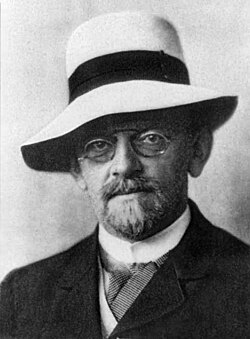
Nobody “discovered” the point or the straight line: they are ideas as old as the habit of measuring land and drawing plans. The first person who attempted to define them in writing was Euclid of Alexandria, around 300 BC, in the The Elements: “point is that which has no parts” and “line is length without width”. More than two thousand years later, in 1899, the German David Hilbert proposed the solution adopted today: leaving the point, line and plane undefined and describing only how they relate to each other.

The story
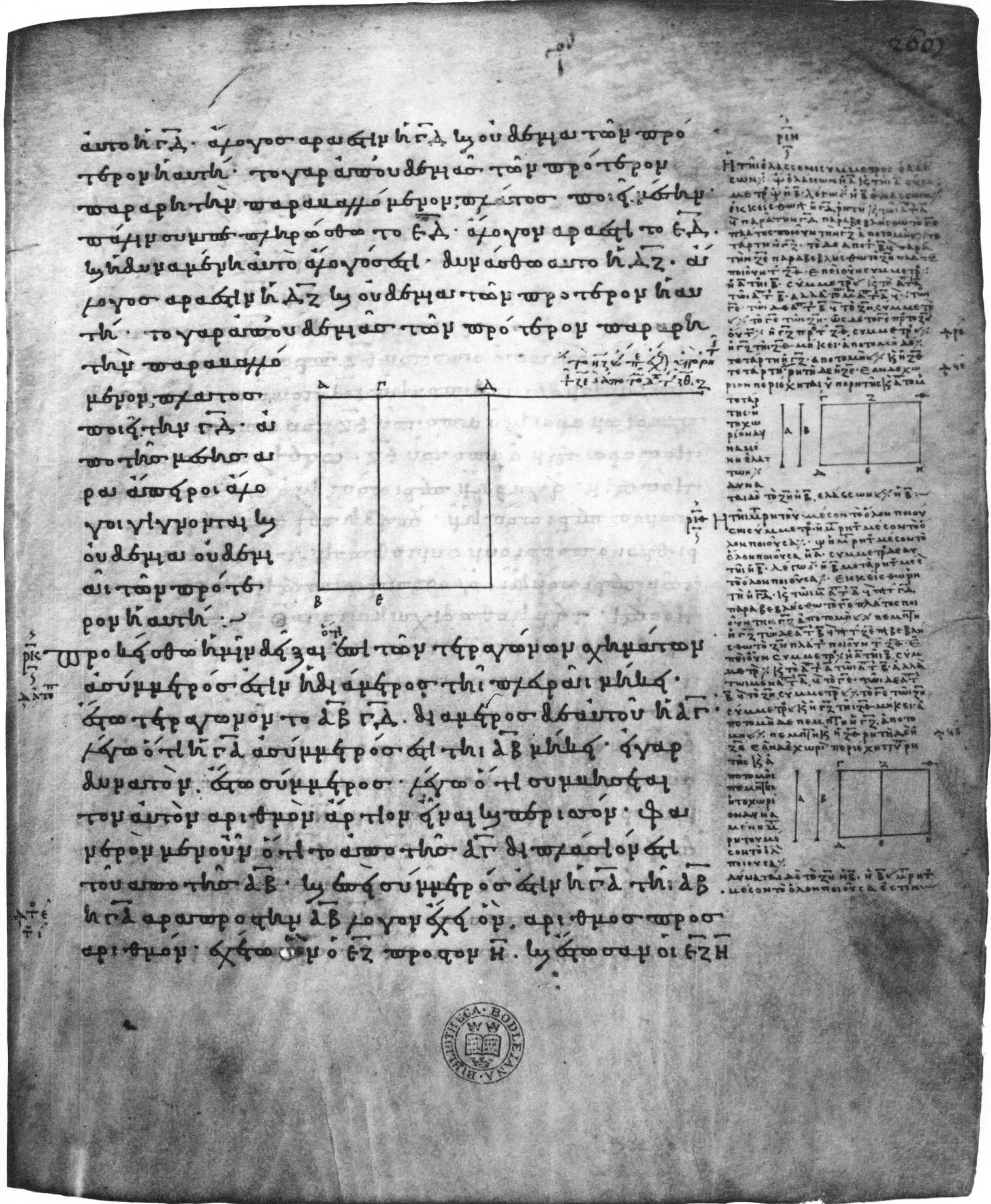
Euclid’s definitions seem clear, but they don’t help in a proof: saying that a point has “no parts” doesn’t tell you anything that can be used to prove a theorem. Every definition uses other words, which would also need to be defined, and the chain never ends. Somewhere you have to stop.
Hilbert stopped right at the beginning. In his book Fundamentals of Geometry, point, straight line and plane are primitive terms: what matters are the rules they obey, such as “a single straight line passes through two points”. It is said that he summarized the idea by saying that it would be possible to exchange “points, lines and planes” for “tables, chairs and beer mugs” — as long as the rules continued to apply, the theorems would remain true.
In everyday life
- Maps and GPS. The pin that marks your address in an app is a dot: it indicates a position, not a size.
- Laser level. The red line that the bricklayer projects on the wall represents a straight line; is the reference for aligning tiles and shelves.
- Table top and floor. Flat surfaces are models of a plane; When a piece of furniture “wobbles”, it is because the floor does not behave like a plane.
- Digital screens. An image is made of pixels, small dots of color organized in rows and columns.
Sources: Euclid (MacTutor) · Hilbert (MacTutor) · Elements, definition I.1.
Theory and constructions
Geometric notions (concepts, terms, entities) are established through definitions. The primitive notions, however, are adopted without definition.
DefiniçãoPrimitive notions
We will adopt without defining the notions of point, straight and plane.
We have intuitive knowledge of these entities, which comes from experience and observation: the mark of a pencil tip suggests a point, a tightly stretched thread suggests a straight line and the top of a table suggests a plane.
Point, line and plane notation
| entity | Letter notation | Examples |
|---|---|---|
| Point | Latin letters capital letters | $A, B, C, \ldots$ |
| Straight | Latin letters lower case | $a, b, c, \ldots$ |
| Flat | Greek letters lower case | $\alpha, \beta, \gamma, \ldots$ |
In graphical representation, the point is a small mark, the straight line is a line that we imagine extended indefinitely in both directions and the plane usually appears as a parallelogram — which is just a piece of it, as the plane is also unlimited.