
Euler's Eyes
2026-11-03
EJU 2021 (1st session) – Mathematics Course 1 solved
Source: JASSO – Mathematics paper in English, in Japanese and official answer key. Files on the page for the 1st session of 2021.
Course 1 is the basic mathematics paper of the EJU. Each letter $\boxed{\text{A}}$, $\boxed{\text{B}}$, … is a digit from 0 to 9 or the minus sign; a group such as $\boxed{\text{BC}}$ is a two-digit number. The statements below are summarized from the official English version.
Answer key
| Question | Topic | Answers |
|---|---|---|
| I Q1 | Two quadratic functions | A=6, BC=24, DE=33, F=2, G=8, H=2, I=1, JK=27 |
| I Q2 | Card game | LM=13, NO=19, PQR=427, STUV=1981, WX=31 |
| II Q1 | Comparing radicals | A=5, B=7, CD=21, E=6, F=6, G=3, H=1, IJKLM=42531 |
| II Q2 | Minimum with a parameter | N=3, O=8, P=3, Q=8, R=8, S=5, T=4, U=6, V=1, W=6, X=1, Y=8, Z=0 |
| III | Bases 5 and 9 | A=1, B=4, C=0, D=4, E=1, F=4, GH=25, I=5, JK=81, L=9, M=6, NO=20, P=4, Q=4, R=1, STU=121, VWXY=1321 |
| IV | Triangle with angles 45° and 75° | A=6, B=3, C=2, DE=75, F=1, G=3, H=1, I=3, J=1, KL=90, MN=75, O=2, P=3, Q=1, R=1, S=2, T=3 |
Question I
Q1: two quadratic functions
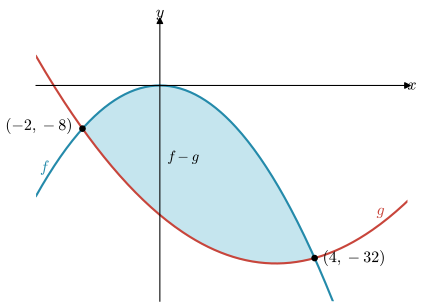
Statement. Consider the functions $f(x) = -2x^2$ and $g(x) = x^2 + ax + b$. The function $g$ satisfies: (i) $g$ is smallest at $x = 3$; (ii) $g(4) = f(4)$.
- From (i), $a = -\boxed{\text{A}}$. From (ii), $b = -\boxed{\text{BC}}$. The minimum value of $g$ is $-\boxed{\text{DE}}$.
- The value $x \ne 4$ with $f(x) = g(x)$ satisfies $x^2 - \boxed{\text{F}}\,x - \boxed{\text{G}} = 0$, that is, $x = -\boxed{\text{H}}$.
- On $-\boxed{\text{H}} \le x \le 4$, $f(x) - g(x)$ is largest at $x = \boxed{\text{I}}$, with maximum value $\boxed{\text{JK}}$.
Solution.
1. The vertex of $g$ is at $x = -\frac a2 = 3$, so $a = -6$. From $g(4) = 16 - 24 + b = f(4) = -32$ we get $b = -24$. Completing the square, $g(x) = (x - 3)^2 - 33$: the minimum is $-33$.
2. $-2x^2 = x^2 - 6x - 24$ gives $3x^2 - 6x - 24 = 0$, or $x^2 - 2x - 8 = 0$. The roots are $4$ and $-2$.
3. $f(x) - g(x) = -3x^2 + 6x + 24 = -3(x - 1)^2 + 27$. The vertex $x = 1$ is in $[-2, 4]$, so the maximum is $27$, at $x = 1$.
Answers: A=6, BC=24, DE=33, F=2, G=8, H=2, I=1, JK=27.
Q2: a card game
Statement. A and B each have a bag with three cards numbered 1, 2 and 3. Each draws a card from their own bag and they compare the numbers: if equal, it is a draw; otherwise, whoever drew the larger wins.
- In one game, the probability of a draw is $\dfrac{\boxed{\text{L}}}{\boxed{\text{M}}}$.
- Playing four times, returning the cards each time:
- the probability that A wins three or more times is $\dfrac{\boxed{\text{N}}}{\boxed{\text{O}}}$;
- that A wins once, loses once and draws twice is $\dfrac{\boxed{\text{P}}}{\boxed{\text{QR}}}$;
- that A and B win the same number of times is $\dfrac{\boxed{\text{ST}}}{\boxed{\text{UV}}}$; so that A wins more times than B is $\dfrac{\boxed{\text{WX}}}{\boxed{\text{UV}}}$.
Solution.
1. Of the $9$ equally likely pairs, $3$ are draws: $\frac13$. Of the remaining $6$, half are wins for A. So each game is a win, loss or draw for A with probability $\frac13$ each.
2. With four games, each sequence of results has probability $\frac{1}{81}$.
- (i) Three wins: $\binom43\cdot 2 = 8$ sequences (the remaining game is a loss or a draw); four wins: $1$. Total $\frac{9}{81} = \frac19$.
- (ii) One win, one loss and two draws: $\frac{4!}{1!\,1!\,2!} = 12$ sequences, $\frac{12}{81} = \frac{4}{27}$.
- (iii) Same number of wins: $(0, 0)$ with four draws, $1$ sequence; $(1, 1)$, $12$ sequences; $(2, 2)$, $\binom42 = 6$. Total $\frac{19}{81}$. By symmetry between A and B, the rest splits in half: $\frac12\left(1 - \frac{19}{81}\right) = \frac{31}{81}$.
Answers: LM=13, NO=19, PQR=427, STUV=1981, WX=31.
Question II
Q1: comparing radicals
Statement.
-
The positive integers $m$ and $n$ that simultaneously satisfy $\frac m3 < \sqrt3 < \frac n4$ and $\frac n3 < \sqrt6 < \frac m2$ are $m = \boxed{\text{A}}$ and $n = \boxed{\text{B}}$.
-
Using (1), compare the numbers
$$\text{①} \left(\sqrt{(-3)(-4)}\right)^3 \quad \text{②} 6\sqrt{(-2)^3(-3)} \quad \text{③} \sqrt{\{(-4)(-3)^2\}^2} \quad \text{④} (-1)^3\sqrt{\{(-2)^5\}^2} \quad \text{⑤} \left(\frac{5\sqrt3}{1 - \sqrt6}\right)^2.$$Rationalizing, $\text{⑤} = \boxed{\text{CD}} + \boxed{\text{E}}\sqrt{\boxed{\text{F}}}$. Of the five numbers, $\boxed{\text{G}}$ are greater than 35 and $\boxed{\text{H}}$ are negative. In increasing order: $\boxed{\text{I}} < \boxed{\text{J}} < \boxed{\text{K}} < \boxed{\text{L}} < \boxed{\text{M}}$.
Solution.
1. The inequalities say $2\sqrt6 < m < 3\sqrt3$ and $4\sqrt3 < n < 3\sqrt6$, that is, $4.89\ldots < m < 5.19\ldots$ and $6.92\ldots < n < 7.34\ldots$ So $m = 5$ and $n = 7$. We keep what this says: $\frac53 < \sqrt3 < \frac74$ and $\frac73 < \sqrt6 < \frac52$.
2. The five numbers.
- ① $\left(\sqrt{12}\right)^3 = 12\sqrt{12} = 24\sqrt3 > 24\cdot\frac53 = 40$.
- ② $6\sqrt{24} = 12\sqrt6$, between $12\cdot\frac73 = 28$ and $12\cdot\frac52 = 30$.
- ③ $\sqrt{(-36)^2} = 36$.
- ④ $-\sqrt{(-32)^2} = -32$.
- ⑤ $\frac{75}{(1 - \sqrt6)^2} = \frac{75}{7 - 2\sqrt6} = \frac{75(7 + 2\sqrt6)}{49 - 24} = 21 + 6\sqrt6$, between $21 + 14 = 35$ and $21 + 15 = 36$.
Greater than 35: ①, ③ and ⑤ (three). Negative: only ④. Order: ④ < ② < ⑤ < ③ < ①.
Answers: A=5, B=7, CD=21, E=6, F=6, G=3, H=1, I=4, J=2, K=5, L=3, M=1.
Q2: a minimum with a parameter
Statement. The function $f(x) = x^2 + ax + b$ satisfies (i) $f(3) = 1$ and (ii) $13 \le f(-1) \le 25$. We want to write the minimum $m$ of $f$ in terms of $a$ and find the largest and smallest values of $m$.
From (i), $\boxed{\text{N}}\,a + b + \boxed{\text{O}} = 0$, and $f(x) = x^2 + ax - \boxed{\text{P}}\,a - \boxed{\text{Q}}$. From (ii), $-\boxed{\text{R}} \le a \le -\boxed{\text{S}}$. Moreover, $m = -\frac{1}{\boxed{\text{T}}}\left(a + \boxed{\text{U}}\right)^2 + \boxed{\text{V}}$. So $m$ is largest at $a = -\boxed{\text{W}}$, with value $\boxed{\text{X}}$, and smallest at $a = -\boxed{\text{Y}}$, with value $\boxed{\text{Z}}$.
Solution.
1. $f(3) = 9 + 3a + b = 1$ gives $3a + b + 8 = 0$, or $b = -3a - 8$.
2. $f(-1) = 1 - a - 3a - 8 = -4a - 7$. So $13 \le -4a - 7 \le 25$, that is, $20 \le -4a \le 32$, or $-8 \le a \le -5$.
3. The minimum of $f$ is at the vertex $x = -\frac a2$:
$$m = -\frac{a^2}{4} - 3a - 8 = -\frac14(a^2 + 12a) - 8 = -\frac14(a + 6)^2 + 1.$$4. On $[-8, -5]$, $m$ is largest at the vertex $a = -6$ ($m = 1$) and smallest at the endpoint farther from the vertex, $a = -8$: $m = -\frac14\cdot4 + 1 = 0$.
Answers: N=3, O=8, P=3, Q=8, R=8, S=5, T=4, U=6, V=1, W=6, X=1, Y=8, Z=0.
Question III: a number whose digits reverse in bases 5 and 9
Statement. The positive integer $N$ has three digits both in base 5 and in base 9, but with the digits in reverse order. We want $N$ in base 10 and in base 4.
Let $N = abc$ in base 5 and $N = cba$ in base 9. Then
$$\boxed{\text{A}} \le a \le \boxed{\text{B}}, \quad \boxed{\text{C}} \le b \le \boxed{\text{D}}, \quad \boxed{\text{E}} \le c \le \boxed{\text{F}}. \qquad \text{①}$$Since $N = \boxed{\text{GH}}\,a + \boxed{\text{I}}\,b + c = \boxed{\text{JK}}\,c + \boxed{\text{L}}\,b + a$, we have $b = \boxed{\text{M}}\,a - \boxed{\text{NO}}\,c$ ②. The values satisfying ① and ② are $a = \boxed{\text{P}}$, $b = \boxed{\text{Q}}$, $c = \boxed{\text{R}}$. So $N$ in base 10 is $\boxed{\text{STU}}$ and in base 4 it is $\boxed{\text{VWXY}}$.
Solution.
1. The bounds. Base-5 digits run from 0 to 4. The leading digits cannot be zero: $a$ leads $abc$ and $c$ leads $cba$. So $1 \le a \le 4$, $0 \le b \le 4$ and $1 \le c \le 4$.
2. The equation. $N = 25a + 5b + c = 81c + 9b + a$. Simplifying, $24a - 4b - 80c = 0$, or $b = 6a - 20c$.
3. The digits. $0 \le 6a - 20c \le 4$. With $c = 1$: $20 \le 6a \le 24$, so $a = 4$ and $b = 4$. With $c \ge 2$: $6a \ge 40$, impossible with $a \le 4$.
4. The number. $N = 25\cdot4 + 5\cdot4 + 1 = 121$. (Check in base 9: $81 + 36 + 4 = 121$.) In base 4: $121 = 1\cdot64 + 3\cdot16 + 2\cdot4 + 1$, that is, $1321$.
Answers: A=1, B=4, C=0, D=4, E=1, F=4, GH=25, I=5, JK=81, L=9, M=6, NO=20, P=4, Q=4, R=1, STU=121, VWXY=1321.
Question IV: the triangle with angles 45° and 75°
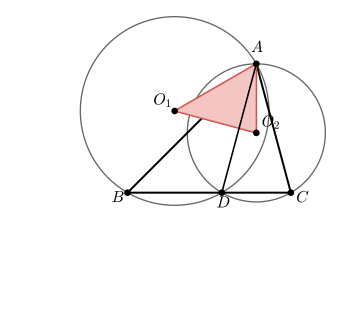
Statement. In triangle $ABC$, $\angle B = 45^\circ$ and $\angle C = 75^\circ$, and $D$ is the point where the bisector of $\angle A$ meets side $BC$.
- By the law of sines, $AC = \dfrac{\sqrt{\boxed{\text{A}}}}{\boxed{\text{B}}}\,BC$ and $AD = \sqrt{\boxed{\text{C}}}\,BD$. Since $\angle ADC = \boxed{\text{DE}}^\circ$, $BD : BC = \boxed{\text{F}} : \sqrt{\boxed{\text{G}}}$, and so $AB : AC = \boxed{\text{H}} : \left(\sqrt{\boxed{\text{I}}} - \boxed{\text{J}}\right)$.
- Let $O_1$ be the circumcenter of triangle $ABD$ and $O_2$ that of triangle $ADC$. We want the ratio of areas $\triangle ABC : \triangle AO_1O_2$. Since $\angle AO_1D = \boxed{\text{KL}}^\circ$ and $\angle AO_2O_1 = \boxed{\text{MN}}^\circ$, by the same reasoning as in (1), $AC = \sqrt{\boxed{\text{O}}}\,AO_1$ and $AO_2 = \left(\sqrt{\boxed{\text{P}}} - \boxed{\text{Q}}\right)AO_1$. So $\triangle ABC : \triangle AO_1O_2 = \boxed{\text{R}} : \left(\boxed{\text{S}} - \sqrt{\boxed{\text{T}}}\right)$.
Solution.
1. The angles. $\angle A = 180^\circ - 45^\circ - 75^\circ = 60^\circ$, and the bisector splits it into $\angle BAD = \angle DAC = 30^\circ$.
2. Law of sines. In triangle $ABC$: $AC = BC\cdot\frac{\sin45^\circ}{\sin60^\circ} = \frac{\sqrt2}{\sqrt3}BC = \frac{\sqrt6}{3}BC$. In triangle $ABD$: $AD = BD\cdot\frac{\sin45^\circ}{\sin30^\circ} = \sqrt2\,BD$.
3. Triangle $ADC$ is isosceles. $\angle ADC = 180^\circ - 30^\circ - 75^\circ = 75^\circ = \angle C$, so $AD = AC$. Equating: $\sqrt2\,BD = \frac{\sqrt6}{3}BC$, that is, $BD : BC = \frac{\sqrt6}{3} : \sqrt2 = 1 : \sqrt3$.
4. Angle bisector theorem. $AB : AC = BD : DC = 1 : (\sqrt3 - 1)$.
5. The centers. A central angle is twice the inscribed one: $\angle AO_1D = 2\angle ABD = 90^\circ$ and $\angle AO_2D = 2\angle ACD = 150^\circ$. Line $O_1O_2$ is the perpendicular bisector of the common chord $AD$, so it halves these angles: $\angle AO_1O_2 = 45^\circ$ and $\angle AO_2O_1 = 75^\circ$.
6. Similarity. Triangle $AO_1O_2$ has angles $45^\circ$ at $O_1$ and $75^\circ$ at $O_2$, as $ABC$ has at $B$ and $C$: the two are similar, with $AO_1 \leftrightarrow AB$ and $AO_2 \leftrightarrow AC$. So $AO_2 = (\sqrt3 - 1)AO_1$.
7. $AC$ and $AO_1$. $AO_1$ is the circumradius of $ABD$, and $AD = 2\,AO_1\sin45^\circ = \sqrt2\,AO_1$. Since $AC = AD$, $AC = \sqrt2\,AO_1$.
8. The areas. The similarity ratio is $\frac{AB}{AO_1}$. With $AB = \frac{AC}{\sqrt3 - 1} = \frac{\sqrt2\,AO_1}{\sqrt3 - 1}$,
$$\frac{\triangle ABC}{\triangle AO_1O_2} = \left(\frac{\sqrt2}{\sqrt3 - 1}\right)^2 = \frac{2}{4 - 2\sqrt3} = \frac{1}{2 - \sqrt3}.$$Answers: A=6, B=3, C=2, DE=75, F=1, G=3, H=1, I=3, J=1, KL=90, MN=75, O=2, P=3, Q=1, R=1, S=2, T=3.