
Euler's Eyes
2026-11-01
MEXT 2023 – Mathematics (A) solved
Source: MEXT / Study in Japan – Mathematics (A) exam and official answer key. Files on the past-exam page.
Mathematics (A) is the exam for undergraduate applicants in the humanities and social sciences. It lasts 60 minutes and has three fill-in-the-blank questions: each box $\boxed{\text{1-1}}$, $\boxed{\text{1-2}}$, … takes a number or an expression. The statements below follow the original English.
Answer key
| Question | Topic | Answers |
|---|---|---|
| 1 | Eight short items | see the table in the question |
| 2 | Tangent to the graph of $\lvert x^2 - 4x + 3\rvert + 2x$ | $-2,\ 6,\ 1,\ -3;\ 2;\ 8,\ 8,\ 3$ |
| 3 | Inscribed pentagon | $2,\ 0;\ 0,\ 1;\ \frac14,\ -\frac14;\ 0,\ 1$ |
Question 1: eight short items
| Item | Boxes | Answer |
|---|---|---|
| (1) | 1-1 | $20$ |
| (2) | 1-2 | $\frac{\sqrt6}{2}$ |
| (3) | 1-3 | $1033$ |
| (4) | 1-4 to 1-7 | $0$, $1$; $20$, $2$ |
| (5) | 1-8 | $-1$ |
| (6) | 1-9 | $24$ |
| (7) | 1-10, 1-11 | $(0, -1)$; $x^3 - 6x^2 + 12x - 6$ |
| (8) | 1-12 to 1-14 | $\frac{5}{14}$, $\frac29$, $\frac19$ |
Item (1)
Statement. Let $a, b, c$ be real numbers with $a + b + c = 2$, $ab + bc + ca = -5$ and $abc = -6$. Then $a^3 + b^3 + c^3 = \boxed{\text{1-1}}$.
Solution. Newton’s identity for three variables is
$$a^3 + b^3 + c^3 = (a + b + c)^3 - 3(a + b + c)(ab + bc + ca) + 3abc.$$Substituting: $8 - 3\cdot 2\cdot(-5) + 3\cdot(-6) = 8 + 30 - 18 = 20$. (The numbers are the roots of $t^3 - 2t^2 - 5t + 6 = (t - 1)(t + 2)(t - 3)$, and indeed $1 - 8 + 27 = 20$.)
Answer: $20$.
Item (2)
Statement. Let $0^\circ \le \theta \le 90^\circ$. If $\sin 2\theta = \frac12$, then $\sin\theta + \cos\theta = \boxed{\text{1-2}}$, with a rationalized denominator.
Solution. $(\sin\theta + \cos\theta)^2 = 1 + 2\sin\theta\cos\theta = 1 + \sin 2\theta = \frac32$. In the first quadrant the sum is positive, so $\sin\theta + \cos\theta = \sqrt{\frac32} = \frac{\sqrt6}{2}$.
Answer: $\frac{\sqrt6}{2}$.
Item (3)
Statement. For the sequence $a_1 = 2$, $a_{n+1} = 2a_n - 1$, the value of $\sum_{n=1}^{10} a_n$ is $\boxed{\text{1-3}}$.
Solution. The fixed point of $x \mapsto 2x - 1$ is $1$, and $a_{n+1} - 1 = 2(a_n - 1)$. Since $a_1 - 1 = 1$, $a_n - 1 = 2^{n-1}$ and $a_n = 2^{n-1} + 1$. Then
$$\sum_{n=1}^{10} a_n = (1 + 2 + \dots + 2^9) + 10 = 1023 + 10 = 1033.$$Answer: $1033$.
Item (4)
Statement. Let $0 \le x \le 2$ and $f(x) = 8^x - 3\cdot 4^x + 4$. The function takes the minimum $\boxed{\text{1-4}}$ at $x = \boxed{\text{1-5}}$ and the maximum $\boxed{\text{1-6}}$ at $x = \boxed{\text{1-7}}$.
Solution. With $t = 2^x \in [1, 4]$, $f = g(t) = t^3 - 3t^2 + 4$ and $g'(t) = 3t(t - 2)$. So $g$ decreases from $t = 1$ to $t = 2$ and increases from $t = 2$ to $t = 4$:
- minimum: $g(2) = 0$, at $2^x = 2$, that is, $x = 1$;
- maximum: the larger of $g(1) = 2$ and $g(4) = 20$, that is, $20$, at $x = 2$.
Answer: minimum $0$ at $x = 1$; maximum $20$ at $x = 2$.
Item (5)
Statement. Compute $\displaystyle\sum_{k=1}^{19}\cos\left(\frac{\pi k}{10}\right) = \boxed{\text{1-8}}$.
Solution. The terms cancel in pairs: $\cos\frac{\pi(10 - k)}{10} = -\cos\frac{\pi k}{10}$ and $\cos\frac{\pi(10 + k)}{10} = -\cos\frac{\pi k}{10}$. So $\sum_{k=1}^{9}\cos\frac{\pi k}{10} = 0$ (the term $k = 5$ is zero), and the same holds for $k = 11, \dots, 19$. The term $k = 10$ is left: $\cos\pi = -1$.
Another reading: the 20 twentieth roots of unity add up to zero; leaving out $k = 0$ (real part $1$), the real parts for $k = 1, \dots, 19$ add up to $-1$.
Answer: $-1$.
Item (6)
Statement. The third largest common divisor of $22392$ and $36216$ is $\boxed{\text{1-9}}$.
Solution. Dividing both numbers by $8$ and then by $9$: $22392 = 72\cdot 311$ and $36216 = 72\cdot 503$. Since $311$ and $503$ are distinct primes, the gcd is $72$. (The Euclidean algorithm gets the same result in eleven divisions.)
The common divisors are the divisors of $72$; the three largest are $72$, $36$ and $24$.
Answer: $24$.
Item (7)
Statement. The points $P$ and $Q$ have coordinates $(1, 2)$ and $(2, 5)$. Let $R$ be the point symmetric to $Q$ with respect to $P$. The coordinates of $R$ are $\boxed{\text{1-10}}$. The graph formed by the points symmetric, with respect to $P$, to the points of the graph of $y = x^3 + 2$ is $y = \boxed{\text{1-11}}$.
Solution.
1. $P$ is the midpoint of $QR$: $R = 2P - Q = (2 - 2,\ 4 - 5) = (0, -1)$.
2. The point $(x, y)$ is symmetric to $(x', y')$ with respect to $P$ when $(x', y') = (2 - x,\ 4 - y)$. So $(x, y)$ lies on the new graph if $4 - y = (2 - x)^3 + 2$:
$$y = 2 - (2 - x)^3 = 2 - (8 - 12x + 6x^2 - x^3) = x^3 - 6x^2 + 12x - 6.$$Answer: $(0, -1)$ and $y = x^3 - 6x^2 + 12x - 6$.
Item (8)
Statement. A box contains nine cards numbered 1 to 9. We take out three cards without returning them. We form the three-digit number whose hundreds, tens and units digits are the first, second and third cards. The probabilities that the number is a multiple of 3, of 4 and of 5 are $\boxed{\text{1-12}}$, $\boxed{\text{1-13}}$ and $\boxed{\text{1-14}}$.
Solution. There are $9\cdot 8\cdot 7 = 504$ equally likely numbers.
1. Multiple of 3. Only the set of three digits matters: its sum must be a multiple of 3. Splitting $\{1, \dots, 9\}$ by remainder mod 3 (three classes of three), the good sets are the three digits of one class ($3$ sets) or one digit from each class ($3^3 = 27$). That is $30$ of the $\binom93 = 84$ sets: $\frac{30}{84} = \frac{5}{14}$.
2. Multiple of 4. The last two digits decide, and they are distinct and non-zero. The two-digit multiples of 4 under these conditions are
$$12, 16, 24, 28, 32, 36, 48, 52, 56, 64, 68, 72, 76, 84, 92, 96,$$that is, $16$ of them ($20, 40, 60, 80$ contain a zero and $44, 88$ repeat a digit). Each allows $7$ hundreds digits: $\frac{16\cdot 7}{504} = \frac{112}{504} = \frac29$.
3. Multiple of 5. The last digit must be $5$, which happens with probability $\frac19$.
Answer: $\frac{5}{14}$, $\frac29$ and $\frac19$.
Question 2: the tangent line to a graph with an absolute value
Statement
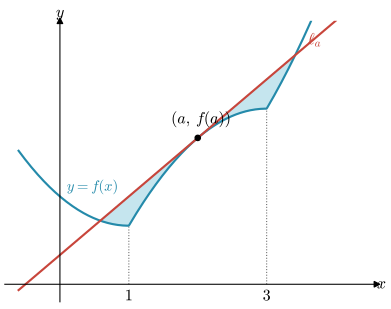
Consider the function $f(x) = |x^2 - 4x + 3| + 2x$. Let $1 < a < 3$ and let $\ell_a$ be the line tangent to the graph of $y = f(x)$ at the point $(a, f(a))$. The answers are integers.
- $\ell_a: y = \left(\boxed{\text{2-1}}\,a + \boxed{\text{2-2}}\right)x + \boxed{\text{2-3}}\,a^2 + \boxed{\text{2-4}}$.
- Let $S(a)$ be the area of the region enclosed by the line $\ell_a$ and the graph of $y = f(x)$. At $a = \boxed{\text{2-5}}$, $S(a)$ takes the minimum $\dfrac{\boxed{\text{2-6}}\sqrt2}{3} - \dfrac{\boxed{\text{2-7}}}{\boxed{\text{2-8}}}$.
Solution
1. The two formulas for $f$. $x^2 - 4x + 3 = (x - 1)(x - 3)$ is negative between $1$ and $3$. So
$$f(x) = \begin{cases} x^2 - 2x + 3 = g(x), & x \le 1 \text{ or } x \ge 3, \\ -x^2 + 6x - 3 = h(x), & 1 \le x \le 3. \end{cases}$$2. The tangent. For $1 < a < 3$, $f = h$ near $a$, with $h'(a) = -2a + 6$:
$$\ell_a: y = (-2a + 6)(x - a) - a^2 + 6a - 3 = (-2a + 6)x + a^2 - 3.$$3. The region. The parabola $h$ is concave, so $\ell_a$ lies above it on $[1, 3]$ (touching it at $x = a$). Outside $[1, 3]$, the convex parabola $g$ rises and crosses $\ell_a$ at two points $x_1 < 1$ and $x_2 > 3$. The region lies between $x_1$ and $x_2$, below $\ell_a$ and above $f$. Since $f = g$ outside $[1, 3]$ and $f = h$ inside,
$$S(a) = \int_{x_1}^{x_2}(\ell_a - g)\,dx - \int_1^3 (h - g)\,dx.$$4. The two integrals. $\ell_a - g = -(x - x_1)(x - x_2)$, and the integral of a parabola between its roots is $\frac{(x_2 - x_1)^3}{6}$. The roots of $x^2 + (2a - 8)x + (6 - a^2) = 0$ differ by
$$x_2 - x_1 = \sqrt{(2a - 8)^2 - 4(6 - a^2)} = 2\sqrt{2a^2 - 8a + 10}.$$And $h - g = -2x^2 + 8x - 6 = -2(x - 1)(x - 3)$, with integral $\frac{2\cdot 2^3}{6} = \frac83$. So
$$S(a) = \frac{8\,(2a^2 - 8a + 10)^{3/2}}{6} - \frac83 = \frac43\big(2(a - 2)^2 + 2\big)^{3/2} - \frac83.$$5. The minimum. $S$ increases with $(a - 2)^2$, so the minimum is at $a = 2$:
$$S(2) = \frac43\cdot 2^{3/2} - \frac83 = \frac{8\sqrt2}{3} - \frac83.$$Answer
$\boxed{\text{2-1}} = -2$, $\boxed{\text{2-2}} = 6$, $\boxed{\text{2-3}} = 1$, $\boxed{\text{2-4}} = -3$; $\boxed{\text{2-5}} = 2$, $\boxed{\text{2-6}} = 8$, $\boxed{\text{2-7}} = 8$, $\boxed{\text{2-8}} = 3$.
Question 3: an inscribed pentagon
Statement
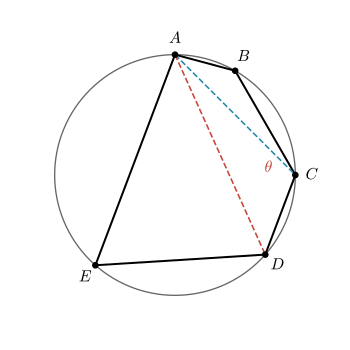
The pentagon $ABCDE$ is inscribed in a circle. The sides $AB$, $BC$, $CD$ and $DE$ measure $-1 + \sqrt3$, $\sqrt2$, $1$ and $2$, and $\angle ABC = 135^\circ$. The answers are integers or fractions (some may be zero or negative).
- $AC = \boxed{\text{3-1}} + \boxed{\text{3-2}}\sqrt6$.
- The radius of the circle is $\boxed{\text{3-3}} + \boxed{\text{3-4}}\sqrt2$.
- Let $\theta = \angle ACD$. Then $\cos\theta = \boxed{\text{3-5}} + \boxed{\text{3-6}}\sqrt7$.
- $EA = \boxed{\text{3-7}} + \boxed{\text{3-8}}\sqrt7$.
Solution
1. $AC$. Law of cosines in triangle $ABC$, with $\cos 135^\circ = -\frac{\sqrt2}{2}$:
$$AC^2 = (\sqrt3 - 1)^2 + 2 + 2(\sqrt3 - 1)\sqrt2\cdot\frac{\sqrt2}{2} = (4 - 2\sqrt3) + 2 + (2\sqrt3 - 2) = 4.$$$AC = 2 = 2 + 0\sqrt6$.
2. The radius. Law of sines: $2R = \frac{AC}{\sin 135^\circ} = \frac{2}{\sqrt2/2} = 2\sqrt2$, so $R = \sqrt2 = 0 + 1\cdot\sqrt2$.
3. $\cos\theta$. In triangle $ACD$, inscribed in the same circle, the law of sines gives $AD = 2R\sin\theta = 2\sqrt2\sin\theta$, and the law of cosines gives $AD^2 = 4 + 1 - 4\cos\theta$. Setting them equal,
$$8(1 - \cos^2\theta) = 5 - 4\cos\theta \iff 8\cos^2\theta - 4\cos\theta - 3 = 0 \iff \cos\theta = \frac{1 \pm \sqrt7}{4}.$$4. Which sign? Each chord of length $\ell$ subtends an arc $\varphi$ with $\ell = 2R\sin\frac\varphi2$:
| Chord | Length | $\sin\frac\varphi2$ | Arc |
|---|---|---|---|
| $AB$ | $\sqrt3 - 1$ | $\frac{\sqrt3 - 1}{2\sqrt2} = \sin 15^\circ$ | $30^\circ$ |
| $BC$ | $\sqrt2$ | $\frac12$ | $60^\circ$ |
| $CD$ | $1$ | $\frac{1}{2\sqrt2}$ | $\approx 41.4^\circ$ |
| $DE$ | $2$ | $\frac{\sqrt2}{2}$ | $90^\circ$ |
The four arcs add up to about $221.4^\circ$, so the arc $EA$ is about $138.6^\circ$. The inscribed angle $\theta = \angle ACD$ subtends the arc $DEA$, of about $228.6^\circ$, and so it is obtuse ($\approx 114.3^\circ$). The negative sign stays:
$$\cos\theta = \frac{1 - \sqrt7}{4} = \frac14 - \frac14\sqrt7.$$5. $EA$. Writing $\varphi_{CD}$ for the arc of $CD$, the arc $EA$ measures $360^\circ - (30^\circ + 60^\circ + 90^\circ) - \varphi_{CD} = 180^\circ - \varphi_{CD}$. So
$$EA = 2R\sin\left(90^\circ - \frac{\varphi_{CD}}{2}\right) = 2\sqrt2\cos\frac{\varphi_{CD}}{2} = 2\sqrt2\sqrt{1 - \frac18} = 2\sqrt2\cdot\frac{\sqrt7}{2\sqrt2} = \sqrt7.$$$EA = 0 + 1\cdot\sqrt7$.
Answer
$AC = 2$ ($2$ and $0$); $R = \sqrt2$ ($0$ and $1$); $\cos\theta = \frac14 - \frac14\sqrt7$; $EA = \sqrt7$ ($0$ and $1$).