
Euler's Eyes
2022-06-07
Sum of natural numbers
A sum to see


Check out the discovery
There are 25 baskets. One path is 18 + 2 + 5: we use 2 from 7 to get to 20 and add the others 5.
Help us build the math website. Donate as much as you can.

Sum of natural numbers
To learn about sum, let’s start with the first set of natural numbers by the Egyptians and Babylonians:
I + II = III
I plus II equals III
1 + 2 = 3
Another example is given below:
The first step in learning sum is the representation of the unit 1. When using the addition or (union) symbol, for example:
$$1 ~\text{unido com}~ 1 = 1+1$$which represents two units, which is the concept of the Arabic number 2 (two).
Now let’s see how the number 3 or 3 units is represented:
From this, we can note that sum has associative property. In short, the order of the sum does not matter
$$1+2 = 2+1=3$$$$a+b = b+a=c$$
Therefore, given \(a\) and \(b\) natural numbers, i.e. \(a,~b \in\mathbb{N}=\{1, 2, 3, 4 ,5 ,6 ,7, 8, 9, 10, \dots\}\).
$$(a + b) = (b + a)$$
Successor of a natural number
Example: the successor of 3 is 4.
| Numeral | Successor |
|---|---|
| 1 | 2 |
| 2 | 3 |
| 3 | 4 |
| 4 | 5 |
The pair of numbers 1 and 2 \((1,2)\) are consecutive numbers.
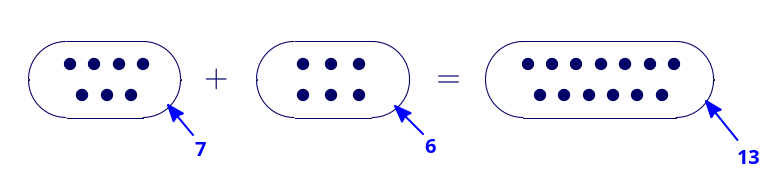
Children, as well as Egyptian adults or people of antiquity, added sums with the concept of successors. For example, given \(a=7\) and \(b=6\) the sum obtained per successor is given by:
Therefore, \(7+6=13\) in the Arabic decimal system.
- Impa Portal: Addition Algorithm
Sum by the Japanese Method (Abacus)
The abacus is widely used in Japan, and is the method used in elementary schools to represent natural numbers.
| Abacus | Transport |
|---|---|
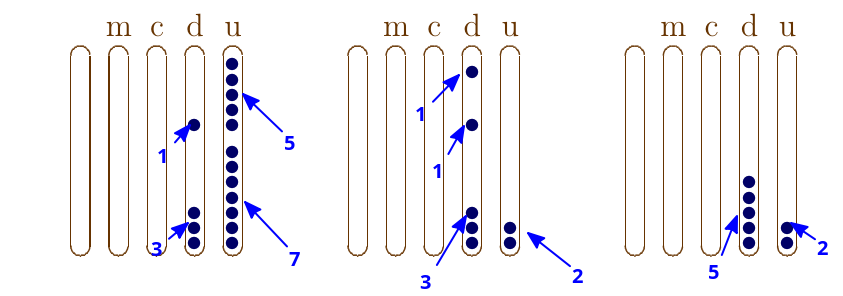
|
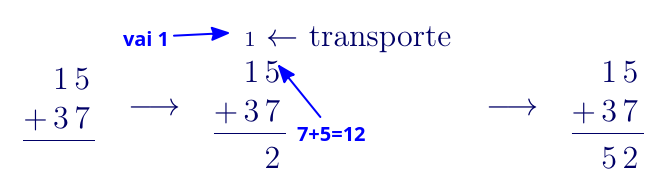
|
Abacus movements are the method taught in elementary schools. The carrier (reserve) is what kids call “go one.”
Sum by Hindu method

Sum by the European Method
The long version was widely used in Europe (16 century) and is done as follows:
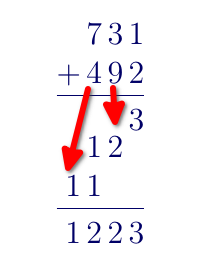
Estimation Concept
A very important concept used in everyday life by every human being is the concept of estimation. For example, if a mother is interested in buying toys for her 2 children, the first one costs 978 reais and the other 493 reais. Given that she has 1500 reais in her pocket, will she be able to buy the toy for her 2 children?
With the concept of estimation, we can roughly approximate the toys for 1000 and 500. This way, we know that what she has in her pocket is enough to buy the toy for her 2 children. We clearly know that there will be money left over, but it is a quick way to make a decision. Before we show the actual bill, we define the terms of the sum as installments, which is a concept used when we divide the sum into equal parts in a purchase. What we call an installment purchase. We will call the result the total, as in the following figure:
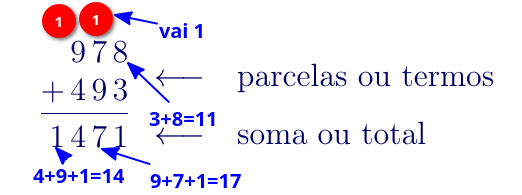
This is the basics for representing natural numbers and for teaching the first grade of elementary school.
Training
Time to practice! Answer and see how many stars you get.