
Euler's Eyes
2022-06-08
Subtraction of naturals
Crossing out also helps to calculate

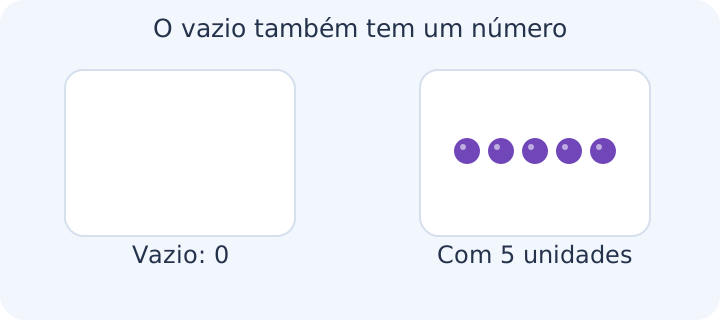
Check out the discovery
6 − 6 = 0 and 6 − 4 = 2. Zero records the quantity when there are no caps left.
Subtraction of natural numbers is the operation that removes one natural number from another. The method we are going to introduce is the abacus method which is the Japanese method.
Predecessor of a natural number
The predecessor of a natural number is the natural number that is the result of subtracting the number by unity. More specifically, the predecessor of a natural number \(a\) is the natural number whose successor is \(a\). We define the predecessor as \(a-1\).
Example: the predecessor of 3 is 2.
| Numeral | Predecessor |
|---|---|
| 2 | 1 |
| 3 | 2 |
| 4 | 3 |
| 5 | 4 |
In this way, the result of subtracting natural numbers \(a\) from \(b\) indicated by \(a-b\) is called a difference.
Children, as well as Egyptian adults or people of antiquity, carried out sums with the concept of predecessors. For example, given \(a=7\) and \(b=6\) the difference obtained by predecessor is given by:
Therefore, \(7-6=1\) in the Arabic decimal system.
Subtraction using the abacus method
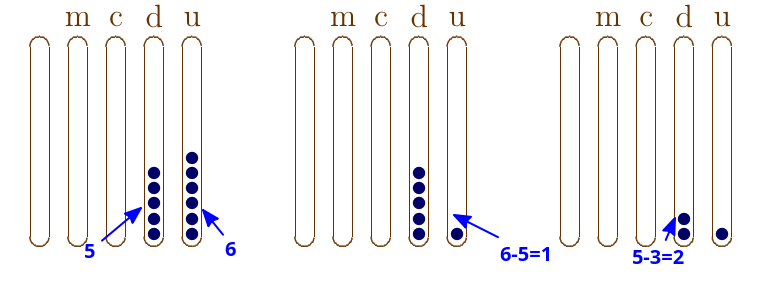
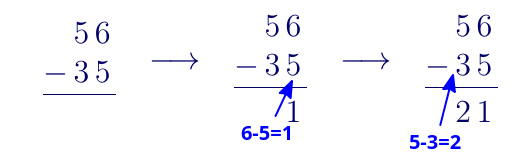
The subtraction of 56 and 35 is given below:
| Abacus | School method |
|---|---|
|
|
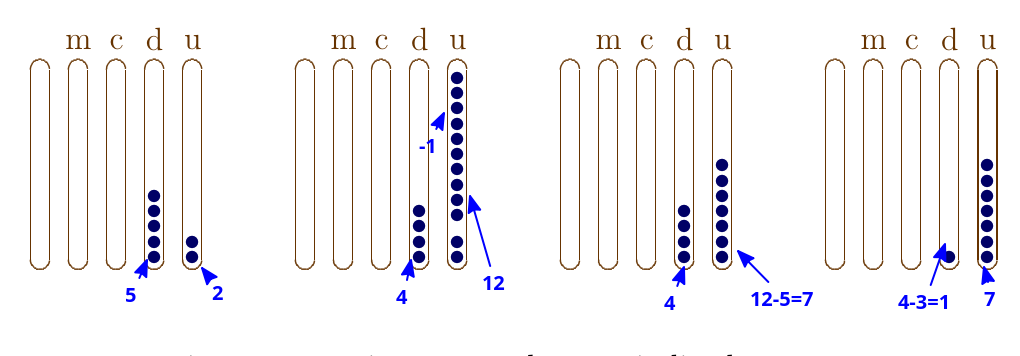
Now let’s look at the calculation of 52-35:
| Abacus | School method |
|---|---|
|

|
Definition
The next step is to present some definitions:
| Subtraction | Definition |
|---|---|
| 7 | Minuend |
| -5 | Subtrahend |
| 2 | Difference or Remainder |
- Impa Portal: Time to Subtract
How to avoid borrowing
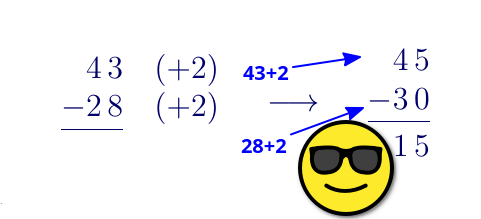
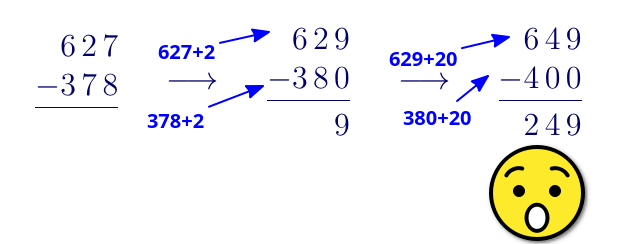
One method to bypass the loan method is to use the scale method.

What is the scale method like? To balance the scales, everything you do on one side, you do on the other in the same proportion. For example, to subtract 43 and 28 we would have to use the loan method. To avoid borrowing, we will add in the minuend 2 and the subtrahend 2 also to balance the scale.
- Impa Portal: Subtraction
- Impa Portal: Subtraction
- Portal Impa: Shall we subtract?
- Impa Portal: The difference
Training
Time to practice! Answer and see how many stars you get.