Nothing is more attractive to intelligent people than an honest, challenging problem, whose possible solution will bestow fame and remain as a lasting monument.
— Johann Bernoulli, Acta Eruditorum (June 1696)
Johann Bernoulli (1667–1748) was the youngest brother of James (Jakob) Bernoulli. He was meant to be a merchant and became a physician; he learned the calculus from his brother and spent the rest of his life trying to prove he was better than him. He sold his discoveries to a French marquis, who published them in a book under his own name. He threw the challenge of the brachistochrone at Europe and recognised Newton “by the lion’s claw”. He quarrelled with his brother, with the English and even with his own son.
He was also the greatest teacher of his time. He taught the calculus to l’Hôpital, to Maupertuis and to his sons, and, on Saturdays, to a young man from Basel named Leonhard Euler. When he died, aged 80, he was being called “the Archimedes of his age”.
In this track we tell the life of Johann Bernoulli and redo, with all the calculations shown, five of his discoveries.
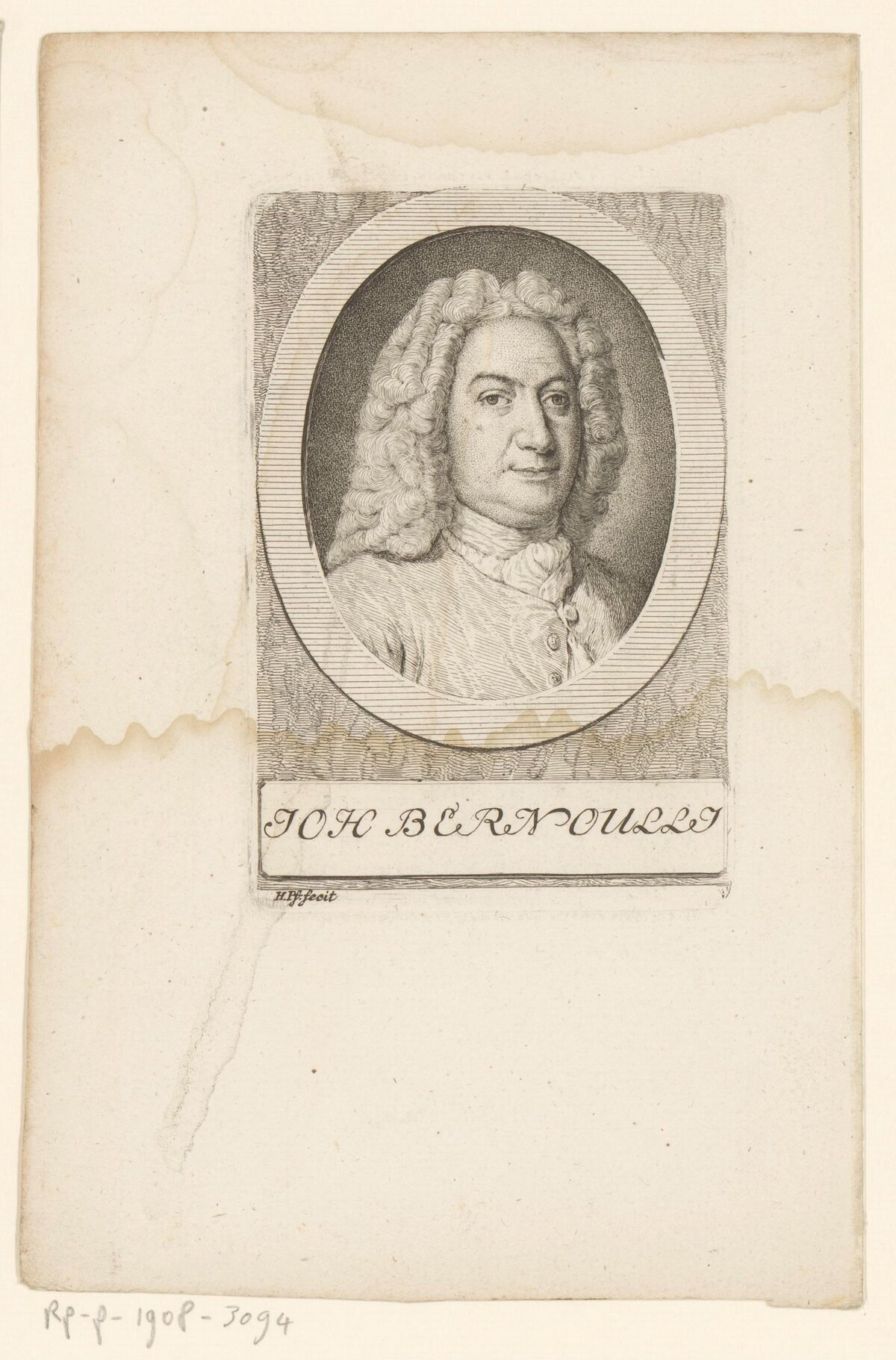
Who he was
Johann Bernoulli
- Nascimento
- 27 July 1667, Basel
- Morte
- 1 January 1748, Basel
- Origem
- Switzerland
- Áreas
- Calculus, mechanics, curves and differential equations
Reading guide
Biography
Discovery and proof
- The catenary: the hanging chain
- L’Hôpital’s rule: the lessons sold to a marquis
- The brachistochrone: the challenge of 1696
- The exponential calculus: differentiating x to the power x
- The principle of virtual work