
Euler's Eyes
2022-11-01
Operations with Sets
In number theory or arithmetic we can use operations such as addition, subtraction, multiplication and division. In set theory the operations are union, intersection, difference. Some of them defined in the previous post. In this post, we will talk about results for operations between sets.

Difference between sets
Initially, let’s talk about the difference between sets. To do this, the following definition follows:
Definition (Difference between sets): Let A and B be two sets, let us denote the difference between the sets $A$ and $B,$ by $A \setminus B$ or $A−B,$ is the set formed by the elements that are in $A$ and are not in $B.$. Symbolically, we write:
$$A - B = \\{x; \quad x \in A \wedge x \notin B\\}.$$
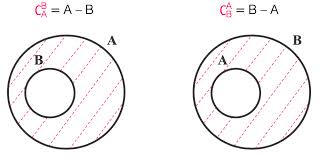
If $A \subseteq B,$ the set $B − A$ is also said to be the complement of A in B and denoted by $A^c_B$. If $A$ is contained in a universe set $U,$ the complement of $A$ in $U$ is denoted simply by
$$A^c = \\{x;\quad x \notin A \\}.$$Property of operations between sets
Theorem 1. Let A, B and C be sets. Then:
- (a) Associations:
- $A \cup(B \cup C) = (A \cup B)\cup C$
- $A \cap(B \cap C) = (A \cap B)\cap C.$
- (b) Commutativities:
- $A \cup B = B \cup A$
- $A \cap B = B \cap A.$
- (c) Distributivities:
- $A \cup (B \cap C) = (A \cup B) \cap (A \cup C) A \cap (B \cup C) = (A \cap B) \cup (A \cap C).$
- (d) Idempotences:
- $A \cup A = A$
- $A \cap A = A.$
- (e) Difference:
- $A − B \subseteq A$
- $(A − B) \cap B = \emptyset.$
- (f) Difference 1:
- $A − B = \emptyset \quad \Leftrightarrow \quad A \subseteq B$
- $A − (A − B) = B \quad \Leftrightarrow \quad B \subseteq A .$
If $A$ and $B$ are subsets of the same universe set U, then:
- (g) Morgan’s Laws
- $(A \cup B)^c= A^c \cap B^c$
- $(A \cap B)^c = A^c \cup B^c.$
- (h) Additional:
- $(A^c)^c = A$
- $A \cap A^c = \emptyset.$
- (i) $A \subseteq B$ if and only if $B^c \subseteq A^c.$
Demonstration: Exercise
Power or parts of a set
In powers or parts of sets we need the following axiom:
Power axiom: For each set, there is a collection of sets that contains among its elements, all subsets of the given set.

In this way, we define it as:
Definition 2 (Set of parts or power). Let A be a set. The power set of $A$ or set of parts of $A,$ denoted by $\mathcal{P}(A),$ is the set whose elements are the subsets of $A.$ Symbolically, we have $\mathcal{P}(A) = \\{B; B \subseteq A \\}.$
Joint example of the parties
For $A = \\{a, b, c \\},$ we have
$$\mathcal{P}(A) = \\{\emptyset, \\{a\\}, \\{b\\}, \\{c\\}, \\{a, b \\}, \\{a, c \\}, \\{b, c \\}, A \\}.$$
Proposition for power
Let A and B be sets. Then:
- (a) $\mathcal{P}(A \cap B) = \mathcal{P}(A) \cap \mathcal{P}(B).$
- (b) $\mathcal{P}(A \cup B) \supseteq \mathcal{P}(A) \cup \mathcal{P}(B).$
Demo:
(a) We have the following equivalences:
By definition we have:
$$X \in \mathcal{P}(A \cap B) \quad \Longleftrightarrow \quad X \subseteq A \cap B$$By theorem 1:
$$X \subseteq A \cap B \quad \Longleftrightarrow \quad X \subseteq A \wedge X \subseteq B$$By definition we have:
$$X \subseteq A \wedge X \subseteq B \quad \Longleftrightarrow \quad X \in \mathcal{P}(A) \wedge X \in \mathcal{P}(B)$$By definition of intersection $\cap$ we have that:
$$X \in \mathcal{P}(A) \wedge X \in \mathcal{P}(B) \quad \Longleftrightarrow \quad X \in \mathcal{P}(A) \cap \mathcal{P}(B)$$which demonstrates item (a).
The proof of item (b) remains as an exercise.
$\square$
Note that the inclusion $\mathcal{P}(A ∪ B) \subseteq \mathcal{P}(A) \cup \mathcal{P}(B)$ is not true. The following counterexample demonstrates this fact.
In fact, for $A = \\{1\\}$ and $B = \\{2\\},$ we have
$$\mathcal{P}(A \cup B) = \mathcal{P}(\\{1, 2\\}) = \\{\emptyset, \\{1\\}, \\{2\\}, \\{1, 2\\}\\}$$e
$$\mathcal{P}(A) \cup \mathcal{P}(B) = \\{\emptyset, \\{1\\}\\} \cup \\{\emptyset, \\{2\\}\\} = \\{\emptyset, \\{1\\}, \\{2\\}\\}.$$Union Axiom
To define the union of a finite number of sets, we can use the specification axiom. For any collection of sets, it is no longer It is possible to use this axiom to construct a union set and an intersection set.
Axiom of union: For every collection of sets there is a set that contains all the elements that belong to some set of the given collection.
In other words, this axiom guarantees that for every collection of sets $\mathcal{C},$ there is a set $U$ such that, if $x \in A$ for some $A$ in $\mathcal{C},$ then $x \in U.$ Thus we can define:

Definition (Union of sets) Let $\mathcal{C}$ be a collection of sets. The union of the sets in $\mathcal{C}$ or the union of the elements of $\mathcal{C}$, denoted by:
$$\bigcup_{A\in \mathcal{C} } A$$or
$$\bigcup \mathcal{C}$$consists of all elements that belong to at least one set of the collection. Yet
$$\bigcup_{A\in \mathcal{C} } A = \\{x \in A;\quad A \in \mathcal{C}\\}.$$

Note that in this definition we use the union axiom and the specification axiom to ensure the existence of
$$ \bigcup_{A\in \mathcal{C} } A$$Uniqueness is guaranteed by the axiom of extension. We can also write
$$\bigcup_{A\in \mathcal{C} } A = \\{x; \exists A \in \mathcal{C}~ \text{ tal que } x \in A \\}$$Axiom of Intersection
For the intersection of sets in a collection we have:
Definition (Axiom of Intersection). Let $\mathcal{C}$ be a collection of sets, we say intersection of sets in $\mathcal{C}$ or the intersection of elements of $\mathcal{C},$ denoted by $\bigcap_{A \in \mathcal{C} } A$ or $\bigcap \mathcal{C}$, which are all elements that belong to all sets in the collection.
$$\bigcap_{A \in \mathcal{C} } A = \\{x; ~ x \in A \text{ para todo } A \in \mathcal{C} \\}. $$We can also write
$$\bigcap \mathcal{C} = \\{x; (A \in \mathcal{C} \rightarrow x \in A) \\}.$$
This is the summary of set operations. Wait for the next posts.