
Euler's Eyes
2026-10-11
Pascal's triangle: build it by adding
Write a $1$. Below it, two $1$s. From then on, each row starts and ends with $1$, and each number in between is the sum of the two numbers just above it:
$$\begin{array}{ccccccccccc} &&&&&1&&&&&\\ &&&&1&&1&&&&\\ &&&1&&2&&1&&&\\ &&1&&3&&3&&1&&\\ &1&&4&&6&&4&&1&\\ 1&&5&&10&&10&&5&&1 \end{array}$$That is all. A rule a child learns in a minute produces one of the richest tables in mathematics. Today it is called Pascal’s triangle, but Pascal was one of the last to find it.
A triangle with many owners
In India, around the 2nd century BC, the poet Pingala counted the ways of combining long and short syllables in a line of verse and arrived at the same numbers. In the 10th century the commentator Halayudha drew the table and called it Meru-prastara, the “staircase of Mount Meru”.
In Baghdad, around the year 1000, al-Karaji used the triangle to expand powers such as $(a+b)^5$. His book was lost, but a century and a half later, around 1150, al-Samaw’al copied the table and the reasoning, giving al-Karaji the credit. In Persia the triangle is also linked to the poet and mathematician Omar Khayyam.
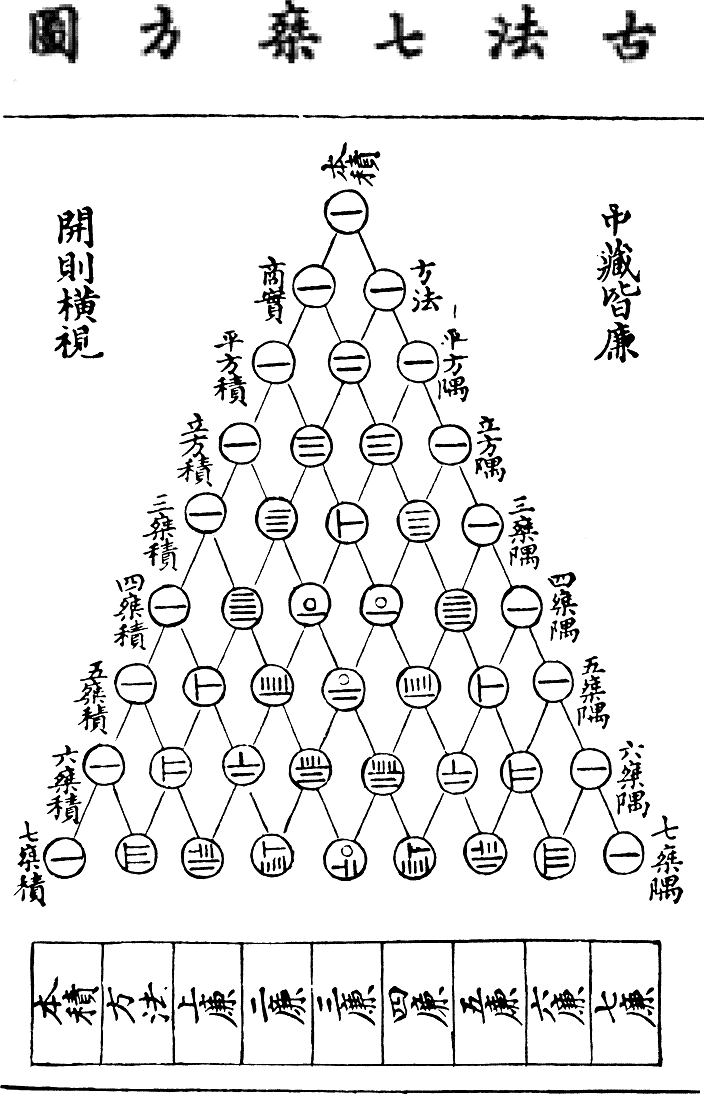
In China, Jia Xian used it around 1050 to extract roots. Yang Hui published it in 1261, and Zhu Shijie drew it in 1303 in his book Jade mirror of the four unknowns, with the numbers written in counting rods.
In Europe the triangle appeared in print on the title page of an arithmetic book by Petrus Apianus in 1527. It was then used by Michael Stifel in 1544 and by Niccolò Tartaglia in 1556. To this day it is called Tartaglia’s triangle in Italy, Khayyam’s triangle in Iran and Yang Hui’s triangle in China.
Pascal’s treatise
In 1654, while discussing bets with Fermat, Pascal wrote the Treatise on the arithmetic triangle, in a French and a Latin version. It begins like this:
The arithmetic triangle is constructed as follows: from any point Z, draw two perpendicular lines, ZL and ZT, and on each of them mark as many equal parts as you like.
— Blaise Pascal, Triangulus arithmeticus (1654)
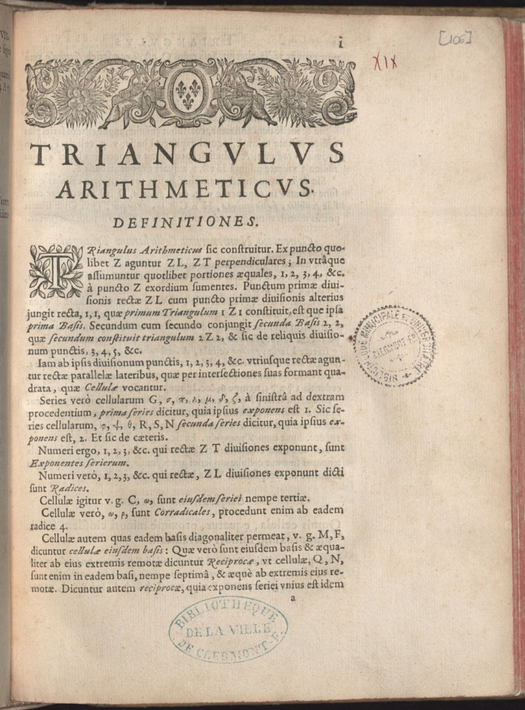
Pascal’s triangle was actually a staircase-shaped grid. He called each little square a cell, the rows parallel ranks, the columns perpendicular ranks and the diagonals bases. Each cell is the sum of the cell above it and the cell to its left, which is the same rule we use today, only rotated.
Pascal did not discover the table. What he did was prove, one by one, nineteen properties of it and show how to use it in three different problems: counting combinations, expanding powers and splitting bets. He was so thorough that fifty years later Pierre de Montmort called it “Monsieur Pascal’s table”, and Abraham de Moivre called it Triangulum arithmeticum Pascalianum. The name stuck.
The rule, with names
We number the rows starting from $0$, and the positions within each row also starting from $0$. We write $C(n,k)$ for the number in row $n$ at position $k$. The construction rule is
$$C(n,k)=C(n-1,k-1)+C(n-1,k),$$with $C(n,0)=C(n,n)=1$. For example, in row 5, $C(5,2)=C(4,1)+C(4,2)=4+6=10$.
Try it: choose a row and a position. Each number in the middle is the sum of its two neighbours above.
The fountain that splits its water
Imagine a fountain of stacked bowls. Water falls into the top bowl and overflows half to each side, into two bowls in the tier below. Each of these also overflows half to each side, and so on.
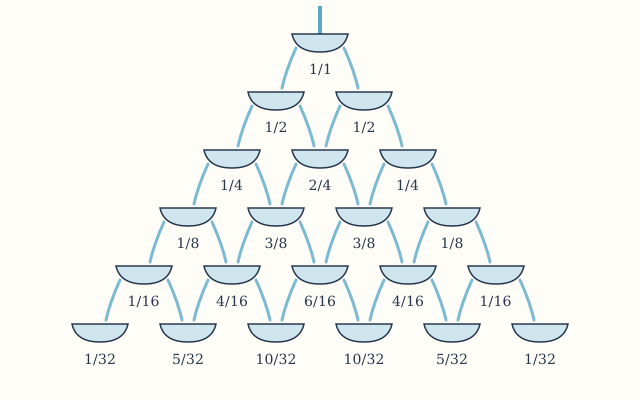
The middle bowl of the third tier receives $\frac14$ from the bowl on the left and $\frac14$ from the bowl on the right: $\frac24$ in all. In the fourth tier the bowls receive $\frac18,\frac38,\frac38,\frac18$. The numerators are exactly the rows of the triangle: the top bowl is row 0, and in row $n$ the denominator is $2^n$. Since no water is lost, each row adds up to $1$.
This explains the most famous property of the table: row $n$ adds up to $2^n$.
$$1+5+10+10+5+1=32=2^5.$$The reason is that each number in a row is used twice in the next row: once to its left and once to its right. So the sum of the next row is double. Starting from $1$, after $n$ rows the sum is $2^n$.
Numbers hidden in the diagonals
Read the triangle along its diagonals. The first diagonal is all $1$s. The second is $1,2,3,4,5,\dots$, the natural numbers. The third is $1,3,6,10,15,\dots$, the triangular numbers: the number of balls that make up a triangle. The fourth is $1,4,10,20,35,\dots$, the numbers of balls in a pyramid with a triangular base.
Pascal knew all these diagonals and wrote a text in Latin just about them: Numeri figurati, the “figurate numbers”.
Exercise: build row 6 and check its sum
Adding the neighbours of row $1,5,10,10,5,1$, we get $1,6,15,20,15,6,1$. The sum is $64=2^6$.
Exercise: in the fountain of bowls, how much water reaches the third bowl of the seventh tier?
Since the top bowl is row $0$, the seventh tier is row $6$, and the third bowl is position $2$. The fraction is $\dfrac{C(6,2)}{2^6}=\dfrac{15}{64}$, about 23% of the water.
Sources: Pascal biography, MacTutor · al-Karaji, MacTutor · Yang Hui, MacTutor.
All Pascal topics · ← The life of Blaise Pascal · Combinations: counting without listing →