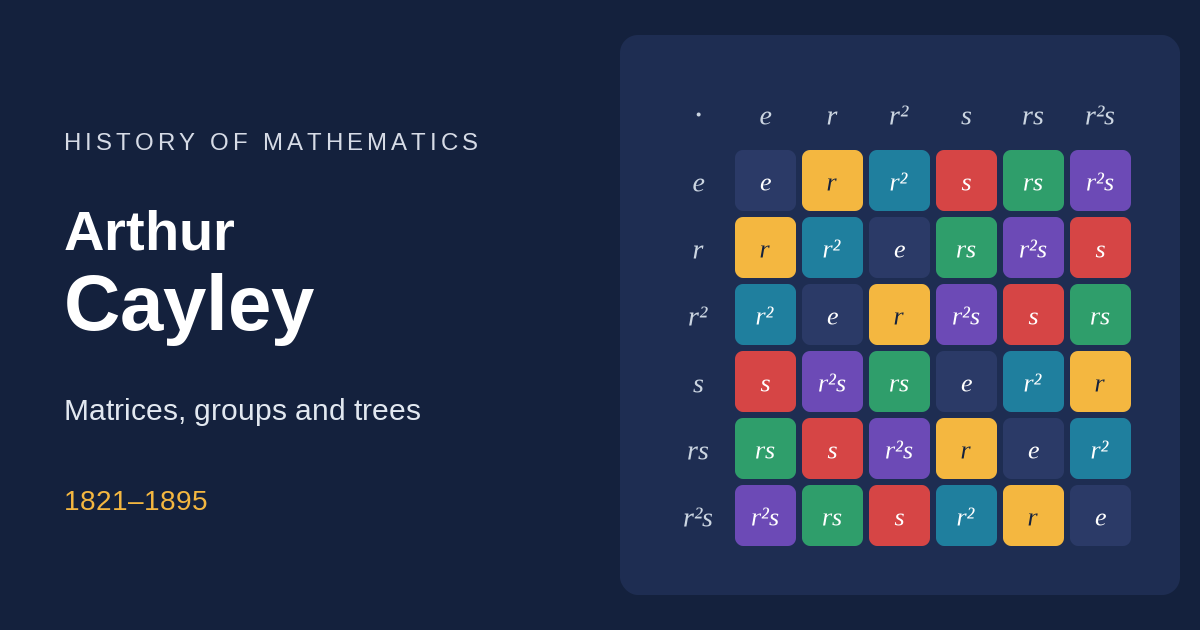
Hero Image
The life of Arthur Cayley

Timeline 1821Born on 16 August in Richmond, near London, during a visit of his parents to England. 1829The family, who lived in St Petersburg, returns to England for good. 1835Enters King’s College School in London. 1838Enters Trinity College, Cambridge. 1842Senior Wrangler, first in the mathematics examination, and first Smith’s Prize. Elected a Fellow of Trinity. 1846Leaves Cambridge and begins studying law at Lincoln’s Inn. 1849Becomes a lawyer. For fourteen years he drafts property deeds. 1850Meets James Joseph Sylvester. 1854Defines abstract groups. 1858Publishes the memoir on the theory of matrices. 1863Becomes the first Sadleirian Professor of Pure Mathematics at Cambridge. Marries Susan Moline. 1882Lectures at Johns Hopkins University in Baltimore. Receives the Copley Medal. 1889His Collected Mathematical Papers begin to appear. Publishes the formula for trees. 1895Dies on 26 January in Cambridge, aged 73. ◀ Previous Follow the journey Next ▶ 1821 RichmondHe is born on 16 August 1821, during a visit of his parents to England. 1821–1829 St PetersburgHe spends his first eight years in the city where his father, Henry Cayley, is a merchant. 1835–1838 King's College SchoolThe family lives in Blackheath. At King’s College School in London, his mathematics master advises that he should go to Cambridge. 1838–1846 Trinity CollegeHe studies at Trinity, is Senior Wrangler in 1842 and stays four years as a fellow, publishing dozens of papers. 1846–1863 Lincoln's InnA lawyer specialising in property deeds. He meets Sylvester and, in his spare time, writes some 250 papers, among them the memoir on matrices. 1882 BaltimoreAt Sylvester’s invitation, he spends half a year lecturing at Johns Hopkins University. 1863–1895 CambridgeFirst Sadleirian Professor of Pure Mathematics. He dies in Cambridge on 26 January 1895. Enable JavaScript to see the map. The stages are listed below. A childhood in St Petersburg, a life between London and Cambridge and a season in Baltimore. Map: © OpenStreetMap contributors

Hero Image
Image credits

Historical images All come from Wikimedia Commons. We use the files or the thumbnails supplied by Commons, reduced to at most 800 pixels wide, with no other editing except where stated. Arthur Cayley, photograph attributed to Herbert Rose Barraud (before 1883): source page · public domain. Used whole in the legacy post and, cropped to the face, in the series card. Arthur Cayley, stipple engraving by G. J. Stodart (1883) after Barraud & Ferrari, Wellcome Collection: source page · CC BY 4.0. We cropped the portrait and the signature. The Great Court of Trinity College, engraving by John Le Keux after J. A. Bell, Memorials of Cambridge (1847): source page · public domain. The Old Hall and chapel of Lincoln’s Inn, drawing by Thomas Hosmer Shepherd engraved by W. Watkins (around 1830), Yale Center for British Art: source page · public domain. James Joseph Sylvester, portrait by Alfred Edward Emslie: source page · public domain. First page of the Memoir on the theory of matrices (1858), Philosophical Transactions, Internet Archive scan: source page · public domain. We extracted the page from the PDF. The first trees, figures from Cayley’s 1857 paper in the Philosophical Magazine: source page · public domain. Figures made for the blog The cover and the six interactive figures (the matrices AB and BA, the Cayley–Hamilton theorem, the group tables, the trees with the Prüfer code, the octonions on the Fano plane and the Cayley–Klein distance) are original illustrations, with text in each of the site’s languages.