
Euler's Eyes
2026-09-26
FUVEST 2023 – 2nd phase: Mathematics solved
Source: FUVEST – 2nd phase test, 2nd day (questions M01 to M06) and document expected approaches.
The 2nd phase of FUVEST 2023 lasted two days. The 1st day was Portuguese and Writing; in 2nd day, the test had 6 questions from each subject, and Mathematics goes from M01 to M06. Each candidate answered only the subjects of their career (in some careers, only the first questions of each subject).
FUVEST does not publish a template for the 2nd phase; the resolutions are ours. She disclosed an “expected approaches” document with the path expected of the candidates. Each resolution below was checked by a second path and compared to this document.
Template
| Question | Subject | Answers |
|---|---|---|
| M01 | Related functions by parts: delivery charges | a) $f_A(x) = 4x + 30$; b) $15 < x < 45$; c) 190 kg and 10 kg, or 150 kg and 50 kg |
| M02 | Quadratic function | a) $a = 1$, $b = c = 0$; b) $c = 12$; c) $b \leq -5$ or $b \geq 5$ |
| M03 | Counting Functions and Probability | a) 256; b) 76; c) $\frac{91}{144}$ |
| M04 | Tangent circles and PG | a) 6; b) $\frac{1}{3}$; c) $18\pi$ |
| M05 | Inequalities: NBR ladder 9077 | a) $31 \leq L \leq 32$; b) 15 steps of 16,8 cm by 30,4 cm; c) max. $\frac{2}{3}$, min. $\frac{1}{2}$ |
| M06 | Complex numbers | a) $b = -2$; b) $z = \frac{3}{2} - 2i$; c) $a < 2$, $a \neq 0$ |
Question M01: Tariffs for two delivery companies (related functions)
Statement
Two freight delivery companies, $A$ and $B$, are competitors. The company $A$ charges R$ 4,00 per kilo of the order plus R$ 30,00 as a fixed fee. Already the The company’s tariff $B$ is R$ 6,00 per kilo, with no fixed fee, for orders of up to 30 kilos; for orders over 30 kilos, the company $B$ charges R$ 2,00 per kilo, plus a fixed fee of R$ 120,00.
a) Give the function expression that describes the tariff charged by company $A$ in terms of the weight $x$ of the order.
b) For which weight range is it cheaper to order delivery from the company $A$ than by company $B$?
c) A customer requested two orders: one delivered by company $A$, and another, by company $B$, with a total weight of 200 kilos. What are the possible ways to distribute this weight between the two companies, knowing that the total delivery fee was it from R$ 850,00?
Resolution
a) The company $A$ charges 4 reais per kilo plus 30 fixed:
$$f_A(x) = 4x + 30 \quad (x \geq 0)$$Response (a): $f_A(x) = 4x + 30$.
b) The $B$ tariff is defined in parts:
Let’s solve for $f_A(x) < f_B(x)$ in each part.
- To $0 \leq x \leq 30$: $4x + 30 < 6x \iff 30 < 2x \iff x > 15$. In this part: $15 < x \leq 30$.
- To $x > 30$: $4x + 30 < 2x + 120 \iff 2x < 90 \iff x < 45$. In this part: $30 < x < 45$.
Putting the two parts together: $15 < x < 45$.
At the extremes, the rates are tied: $f_A(15) = f_B(15) = 90$ and $f_A(45) = f_B(45) = 210$. (The FUVEST approaches document presents the closed range $[15, 45]$, which includes these ties.)
Answer (b): company $A$ is cheaper for orders weighing between 15 kg and 45 kg ($15 < x < 45$); in 15 kg and 45 kg they both charge the same.
c) Let $x$ be the weight sent by company $B$; so $A$ takes $200 - x$ kilos. We need
$$f_A(200 - x) + f_B(x) = 850, \qquad f_A(200 - x) = 4(200 - x) + 30 = 830 - 4x.$$- If $0 \leq x \leq 30$: $830 - 4x + 6x = 850 \iff 2x = 20 \iff x = 10$. OK, because $10 \leq 30$.
- If $x > 30$: $830 - 4x + 2x + 120 = 850 \iff 950 - 2x = 850 \iff x = 50$. Therefore, $50 > 30$ is valid.
Conference:
| Company $A$ | Company $B$ | $A$ fee | $B$ fee | Total |
|---|---|---|---|---|
| 190 kg | 10 kg | $4 \cdot 190 + 30 = 790$ | $6 \cdot 10 = 60$ | 850 |
| 150 kg | 50 kg | $4 \cdot 150 + 30 = 630$ | $2 \cdot 50 + 120 = 220$ | 850 |
Answer (c): there are two ways: 190 kg by company $A$ and 10 kg by $B$, or 150 kg by company $A$ and 50 kg by $B$.
Attention: in the final table of the FUVEST expected approaches document, the columns appear interchanged (10 kg and 50 kg for company $A$). On your own account of the document, $x$ is the weight of the company $B$, and the conference above shows that 10 kg for $A$ and 190 kg for $B$ would cost $70 + 500 = 570$ reais, not 850.
To review, see First Degree Functions.
Question M02: Parabola, triangle and equation with cosine (quadratic function)
Statement
Consider $a, b, c \in \mathbb{R}$ and the given function $f: \mathbb{R} \to \mathbb{R}$ by $f(x) = ax^2 + bx + c$.
a) Determine the values of $a$, $b$, and $c$ so that $f(1) = 1$, $f(0) = 0$, and $f(-1) = 1$.
b) For $a = -1$ and $b = 4$, determine the value of $c$ so that the area of the triangle $ABV$ of the figure is equal to 32 a.u., where $V$ is the vertex of the parabola represented by $f$.
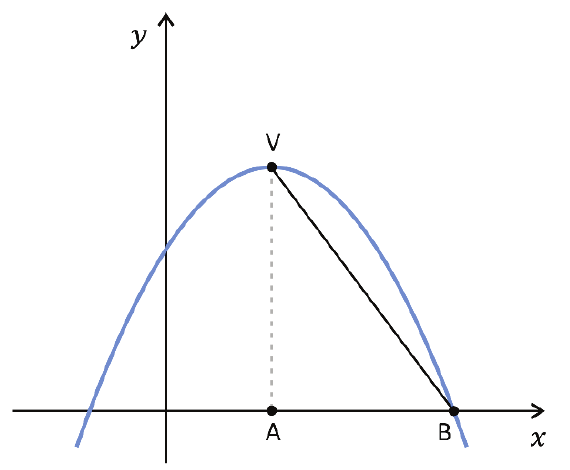
c) Consider $g: \mathbb{R} \to \mathbb{R}$ the function given by $g(t) = \cos t$. Se $a = 3$ and $c = -8$, determine for which values of $b$ the equation $f(g(t)) = 0$ has at least one real solution.
Resolution
a) Replacing the three points:
- $f(0) = c = 0$;
- $f(1) = a + b + c = 1$, then $a + b = 1$;
- $f(-1) = a - b + c = 1$, then $a - b = 1$.
Adding the last two: $2a = 2$, $a = 1$; then $b = 0$. The function is $f(x) = x^2$, which is in fact worth 1 in $x = \pm 1$ and 0 in $x = 0$.
Response (a): $a = 1$, $b = 0$, $c = 0$.
b) With $a = -1$ and $b = 4$: $f(x) = -x^2 + 4x + c$.
1. Vertex. $x_V = -\dfrac{b}{2a} = -\dfrac{4}{-2} = 2$ and $y_V = f(2) = -4 + 8 + c = 4 + c$. Then $V = (2, 4 + c)$ and, from the figure, $A = (2, 0)$ is the foot of the vertical by $V$.
2. Point $B$ (largest root): $-x^2 + 4x + c = 0 \iff x^2 - 4x - c = 0$, and
$$x = \frac{4 \pm \sqrt{16 + 4c}}{2} = 2 \pm \sqrt{4 + c}.$$Then $B = (2 + \sqrt{4 + c}, 0)$.
3. Area. The triangle $ABV$ is a rectangle in $A$, with legs $AB = \sqrt{4 + c}$ and $AV = 4 + c$:
$$\frac{\sqrt{4 + c} \cdot (4 + c)}{2} = 32 \iff (4 + c)^{3/2} = 64 \iff 4 + c = 64^{2/3} = 16 \iff c = 12.$$Conference: with $c = 12$, $f(x) = -x^2 + 4x + 12 = -(x - 6)(x + 2)$. So $V = (2, 16)$, $A = (2, 0)$, $B = (6, 0)$ and the area is $\frac{4 \cdot 16}{2} = 32$.
Response (b): $c = 12$.
c) Now $f(x) = 3x^2 + bx - 8$. As $g(t) = \cos t$ assumes all values of $[-1, 1]$ (and only them), the equation $f(\cos t) = 0$ has a solution if, and only if $f$ has at least one root in the range $[-1, 1]$.
1. The roots have opposite signs. The product of the roots is $\frac{c}{a} = -\frac{8}{3} < 0$, then there is a negative root $x_1$ and a positive $x_2$ (the discriminant $b^2 + 96$ is always positive).
2. When one of them falls into $[-1, 1]$. Like $a = 3 > 0$ and $f(0) = -8 < 0$, the parabola is below the axis between the roots. Like this:
- the positive root is $\leq 1$ if, and only if, $f(1) \geq 0$: $3 + b - 8 \geq 0 \iff b \geq 5$;
- the negative root is $\geq -1$ if and only if $f(-1) \geq 0$: $3 - b - 8 \geq 0 \iff b \leq -5$.
Second path (root formula): $x = \dfrac{-b \pm \sqrt{b^2 + 96}}{6}$. The positive root is $\leq 1$ when $\sqrt{b^2 + 96} \leq 6 + b$; with $b \geq -6$ and squaring, $b^2 + 96 \leq 36 + 12b + b^2 \iff b \geq 5$. By symmetry, the negative is $\geq -1$ when $b \leq -5$. For example, with $b = 5$: $3x^2 + 5x - 8 = (x - 1)(3x + 8)$, and $x = 1 = \cos 0$ is root.
Response (c): $b \leq -5$ or $b \geq 5$ (i.e. $|b| \geq 5$).
To review, see 2th degree equation.
Question M03: Counting functions and fixed points
Statement
Considering $A = \\{1, 2, 3, 4\\}$ and $B = \\{1, 2, 3, 4, 5, 6\\}$,
a) How many functions $f: A \to A$ (not necessarily surjective) are there?
b) how many functions $f: B \to B$ satisfy $f(f(n)) = n$, for all $n \in B$?
c) randomly choosing a bijective function $f: B \to B$, what is the probability of $f$ having at least one fixed point?
Note and adopt: We say that $n \in B$ is a fixed point of $f$ s and $f(n) = n$.
Resolution
a) Each of the 4 domain elements can go to any of the 4 elements of the range, independently:
$$4 \cdot 4 \cdot 4 \cdot 4 = 4^4 = 256.$$Answer (a): 256 functions.
b) If $f(f(n)) = n$, then $f$ is bijective, and for each $n$, or $f(n) = n$ (fixed point), or $f(n) = m \neq n$ and $f(m) = n$ (the two change place). Then $f$ is determined by which pairs of elements exchange between yes; the rest remain fixed. Counting by the number of pairs:
- 0 pairs: just the identity: 1.
- 1 pair: choose 2 from 6: $C_{6,2} = 15$.
- 2 pairs: choose 4 elements and divide them into 2 pairs: $C_{6,4} \cdot 3 = 15 \cdot 3 = 45$ (4 elements form 3 different pairings).
- 3 pairs: split the 6 into 3 pairs: $5 \cdot 3 \cdot 1 = 15$ (the element 1 chooses your pair of 5 ways, the smallest one left chooses from 3, and the last pair is determined).
Answer (b): 76 functions.
c) There are $6! = 720$ bijective functions of $B$ on $B$. It’s easier to count complementary: bijections without fixed point (called chaotic permutations or derangements). According to the inclusion-exclusion principle, their number is
$$D_6 = 6!\left(1 - \frac{1}{1!} + \frac{1}{2!} - \frac{1}{3!} + \frac{1}{4!} - \frac{1}{5!} + \frac{1}{6!}\right) = 720 - 720 + 360 - 120 + 30 - 6 + 1 = 265.$$Then there are $720 - 265 = 455$ bijections with at least one fixed point, and
$$P = \frac{455}{720} = \frac{91}{144} \approx 0{,}632.$$Second path (recurrence): the derangements satisfy $D_n = (n - 1)(D_{n-1} + D_{n-2})$, with $D_1 = 0$ and $D_2 = 1$. Hence $D_3 = 2$, $D_4 = 3 \cdot 3 = 9$, $D_5 = 4 \cdot 11 = 44$ and $D_6 = 5 \cdot 53 = 265$, the same value. (We also check by computer, listing the 720 permutations: 455 have a fixed point, and 76 functions satisfy item b.)
Response (c): $\dfrac{91}{144}$.
To review, see Equiprobable Events.
Question M04: Tangent circles in geometric progression
Statement
Consider the circles $C, C_1, C_2, C_3, \ldots, C_n, \ldots$ and the straight line $s$ satisfying the following properties:
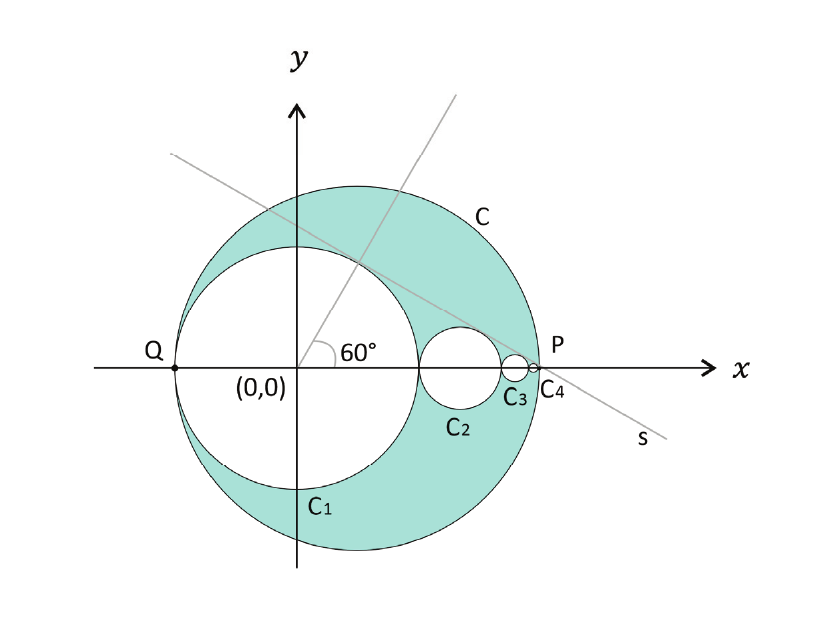
- The circle $C_1$ has center $(0, 0)$ and radius $r = 4$. The centers of the other circles belong to the $Ox$ axis.
- The circle $C_2$ is tangent to $C_1$ and $C_3$, the circle $C_3$ is tangent to $C_2$ and $C_4$, and so on.
- The line $s$ is tangent to each circle $C_n$ to $n \geq 1$.
- The segment that connects the center of $C_1$ to the point where $s$ touches $C_1$ forms an angle of $60^\circ$ with the $Ox$ axis.
- The circle $C$ is tangent to $C_1$ at the point $Q = (-4, 0)$ and passes through point $P = (x_0, 0)$.
Based on this information,
a) determine the radius of the circle $C$.
b) given $n \geq 1$, determine the ratio between the radii of the circles $C_{n+1}$ and $C_n$.
c) Determine the area of the shaded region in the figure.
Resolution
a) The circles $C_n$ get smaller and smaller and accumulate at the point $P$, where the straight line $s$ cuts the axis $Ox$ (see the figure).
Let $T$ be the point where $s$ touches $C_1$ and $O = (0, 0)$. The radius $OT$ is perpendicular to the tangent line, then the triangle $OTP$ is right-angled at $T$, with $OT = 4$ and angle $T\hat{O}P = 60^\circ$. Like this
$$\cos 60^\circ = \frac{OT}{OP} \iff \frac{1}{2} = \frac{4}{x_0} \iff x_0 = 8.$$The segment $QP$, from $(-4, 0)$ to $(8, 0)$, is a diameter of $C$ (the two points are on the $Ox$ axis, which passes through the center of $C$ by symmetry). So the diameter measures 12 and the radius measures 6.
Answer (a): the radius of $C$ is 6.
b) In triangle $OTP$, the angle at $P$ is $90^\circ - 60^\circ = 30^\circ$. The same goes for each $C_n$: if $r_n$ is the radius and $d_n$ is the distance from the center of $C_n$ to $P$, the triangle formed by the center, the point of tangency with $s$ and $P$ is rectangle with angle from $30^\circ$ to $P$, then
$$\text{sen } 30^\circ = \frac{r_n}{d_n} \iff d_n = 2r_n.$$(For $C_1$: $d_1 = 8 = 2 \cdot 4$.) Since $C_n$ and $C_{n+1}$ are tangents externally and have centers on the axis, the distance between the centers is the sum of the spokes:
$$d_n - d_{n+1} = r_n + r_{n+1} \iff 2r_n - 2r_{n+1} = r_n + r_{n+1} \iff r_n = 3r_{n+1}.$$Response (b): $\dfrac{r_{n+1}}{r_n} = \dfrac{1}{3}$.
c) The shaded region is the interior of $C$ minus the interiors of all $C_n$.
- Area of $C$: $\pi \cdot 6^2 = 36\pi$.
- The rays form the PG $4, \frac{4}{3}, \frac{4}{9}, \ldots$; the areas form the PG $16\pi, \frac{16\pi}{9}, \frac{16\pi}{81}, \ldots$, ratio $\frac{1}{9}$. The sum infinite is
Shaded area: $36\pi - 18\pi = 18\pi$.
Second way (numerical conference): adding the areas of 50 first circles, $36\pi - \sum \pi r_n^2 \approx 56{,}549 \approx 18\pi$. You can also check item b with the numbers: $r_2 = \frac{4}{3}$ gives $d_2 = \frac{8}{3}$, and indeed $d_1 - d_2 = 8 - \frac{8}{3} = \frac{16}{3} = 4 + \frac{4}{3}$.
Response (c): $18\pi$ u.a.
To review, see Circle Area.
Question M05: Steps on a ladder (inequalities)
Statement
According to NBR 9077 standards, a staircase must have all steps with the same height and the same width. Furthermore, indicating by $L$ the width of a step and by $A$ your height, both in centimeters, the following inequalities must be satisfied:
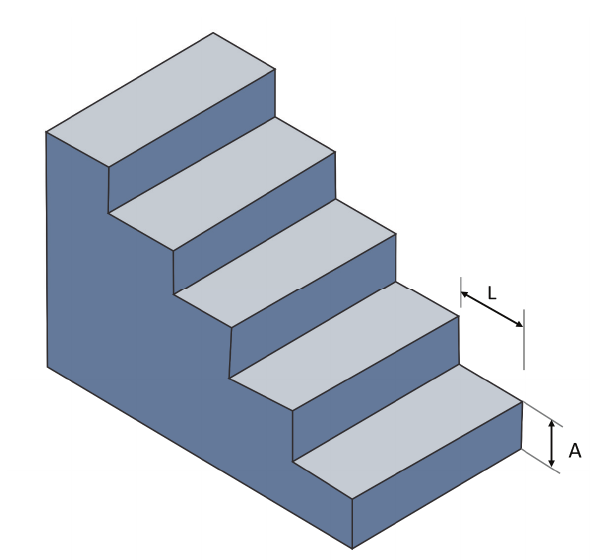
a) If $A = 16$, what are the possible values of $L$?
b) The height of the first floor of a townhouse is 2,52 meters, measured from one floor to the other. The architect designed the staircase to have the greatest length (sum of step widths) possible, respecting the aforementioned standards. That way, How many steps will the staircase have and what is the height and width of each one?
c) What are the largest and smallest possible values for the tangent of the angle of slope of a staircase constructed in accordance with this standard?
Note and adopt: The figure is merely illustrative and does not represent the ladder of statement.
Resolution
a) With $A = 16$: $63 \leq 32 + L \leq 64 \iff 31 \leq L \leq 32$.
Answer (a): $L$ can be any value between 31 cm and 32 cm ($31 \leq L \leq 32$).
b) 1. Number of steps. With $n$ equal steps, each has a height $A = \frac{252}{n}$ cm. The standard requires $16 \leq \frac{252}{n} \leq 18$, that is,
$$\frac{252}{18} \leq n \leq \frac{252}{16} \iff 14 \leq n \leq 15{,}75.$$As $n$ is an integer, $n = 14$ or $n = 15$.
2. Greater width for each case. For the length $n \cdot L$ to be the largest possible, $L$ should be the largest allowed: $2A + L = 64$, or $L = 64 - 2A$.
| Steps $n$ | Height $A = 252/n$ | Maximum width $L = 64 - 2A$ | Length $n \cdot L$ |
|---|---|---|---|
| 14 | 18 cm | 28 cm | $14 \cdot 28 = 392$ cm |
| 15 | 16,8 cm | 30,4 cm | $15 \cdot 30{,}4 = 456$ cm |
The longest length is with 15 steps.
Conference: $2 \cdot 16{,}8 + 30{,}4 = 64$ and $16 \leq 16{,}8 \leq 18$. Right.
Answer (b): 15 steps, each with a height of 16,8 cm and a width of 30,4 cm.
c) The slope of the ladder is that of each step: $\tan \alpha = \dfrac{A}{L}$.
- Largest tangent: we want $A$ big and $L$ small. According to the standard, $L \geq 63 - 2A$, then $\dfrac{A}{L} \leq \dfrac{A}{63 - 2A}$. This fraction grows with $A$ (the numerator increases and the denominator decreases), so the maximum is at $A = 18$: $\dfrac{18}{63 - 36} = \dfrac{18}{27} = \dfrac{2}{3}$.
- Smallest tangent: we want $A$ small and $L$ large. Like $L \leq 64 - 2A$, $\dfrac{A}{L} \geq \dfrac{A}{64 - 2A}$, which also grows with $A$; the minimum is in $A = 16$: $\dfrac{16}{64 - 32} = \dfrac{16}{32} = \dfrac{1}{2}$.
Both values are reached: $(A, L) = (18, 27)$ and $(A, L) = (16, 32)$ fulfill the norm.
Second way: writing $L = \frac{A}{t}$ with $t = \tan \alpha$, the condition $63 \leq 2A + \frac{A}{t} \leq 64$ turns $\frac{63}{A} - 2 \leq \frac{1}{t} \leq \frac{64}{A} - 2$. The highest possible value of $\frac{1}{t}$ is $\frac{64}{16} - 2 = 2$ (thus $t \geq \frac{1}{2}$), and the smallest is $\frac{63}{18} - 2 = \frac{3}{2}$ (then $t \leq \frac{2}{3}$). Same result.
Answer (c): the largest tangent is $\dfrac{2}{3}$ and the smallest is $\dfrac{1}{2}$.
To review, see Inequalities of real numbers.
Question M06: Real part, module and circumference (complex numbers)
Statement
A complex number is of the form $z = x + yi$, where $x, y \in \mathbb{R}$ and $i^2 = -1$.
a) Determine the value of $b \in \mathbb{R}$ so that the real part of the number complex $\dfrac{2 + bi}{1 + i}$ is equal to zero.
b) Determine the solution to equation $|z| - z = 1 + 2i$.
c) Determine the value of $a \in \mathbb{R}$, $a \neq 0$, so that the equation
$$az\bar{z} + (1 + i)z + \overline{(1 + i)z} + 1 = 0$$describe a circle in the Cartesian plane.
Resolution
a) Multiplying numerator and denominator by the conjugate of the denominator:
$$\frac{2 + bi}{1 + i} \cdot \frac{1 - i}{1 - i} = \frac{2 - 2i + bi - bi^2}{1 - i^2} = \frac{(2 + b) + (b - 2)i}{2}.$$The real part is $\dfrac{2 + b}{2}$, which is zero when $b = -2$.
Conference: $\dfrac{2 - 2i}{1 + i} = \dfrac{(2 - 2i)(1 - i)}{2} = \dfrac{2 - 4i + 2i^2}{2} = -2i$, which is pure imaginary.
Response (a): $b = -2$.
b) With $z = x + yi$, $|z| = \sqrt{x^2 + y^2}$ is real, and the equation becomes
$$\sqrt{x^2 + y^2} - x - yi = 1 + 2i.$$Equating the imaginary parts: $-y = 2$, then $y = -2$. Equating the parties real:
$$\sqrt{x^2 + 4} = 1 + x \Rightarrow x^2 + 4 = 1 + 2x + x^2 \Rightarrow x = \frac{3}{2}.$$(As we squared it, we see: $1 + x = \frac{5}{2} \geq 0$ and $\sqrt{\frac{9}{4} + 4} = \sqrt{\frac{25}{4}} = \frac{5}{2}$. Right.)
Conference in the original equation: $|z| = \frac{5}{2}$ and $\frac{5}{2} - \left(\frac{3}{2} - 2i\right) = 1 + 2i$.
Response (b): $z = \dfrac{3}{2} - 2i$.
c) With $z = x + yi$:
- $z\bar{z} = |z|^2 = x^2 + y^2$;
- $(1 + i)z = (1 + i)(x + yi) = (x - y) + (x + y)i$;
- Adding a number to its conjugate gives twice the real part: $(1 + i)z + \overline{(1 + i)z} = 2(x - y)$.
The equation becomes
$$a(x^2 + y^2) + 2x - 2y + 1 = 0.$$Dividing by $a \neq 0$ and completing squares:
$$\left(x + \frac{1}{a}\right)^2 + \left(y - \frac{1}{a}\right)^2 = \frac{2}{a^2} - \frac{1}{a} = \frac{2 - a}{a^2}.$$This is a circle (with center $\left(-\frac{1}{a}, \frac{1}{a}\right)$) if and only if, the right side is positive: $\frac{2 - a}{a^2} > 0 \iff a < 2$. If $a = 2$ equation represents a single point, and if $a > 2$ has no solution.
Second way (numerical example): with $a = 1$, the equation is $x^2 + y^2 + 2x - 2y + 1 = 0$, or $(x + 1)^2 + (y - 1)^2 = 1$: circumference of radius 1, according to $\frac{2 - 1}{1^2} = 1$. With $a = 3$ it would be $(x + \frac{1}{3})^2 + (y - \frac{1}{3})^2 = -\frac{1}{9}$, impossible.
Response (c): $a < 2$, with $a \neq 0$.