
Euler's Eyes
2022-08-03
Percentage Basics
The garden of a hundred flowers
Color 25%, 50% and 75%. How many flowers are colored in each case?
Percentage can be defined as a quantity in relation to another evaluated over a hundred. This quantity is a value between zero and 100. It is present in the news, financial markets and everyday life in general.
Decimal representation
Fractions can also be called proportions, ratios, rates or percentages. They depend on how we are going to use each of them in everyday applications.
The decimal representation is any fraction or rational number, which is a multiple of 10, for example:
$$100, 1000, 10000 , \dots$$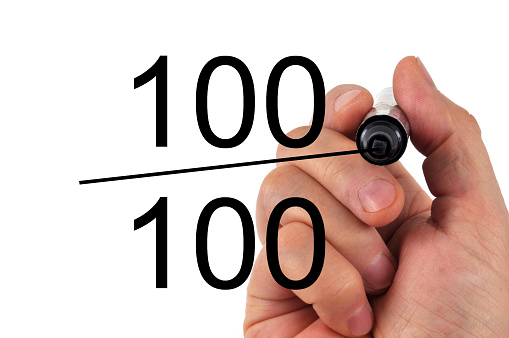
In this way, we will represent decimal numbers as:
The genesis of the percentage symbol
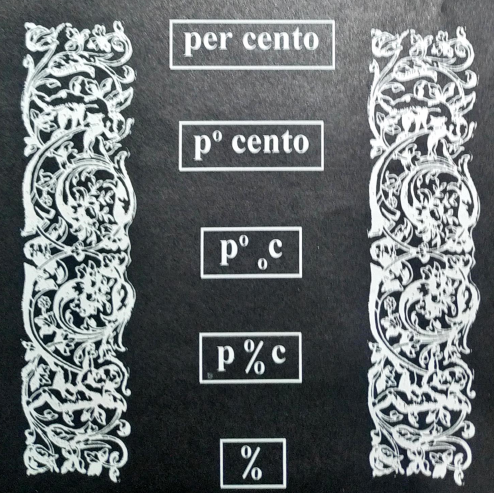
In Italian manuscripts from the 14th and 15th centuries, we notice the evolution of this symbol, which happened in a natural and curious way.

To understand this evolution, we just need to notice the contraction of an Italian word Celsius, a symbol used for temperature:

With this, they allowed other authors to write:
Percentage
Especially in the main school years, the first idea for understanding percentages is part for whole. In fractions we can indicate the relationship that exists between a number of parts and the total number of parts.
It is worth remembering that every fraction is also a ratio, but not every ratio can be expressed as a fraction. In this way, we will present the definitions:
Definition: Fraction is the result of the quotient between two whole numbers ($\mathbb{Z}$), which in the set of rationals ($\mathbb{Q}$), the fraction is a rational number.
Definition: Ratio is the result of the quotient between any two numbers. Here we have not yet defined the other sets, besides the rational ones. Thus, for now the ratio is the result of the quotient between two numbers.
Example: Family with children
$$\dfrac{2 \text{ filhas meninas } }{10 \text{ filhos no total} } = \dfrac{\text{ parte } }{ \text{ todo} }$$Problem: Suppose a family has 10 children, with 2 girls and 8 boys. If the question is what is the ratio of girls in relation to the total number of children, we can answer:

Example with children’s height
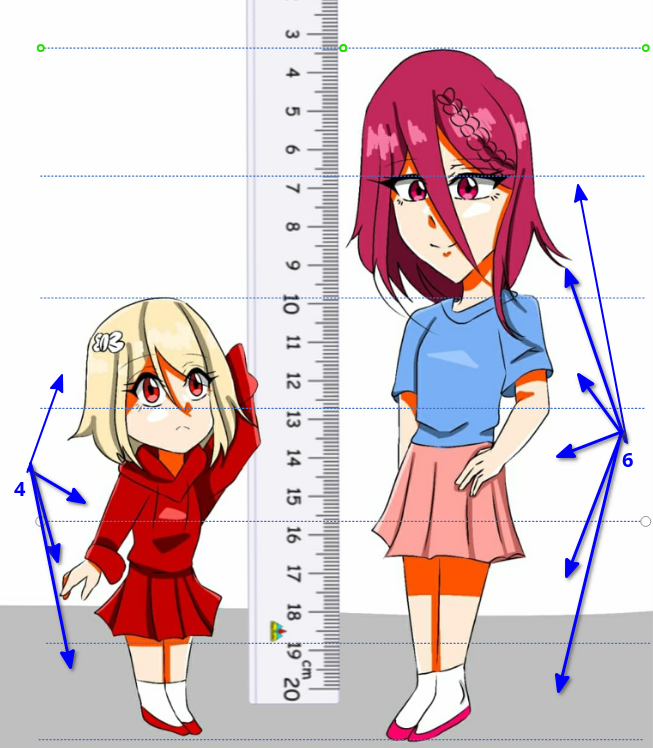
Next we will present two girls Terumi (left) and Naomi (right), each with different (distinct) heights. In this case, we say that:
- Terumi’s height is $\dfrac{4}{6}=\dfrac{2}{3}$ the height of Naomi
- Nami’s height is $\dfrac{6}{4}=\dfrac{3}{2}$ the height of Naomi
Equivalence between ratio and percentage
The percentage will be presented as fractions (ratios) between two quantities, where the result of this ratio is a number between zero and 1. For example:
Basically those where the numerator is greater than the denominator. The reasons in which the numerator is greater than the denominator, we will classify as rates.
The percentage is to represent a rational number between zero and 1, as a number in decimal representation as follows:
Application for fixing the percentage concept
To finish the post, we will exercise our thinking with an app we made to understand the transition from ratio to percentage.
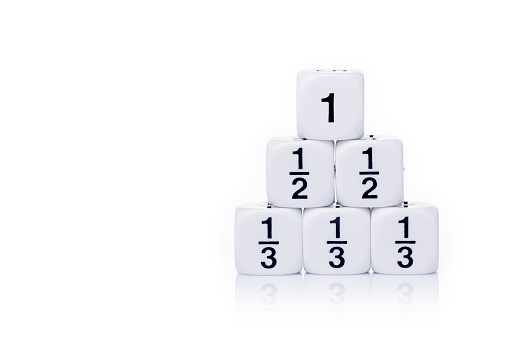
| Fractions | Fractions represented graphically |
|---|---|
|
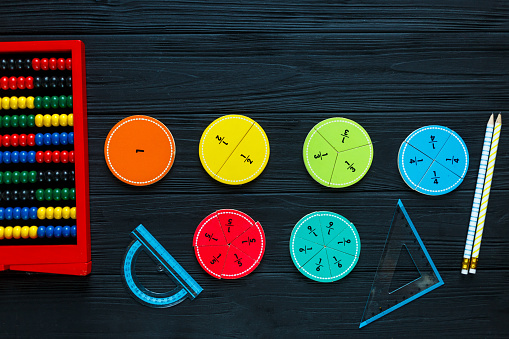
|
Now they can interact with the App following percentages.
This is a summary for percentage. In the next posts, we will talk about other concepts of rational numbers.