
Euler's Eyes
2020-06-19
OBMEP 2019 - Second Phase
In this post we will resolve the OBMEP 2019 questions with comments.
Question 1
Marcelo throws five rings onto a wooden peg, one at a time. When the ring hits the pin, he earns points, as shown in the table below. When the ring doesn’t hit the pin, he doesn’t get any points. The figure shows five throws made by Marcelo, in which only the blue and green rings hit the pin. Note that the green ring was the last one thrown, as it was on top of the others
| Release number | Number of points |
|---|---|
| 1º | 10 |
| 2º | 5 |
| 3º | 3 |
| 4º | 1 |
| 5º | 1 |
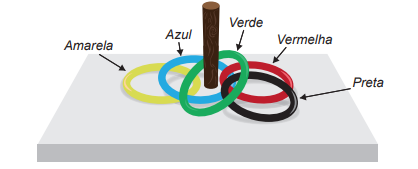
Q1 Item a
a) How many points did Marcelo score with the five throws shown in the figure above?

- 1st throw: out $\rightarrow$ 0 point.
- 2nd throw: hit $\rightarrow$ 5 points
- 3rd throw: out $\rightarrow$ 0 point.
- 4th throw: out $\rightarrow$ 0 point.
- 5th throw: hit $\rightarrow$ 1 points.
Q1 Item b
b) In five other throws, Marcelo only missed one of them and scored 17 points. What was the throw number he missed?
| Release number | Number of points |
|---|---|
| 1º | $10$ |
| 2º | $5$ |
| 3º | $\cancel{3}$ |
| 4º | $1$ |
| 5º | $1$ |
The third throw was wrong, because $10+5+1+1=17$ points.
Q1 Item c
c) The figure below shows what five other launches made by Marcelo looked like. If the third ring thrown was the red one, what is the highest score he could have gotten from those throws?

- 3rd red throw: out $\rightarrow$ -3 points.
- 2nd black throw: before the red one out $\rightarrow$ -5 points.
- Maximum score: 1st successful launch $\rightarrow$ +10 points.
- Minimum surplus: 5th throw out $\rightarrow$ -1 points.
- Leftover hit: 4th throw hit $\rightarrow$ +1 points.
Question 2
Roberta has two cards, one with the numbers 1 to 15 and the other with the numbers 16 to 30. She chooses a number from each card and calculates their sum.
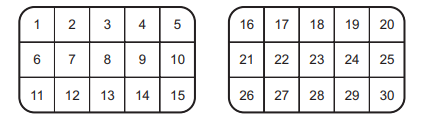
Q2 Item A
a) What are the possible choices for Roberta to obtain the sum 18?

The choices for sum 18 are:
- $1+17=18$
- $2+16=18$
Q2 Item B
b) If Roberta makes all possible choices, how many different results can she obtain?

| Type | Sum | Result |
|---|---|---|
| Largest Sum | $1+16$ | $17$ |
| Smallest Sum | $15+30$ | $45$ |
In this way, the set of possible choices are the natural numbers between 17 and 45.
$$\text{escolhas} = \\{17, 18,19,20,21,22,23,24,25,26,27,28,29,30,31,32,33,34,35,36,37,38,39,40,41,42,43,44,45\\}$$To avoid miscalculating, see:
- If results 17 to 18: $$\text{resultado}=(18-17) + 1 = 2\text{ possibilidades}$$
- If results 17 to 20: $$\text{resultado}=(20-17) + 1 = 4\text{ possibilidades}$$
The number of possibilities is:
$$\text{possibilidades} = \text{diferença}+1 = (45-17) +1 = 29$$Therefore, the number of possibilities is $29.$
Q2 Item C
c) If Roberta makes all possible choices, which result will appear most often? Why?
The number that appears most often is the average of the sums.
$$\text{média} =\dfrac{\text{soma} }{\text{número de termos} }$$Remember Gauss? At 5 years of age, he found the sum of the terms of an arithmetic progression. As? A teacher made the students add from 1 to 100. Gauss calculated it at 1 min.
Put the numbers in ascending and descending order.
Now, let’s go back to the item.
$$\text{soma} = \dfrac{(17+45)~.~29}{2}=\dfrac{62 ~.~29}{2} = 31~.~29$$Average calculation:
$$\text{média} =\dfrac{\text{soma} }{\text{número de termos} } = \dfrac{31~.~\cancel{29} }{\cancel{29} }=31$$This fact is due to the law of large numbers, but let’s see visually.
| row/column | $1$ | $2$ | $3$ | $\dots$ | $15$ |
|---|---|---|---|---|---|
| $16$ | $1+16$ | $2+16$ | $3+16$ | $\dots$ | $\color{red}{15+16}$ |
| $17$ | $1+17$ | $2+17$ | $3+17$ | $\dots$ | $15+17$ |
| $\vdots$ | $\vdots$ | $\vdots$ | $\vdots$ | $\dots$ | $\vdots$ |
| $28$ | $1+28$ | $2+28$ | $\color{red}{3+28}$ | $\dots$ | $15+28$ |
| $29$ | $1+29$ | $\color{red}{2+29}$ | $3+17$ | $\dots$ | $15+29$ |
| $30$ | $\color{red}{1+30}$ | $2+17$ | $3+17$ | $\dots$ | $15+30$ |

Question 3
Paulinho has pieces with five different shapes (cubes, pyramids, spheres, cylinders and cones). Pieces with the same shape have the same weight (mass). He places some pieces on a scale and observes the balance in the two situations below.

Q3 Item A
a) Indicate whether the figures below represent right or wrong situations.
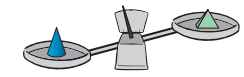
- Right
- Wrong
That’s right, because they need the cone to have more mass than two objects (pyramid + cylinder)
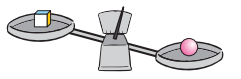
- Right
- Wrong
That’s right, because they need the sphere to have more mass than two objects (cube + cylinder)
Q3 Item B
b) Which of the figures below represents the correct situation?

Only C is correct, because:
- A cone is equal to (pyramid + cone)
- Right side: (pyramid + cylinder + cube)
- A sphere is equal (cube + cylinder)
- Left side: (pyramid + cylinder + cube)

Q3 Item C
c) With some known weights, Paulinho observed the equilibrium situation below. How much do a cube, a pyramid, a sphere, a cylinder and a cone weigh together?
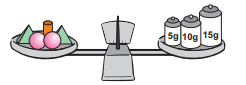
From the hypothesis we have:
$$\text{2 pirâmides + 2 esferas + 1 cone } = 5+10+15 = 30 \text{ gramas} $$Just change:
- 1 sphere by 1 cube + 1 cylinder
- 1 cylinder + 1 pyramid by 1 cone
- Result 1 sphere + 1 pyramid + 1 cone + 1 cube + 1 cylinder is equal to 30 grams.

Question 4
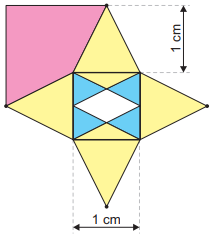
In the figure, the square has side 1 cm. The four blue triangles are the same, as are the two smaller yellow triangles. The four largest yellow triangles each have a base equal to the side of the square, a height in relation to this base equal to 1 cm, and their other two sides have the same measurement. Two sides of the pink quadrilateral are parallel to the sides of the square. In the figure, the square has side 1 cm. The four blue triangles are the same, as are the two smaller yellow triangles. The four largest yellow triangles each have a base equal to the side of the square, a height in relation to this base equal to 1 cm, and their other two sides have the same measurement. Two sides of the pink quadrilateral are parallel to the sides of the square
Q4 Item A
a) What is the area of the region formed by the blue triangles?
From the figure we obtain:
- 16 Total triangles
- Area of the square 1 cm²
- 8 blue triangles
- Area half the area of the square, which is 0.5 cm²

Q4 Item B
b) What is the area of the region formed by the yellow triangles?
The yellow parts correspond to:
- 4 large yellow triangles glued to the central square.
- 4 small yellow triangles in the central square.
Area of the large triangle:
$$A_{\text{triângulo grande} } = \dfrac{1~.~1}{2}= \dfrac{1}{2}cm^2$$4 large triangles:
$$4~.~A_{\text{triângulo grande} } = \dfrac{4}{2}= 2cm^2$$Area of the square 1 cm² equal to 16 small triangles:
$$A_{\text{triângulo pequeno} } = \dfrac{1 \text{ quadrado} }{16 \text{ triângulos pequenos} } ~.~ 4 \text{ triângulos pequenos}= \dfrac{1}{4}cm^2$$
Therefore, the total area:
Q4 Item C
c) What is the area of the pink quadrilateral?

- From item b we have that the area of the large triangle is 0.5 cm²
- From the statement, the area of the square is 1 cm²
- Therefore, total $A_{\text{total}} = 1 + 0.5 = 1.5 cm^2$
Question 5
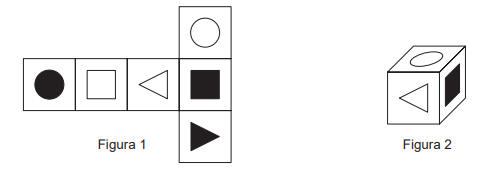
Figure 1 is a planification of a cube. By making the necessary folds and gluing the loose edges, we obtain the cube in Figure 2.
Q5 Item A
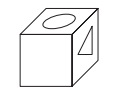
a) In another view of the same cube, shown below, the drawing on the front face is missing. Make this drawing.

Q5 Item B
b) Below we have two other views of the same cube, each with the front face without a drawing. Draw the missing drawings on these faces.
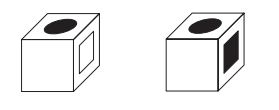

Response:
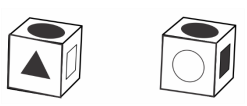
Q5 Item C
c) Below we have another plan of the same cube. Make the missing drawings in this planning.
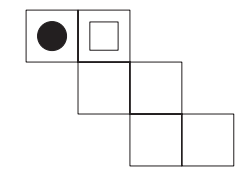
Response:

Question 6
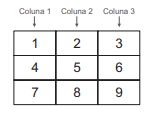
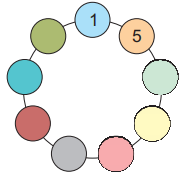
The numbers in the table below will be placed in the colored circles so that none of them appears more than once and the sum of the numbers in three consecutive circles is always a multiple of 3.
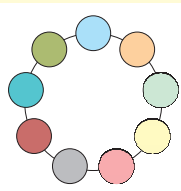
Q6 Item A
a) Complete the form below.
Response:

In fact:
- $1+5+3=9 \qquad \Rightarrow \qquad \div 3$ ok.
- $5+3+4=12 \qquad \Rightarrow \qquad \div 3$ ok.
- $3+4+2=9 \qquad \Rightarrow \qquad \div 3$ ok.
- $4+2+6=12 \qquad \Rightarrow \qquad \div 3$ ok.
- $2+6+7=15 \qquad \Rightarrow \qquad \div 3$ ok.
- $6+7+8=21 \qquad \Rightarrow \qquad \div 3$ ok.
- $7+8+9=24 \qquad \Rightarrow \qquad \div 3$ ok.
- $8+9+1=18 \qquad \Rightarrow \qquad \div 3$ ok.
- $9+1+5=15 \qquad \Rightarrow \qquad \div 3$ ok.
Q6 Item B
b) Explain why, in any filling, three consecutive circles will always be filled with different column numbers in the table.
Response:
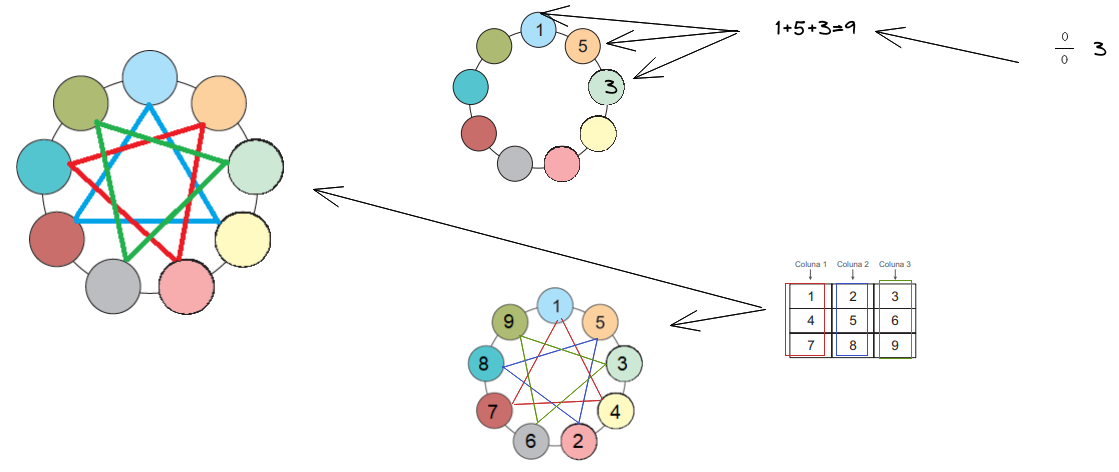
Note from the figure that any combination other than different columns (column 1, column, column 3) is not a multiple of 3. Furthermore, there will come a moment that will hurt one of the assumptions, which is neighbors in the same column.
Q6 Item C
c) How many different fillings are possible?
Response:
