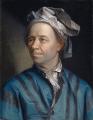
Euler's Eyes
2026-10-27
Vectors and scalars: Hamilton's words
In a quaternion $q = a + bi + cj + dk$ there are two parts of different kinds. The number $a$ stays put on the line of real numbers; the part $bi + cj + dk$ points in a direction in space. In 1846 Hamilton named them: the first is the scalar, because it can be read off a scale, from less to more; the second is the vector, from the Latin vector, “carrier”, because it carries one point to another. Both words caught on, and today they are used by people who have never heard of quaternions.
Two products in one
Multiply two pure vectors, $u = u_1 i + u_2 j + u_3 k$ and $v = v_1 i + v_2 j + v_3 k$, with the rules from the bridge. After distributing the nine products and collecting terms, the result is
$$uv = -(u_1 v_1 + u_2 v_2 + u_3 v_3) + (u_2 v_3 - u_3 v_2)\,i + (u_3 v_1 - u_1 v_3)\,j + (u_1 v_2 - u_2 v_1)\,k.$$The scalar part is minus the dot product $u \cdot v$; the vector part is the cross product $u \times v$:
$$uv = -\,u \cdot v + u \times v.$$The two products every physics student learns, one measuring how far two vectors point the same way and the other giving the direction perpendicular to both, were born together, as the two halves of a multiplication of quaternions. Hamilton also introduced the differential operator now written $\nabla$, and with it the gradient, the divergence and the curl appeared as parts of the same symbol.
The quaternion war
After Hamilton’s death, the Scot Peter Guthrie Tait became the great champion of quaternions and tried to persuade his friend James Clerk Maxwell to write electromagnetism with them. Maxwell used the notation in part of his 1873 Treatise, but without enthusiasm. In the 1880s the American Josiah Willard Gibbs and the Englishman Oliver Heaviside did what Hamilton had refused to do: they separated the two products, threw away the whole quaternion and kept only vectors, the dot product and the cross product. A bitter dispute followed, in the pages of Nature, between the partisans of the two notations. Gibbs’s and Heaviside’s vectors won in the physics books; quaternions came back a century later, in computers.
Quaternions came from Hamilton after his really good work had been done; and, though beautifully ingenious, have been an unmixed evil to those who have touched them in any way, including Clerk Maxwell.
— Lord Kelvin, letter of 1892
Exercise: a complete product
Compute $(2i + j)(i - k)$ as a product of quaternions and check it against the dot and cross products.
$(2i + j)(i - k) = 2i^2 - 2ik + ji - jk = -2 + 2j - k - i$. By the formula: $u \cdot v = 2 \cdot 1 + 1 \cdot 0 + 0 \cdot (-1) = 2$ and $u \times v = (1 \cdot (-1) - 0 \cdot 0,\; 0 \cdot 1 - 2 \cdot (-1),\; 2 \cdot 0 - 1 \cdot 1) = (-1, 2, -1)$. So $uv = -2 - i + 2j - k$. It checks.
Exercise: perpendiculars anticommute
Show that two vectors $u$ and $v$ are perpendicular if and only if $uv = -vu$.
Since $u \times v = -\,v \times u$ and $u \cdot v = v \cdot u$, we have $vu = -u \cdot v - u \times v$. So $uv = -vu$ means $-u \cdot v + u \times v = u \cdot v + u \times v$, that is, $u \cdot v = 0$: the vectors are perpendicular. That is why $ij = -ji$.
Sources: William Rowan Hamilton, “On Quaternions”, Philosophical Magazine (1844–1850) · Michael J. Crowe, A History of Vector Analysis (1967) · J. Willard Gibbs, Elements of Vector Analysis (1881–1884) · Oliver Heaviside, Electromagnetic Theory, vol. 1 (1893).
All topics on William Rowan Hamilton · ← Rotating in space with quaternions · The Cayley–Hamilton theorem →