
Euler's Eyes
2026-10-14
Light is an electromagnetic wave
We can scarcely avoid the inference that light consists in the transverse undulations of the same medium which is the cause of electric and magnetic phenomena.
— James Clerk Maxwell, “On physical lines of force” (1862), with the original italics
In the summer of 1861, at Glenlair, far from his books, Maxwell did a calculation with his model of vortices and little wheels: if the medium that transmits electric and magnetic forces were shaken, the disturbance would travel as a wave. At what speed? The calculation gave a number that depended only on two constants measured in the laboratory with magnets and charges. He did not have the values to hand. When he returned to London in October, he looked them up. The number was the speed of light.
The wave equation
Let us redo the calculation with the equations in today’s form. In a place with no charges and no currents, $\rho=0$ and $\mathbf J=0$, and the equations become
$$\nabla\cdot\mathbf E=0,\qquad\nabla\cdot\mathbf B=0,\qquad\nabla\times\mathbf E=-\frac{\partial\mathbf B}{\partial t},\qquad\nabla\times\mathbf B=\mu_0\varepsilon_0\frac{\partial\mathbf E}{\partial t}.$$Take the curl of the third:
$$\nabla\times(\nabla\times\mathbf E)=-\frac{\partial}{\partial t}(\nabla\times\mathbf B)=-\mu_0\varepsilon_0\frac{\partial^2\mathbf E}{\partial t^2},$$using the fourth. On the left, a vector identity says that $\nabla\times(\nabla\times\mathbf E)=\nabla(\nabla\cdot\mathbf E)-\nabla^2\mathbf E$, and the first term is zero by the first equation. What is left is
$$\boxed{\nabla^2\mathbf E=\mu_0\varepsilon_0\,\frac{\partial^2\mathbf E}{\partial t^2}.}$$This is the wave equation, the same as for d’Alembert’s vibrating strings and for sound. In a wave equation $\nabla^2u=\frac1{v^2}\frac{\partial^2u}{\partial t^2}$, the speed of the wave is $v$. Here, then,
$$v=\frac{1}{\sqrt{\mu_0\varepsilon_0}}.$$The number
With today’s values, $\varepsilon_0\approx8.854\times10^{-12}$ F/m and $\mu_0\approx1.257\times10^{-6}$ H/m,
$$v=\frac1{\sqrt{8.854\times10^{-12}\cdot1.257\times10^{-6}}}\approx2.998\times10^8\ \text{m/s}=299{,}792\ \text{km/s}.$$In 1862 Maxwell used the constant measured in 1856 by the Germans Wilhelm Weber and Rudolf Kohlrausch, with discharges from a Leyden jar, and obtained 310,740 km/s. The best measurement of the speed of light, made by the Frenchman Hippolyte Fizeau in 1849 with a toothed wheel and a mirror 8 km away, gave 314,858 km/s. The two numbers, obtained by routes that had nothing to do with each other, one with magnets and the other with mirrors, differed by little more than 1%. Hence the sentence in the quotation, which Maxwell wrote in italics.
What the wave looks like
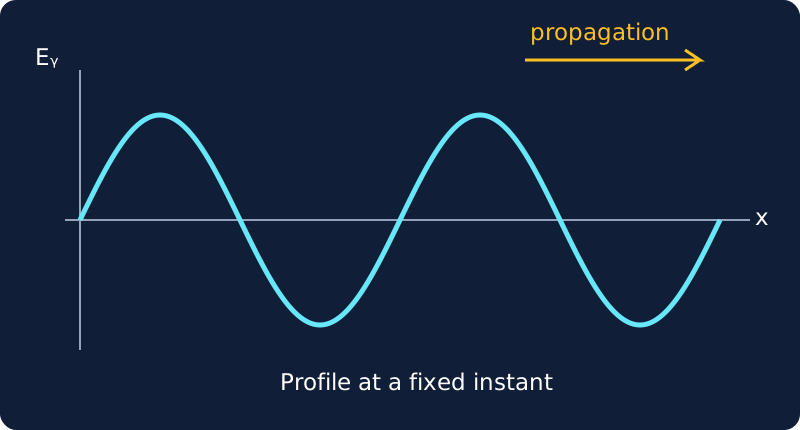
The simplest solution is a plane wave travelling in the $x$ direction:
$$\mathbf E=E_0\cos(kx-\omega t)\,\hat{\mathbf y},\qquad\mathbf B=\frac{E_0}{c}\cos(kx-\omega t)\,\hat{\mathbf z},$$with $\omega=ck$. The electric field oscillates in the $y$ direction, the magnetic field in the $z$ direction, and both are perpendicular to the direction in which the wave travels: the wave is transverse, as Maxwell predicted, and that is why light can be polarised, something already known since the eighteenth century. The magnetic field is $c$ times smaller, and the two oscillate together, in phase.
Hertz and the spectrum
Nothing in the equations limited the frequency. If visible light was an electromagnetic wave with some 500 trillion oscillations per second, there should be waves of any frequency, slower and faster. Maxwell died in 1879 without seeing them. In 1887 the German Heinrich Hertz produced sparks in a circuit and detected, on the other side of the room, sparks induced in a loop of wire: they were electromagnetic waves a few metres long, which were reflected, refracted and travelled at the speed of light. Asked what they were good for, Hertz replied that they were good for nothing: they only proved that Maxwell was right. Seven years later, Marconi was beginning to make radio.
Today, since $c=\lambda f$, we can read the whole spectrum with one calculation:
| Wave | Frequency | Wavelength |
|---|---|---|
| FM radio | 100 MHz | 3 m |
| Microwaves and wi-fi | 2.45 GHz | 12 cm |
| Green light | $6\times10^{14}$ Hz | 500 nm |
| X-rays | $3\times10^{18}$ Hz | 0.1 nm |
Exercise: what is the wavelength of an AM radio station at 1,000 kHz?
$\lambda=\frac cf=\frac{3\times10^8}{10^6}=300$ m. That is why AM radio antennas are huge towers: they are usually an appreciable fraction of the wavelength, tens of metres.
Exercise: a red laser at 650 nm. What is its frequency? How many oscillations does the field make while the light travels 1 metre?
$f=\frac c\lambda=\frac{3\times10^8}{650\times10^{-9}}\approx4.6\times10^{14}$ Hz. One metre holds $\frac{1}{650\times10^{-9}}\approx1.54$ million wavelengths: the field oscillates 1.5 million times over that stretch.
Sources: James Clerk Maxwell, “On physical lines of force”, part III, Philosophical Magazine 23 (1862) · Heinrich Hertz, Electric Waves (1893) · The Feynman Lectures on Physics, volume II, chapter 20.
All topics on James Clerk Maxwell · ← The displacement current: the missing term · The legacy of James Clerk Maxwell →