
Euler's Eyes
2026-11-04
EJU 2017 (2nd session) – Mathematics Course 1 solved
Source: JASSO – Mathematics paper in English, in Japanese and official answer key. Files on the page for the 2nd session of 2017.
Course 1 is the basic mathematics paper of the EJU. Each letter $\boxed{\text{A}}$, $\boxed{\text{B}}$, … is a digit from 0 to 9 or the minus sign. The statements below are summarized from the official English version.
Answer key
| Question | Topic | Answers |
|---|---|---|
| I Q1 | Minimum under constraints | A=1, B=8, C=1, DE=−2, F=4, G=0, HI=−1, JK=−1, LM=−3 |
| I Q2 | A ball on a triangle | N=9, O=7, PQ=54, RS=13, TUV=108, WX=13, YZ=36 |
| II Q1 | Irrational root and inequality | A=5, B=1, C=6, D=2, E=5, F=2, GH=−4, I=2, J=5, K=1, L=2 |
| II Q2 | A parabola on an interval | M=2, N=4, O=3, P=4, Q=1, R=1, S=7, T=4, U=4 |
| III | Sets and squares | AB=16, C=4, D=9, E=4, F=2, GH=22, I=3, J=2, K=3, L=4, MN=16 |
| IV | Distance between two centers | A=7, B=8, CD=15, E=8, FG=16, HI=15, JK=15, L=4, MN=15, OP=15, QR=28, ST=15, UV=15, W=8, XY=15, Z=5 |
Question I
Q1: the minimum of a quadratic under constraints
Statement. The function $f(x) = 2x^2 + ax - 1$ satisfies $f(-1) \ge -3$ and $f(2) \ge 3$ ①. Let $m$ be the minimum value of $f(x)$.
- $m = -\dfrac{\boxed{\text{A}}}{\boxed{\text{B}}}a^2 - \boxed{\text{C}}$.
- The values of $a$ satisfying ① are $\boxed{\text{DE}} \le a \le \boxed{\text{F}}$.
- $m$ is largest when the axis of symmetry is $x = \boxed{\text{G}}$, and then $m = \boxed{\text{HI}}$.
- $m$ is smallest when the axis is $x = \boxed{\text{JK}}$, and then $m = \boxed{\text{LM}}$.
Solution.
1. $f(x) = 2\left(x + \frac a4\right)^2 - \frac{a^2}{8} - 1$, so $m = -\frac18a^2 - 1$ (with axis $x = -\frac a4$).
2. $f(-1) = 1 - a \ge -3$ gives $a \le 4$; $f(2) = 7 + 2a \ge 3$ gives $a \ge -2$.
3. On $[-2, 4]$, $m$ is largest at $a = 0$ (axis $x = 0$, $m = -1$) and smallest at the $a$ of largest absolute value, $a = 4$ (axis $x = -1$, $m = -2 - 1 = -3$).
Answers: A=1, B=8, C=1, DE=−2, F=4, G=0, HI=−1, JK=−1, LM=−3.
Q2: a ball moving on a triangle
Statement. On a triangle $ABC$ drawn in the plane, a ball starts at vertex $A$. A die is rolled and the ball moves by these rules:
- if the ball is at $A$ and 1 comes up, it moves to $B$; otherwise it stays at $A$;
- if the ball is at $B$ and 4 or less comes up, it moves to $C$; otherwise it stays at $B$.
When the ball reaches $C$, we stop. We want the probability that the ball reaches $C$ within 4 rolls.
- The probability of reaching $C$ on the 2nd roll is $\dfrac{1}{\boxed{\text{N}}}$.
- On the 3rd roll: $\dfrac{\boxed{\text{O}}}{\boxed{\text{PQ}}}$.
- On the 4th roll: $\dfrac{\boxed{\text{RS}}}{\boxed{\text{TUV}}}$.
So the probability of reaching $C$ within 4 rolls is $\dfrac{\boxed{\text{WX}}}{\boxed{\text{YZ}}}$.
Solution. At $A$, the ball leaves with probability $\frac16$ and stays with $\frac56$. At $B$, it leaves with $\frac23$ and stays with $\frac13$. To reach $C$ exactly on roll $n$, the ball leaves $A$ on some roll $k < n$, stays at $B$ on rolls $k + 1$ to $n - 1$ and leaves $B$ on roll $n$:
$$P_n = \sum_{k=1}^{n-1}\left(\frac56\right)^{k-1}\cdot\frac16\cdot\left(\frac13\right)^{n-1-k}\cdot\frac23.$$- $n = 2$: $\frac16\cdot\frac23 = \frac19$.
- $n = 3$: $\frac16\cdot\frac13\cdot\frac23 + \frac56\cdot\frac16\cdot\frac23 = \frac{4}{108} + \frac{10}{108} = \frac{7}{54}$.
- $n = 4$: $\frac{1}{6}\cdot\frac19\cdot\frac23 + \frac56\cdot\frac16\cdot\frac13\cdot\frac23 + \frac{25}{36}\cdot\frac16\cdot\frac23 = \frac{4 + 10 + 25}{324} = \frac{39}{324} = \frac{13}{108}$.
(Reaching $C$ on the 1st roll is impossible.) Adding up: $\frac{12 + 14 + 13}{108} = \frac{39}{108} = \frac{13}{36}$.
Answers: N=9, O=7, PQ=54, RS=13, TUV=108, WX=13, YZ=36.
Question II
Q1: an irrational root and an inequality
Statement. Let $a, b$ be rational and $p$ real. The equation $x^2 + ax + b = 0$ ① has the solution $x = \frac{\sqrt5 + 3}{\sqrt5 + 2}$; consider also the inequality $x + 1 < 2x + p + 3$ ②.
- Rationalizing, $x = \sqrt{\boxed{\text{A}}} - \boxed{\text{B}}$. Substituting into ①, $-a + b + \boxed{\text{C}} + \left(a - \boxed{\text{D}}\right)\sqrt{\boxed{\text{E}}} = 0$, so $a = \boxed{\text{F}}$, $b = \boxed{\text{GH}}$.
- The smallest integer $p$ for which both solutions of ① satisfy ②. Solving ②, $x > -p - \boxed{\text{I}}$. Since both solutions satisfy this, $p > \sqrt{\boxed{\text{J}}} - \boxed{\text{K}}$, and the smallest integer is $\boxed{\text{L}}$.
Solution.
1. $x = \frac{(\sqrt5 + 3)(\sqrt5 - 2)}{5 - 4} = 5 - 2\sqrt5 + 3\sqrt5 - 6 = \sqrt5 - 1$. Substituting: $(6 - 2\sqrt5) + a(\sqrt5 - 1) + b = (-a + b + 6) + (a - 2)\sqrt5 = 0$. Since $a$ and $b$ are rational and $\sqrt5$ is not, both parts vanish: $a = 2$ and $b = -4$.
2. The equation is $x^2 + 2x - 4 = 0$, with roots $-1 \pm \sqrt5$. Inequality ② gives $x > -p - 2$. The smaller root must satisfy it: $-1 - \sqrt5 > -p - 2$, that is, $p > \sqrt5 - 1 \approx 1.24$. The smallest integer is $2$.
Answers: A=5, B=1, C=6, D=2, E=5, F=2, GH=−4, I=2, J=5, K=1, L=2.
Q2: a parabola that maps an interval onto itself
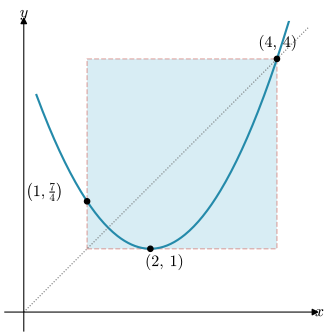
Statement. Let $f(x) = \frac34x^2 - 3x + 4$, and let $a, b$ be real numbers with $0 < a < b$ and $2 < b$. We want $a$ and $b$ such that the values of $f$ on $a \le x \le b$ are exactly $a \le y \le b$.
The axis of symmetry is $x = \boxed{\text{M}}$; we split into (i) $\boxed{\text{M}} \le a$ and (ii) $0 < a < \boxed{\text{M}}$. In case (i), $f$ increases on $[a, b]$, so $f(a) = a$ and $f(b) = b$, giving $a = \dfrac{\boxed{\text{N}}}{\boxed{\text{O}}}$ and $b = \boxed{\text{P}}$; but this $a$ does not satisfy (i). In case (ii), the minimum of $f$ on $[a, b]$ is $\boxed{\text{Q}}$, so $a = \boxed{\text{R}}$, which satisfies (ii). Since $f(a) = \dfrac{\boxed{\text{S}}}{\boxed{\text{T}}} < b$, we have $f(b) = b$, and $b = \boxed{\text{U}}$.
Solution.
1. $f(x) = \frac34(x - 2)^2 + 1$: axis $x = 2$, minimum $1$.
2. Case (i). $f(x) = x$ gives $\frac34x^2 - 4x + 4 = 0$, or $3x^2 - 16x + 16 = (3x - 4)(x - 4) = 0$: $x = \frac43$ or $4$. So $a = \frac43$ and $b = 4$, but $\frac43 < 2$, a contradiction.
3. Case (ii). The vertex lies in $[a, b]$, and the smallest value of $f$ is $1$; since this value must be $a$, $a = 1$. Then $f(1) = \frac74$. The largest value of $f$ on the interval is $\max\{f(1), f(b)\}$, and it must be $b$; since $f(1) = \frac74 < 2 < b$, we need $f(b) = b$ with $b > 2$: $b = 4$. (Check: on $[1, 4]$, $f$ goes from $1$ to $f(4) = 4$.)
Answers: M=2, N=4, O=3, P=4, Q=1, R=1, S=7, T=4, U=4.
Question III: a set and its squares
Statement. The natural numbers $a, b, c, d$ satisfy $1 < a < b < c < d$, and the sets $A = \{a, b, c, d\}$ and $B = \{a^2, b^2, c^2, d^2\}$ satisfy:
- $A \cap B$ has exactly two elements, whose sum is between 15 and 25 (inclusive);
- the sum of the elements of $A \cup B$ is at most 300.
Let $A \cap B = \{x, y\}$ with $x < y$. Since $x, y \in B$, (i) implies $y = \boxed{\text{AB}}$ and $x$ is $\boxed{\text{C}}$ or $\boxed{\text{D}}$ ($\boxed{\text{C}} < \boxed{\text{D}}$). By (ii), $x = \boxed{\text{E}}$, so $A$ contains $\boxed{\text{F}}$, $\boxed{\text{F}}^2$ and $\boxed{\text{F}}^4$. If $z$ is the remaining element of $A$, by (ii) $z^2 + z \le \boxed{\text{GH}}$, and $z = \boxed{\text{I}}$. So $a = \boxed{\text{J}}$, $b = \boxed{\text{K}}$, $c = \boxed{\text{L}}$ and $d = \boxed{\text{MN}}$.
Solution.
1. The candidates. $x$ and $y$ are in $B$, so they are perfect squares greater than 1: $4, 9, 16, 25, \dots$ The sums of two of them between 15 and 25 are $4 + 16 = 20$ and $9 + 16 = 25$. So $y = 16$ and $x \in \{4, 9\}$.
2. Ruling out $x = 9$. If $9$ and $16$ are in both $A$ and $B$, then $3$ and $4$ are in $A$ (because $9 = 3^2$ and $16 = 4^2$ are in $B$). Then $A = \{3, 4, 9, 16\}$, $B = \{9, 16, 81, 256\}$ and the union sums to $3 + 4 + 9 + 16 + 81 + 256 = 369 > 300$.
3. With $x = 4$. $4 \in B$ gives $2 \in A$; $16 \in B$ gives $4 \in A$; and $16 \in A$. So $A \supset \{2, 4, 16\}$ and $B \supset \{4, 16, 256\}$. With the fourth element $z$, the union sums to $2 + 4 + 16 + 256 + z + z^2 \le 300$, that is, $z^2 + z \le 22$, or $z \le 4$. Since $z \notin \{2, 4\}$ and $z > 1$, $z = 3$.
4. $A = \{2, 3, 4, 16\}$, $B = \{4, 9, 16, 256\}$ and $A \cap B = \{4, 16\}$, with sum $20$. ✓
Answers: AB=16, C=4, D=9, E=4, F=2, GH=22, I=3, J=2, K=3, L=4, MN=16.
Question IV: the distance between two centers
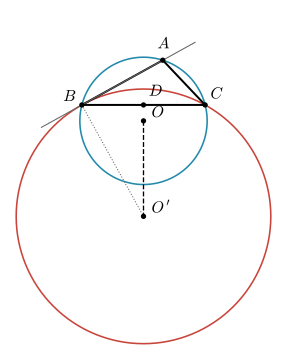
Statement. Triangle $ABC$ has $AB = 6$, $BC = 8$ and $CA = 4$. Let $O'$ be the center of the circle through $B$ and $C$ tangent to line $AB$, and $O$ the circumcenter of $ABC$. We want $OO'$.
- $\cos\angle ABC = \dfrac{\boxed{\text{A}}}{\boxed{\text{B}}}$ and $\sin\angle ABC = \dfrac{\sqrt{\boxed{\text{CD}}}}{\boxed{\text{E}}}$.
- The circumradius is $\dfrac{\boxed{\text{FG}}\sqrt{\boxed{\text{HI}}}}{\boxed{\text{JK}}}$.
- Let $D$ be the intersection of line $OO'$ with side $BC$. Then $OD = \dfrac{\boxed{\text{L}}\sqrt{\boxed{\text{MN}}}}{\boxed{\text{OP}}}$ and $O'D = \dfrac{\boxed{\text{QR}}\sqrt{\boxed{\text{ST}}}}{\boxed{\text{UV}}}$, and $OO' = \dfrac{\boxed{\text{W}}\sqrt{\boxed{\text{XY}}}}{\boxed{\text{Z}}}$.
Solution.
1. $\cos B = \frac{36 + 64 - 16}{2\cdot6\cdot8} = \frac{84}{96} = \frac78$ and $\sin B = \sqrt{1 - \frac{49}{64}} = \frac{\sqrt{15}}{8}$.
2. $R = \frac{CA}{2\sin B} = \frac{4}{\sqrt{15}/4} = \frac{16}{\sqrt{15}} = \frac{16\sqrt{15}}{15}$.
3. Line $OO'$. Both centers are equidistant from $B$ and $C$, so they lie on the perpendicular bisector of $BC$, and $D$ is the midpoint of $BC$: $BD = 4$.
4. $OD$. $OD = \sqrt{R^2 - BD^2} = \sqrt{\frac{256}{15} - 16} = \frac{4}{\sqrt{15}} = \frac{4\sqrt{15}}{15}$.
5. $O'D$. The circle with center $O'$ is tangent to $AB$ at $B$, so $O'B \perp AB$ and $\angle O'BD = 90^\circ - B$. In right triangle $O'DB$:
$$O'D = BD\tan(90^\circ - B) = 4\cdot\frac{\cos B}{\sin B} = 4\cdot\frac{7}{\sqrt{15}} = \frac{28\sqrt{15}}{15}.$$6. On the same side. Angle $A$ is obtuse ($\cos A = \frac{36 + 16 - 64}{48} < 0$), so $O$ lies on the side of $BC$ opposite to $A$; and $O'$, on the perpendicular to $AB$ at $B$, does too (as in the figure). Hence $OO' = O'D - OD = \frac{24\sqrt{15}}{15} = \frac{8\sqrt{15}}{5}$.
Answers: A=7, B=8, CD=15, E=8, FG=16, HI=15, JK=15, L=4, MN=15, OP=15, QR=28, ST=15, UV=15, W=8, XY=15, Z=5.