The problem my mind conceived was solved by the luminous sky of Brazil.
— Albert Einstein, at the Brazilian Academy of Sciences (7 May 1925)
Albert Einstein (1879–1955) failed the university entrance exam, could not get a teaching job and went to work in a patent office in Bern. There, in his spare time, in 1905, he wrote four papers that changed physics: one says that light comes in packets, another proves that atoms exist, the third shows that time passes differently for someone who moves, and the fourth ends with the most famous formula in the world, $E=mc^2$.
Ten years later he discovered that gravity is a curvature of space and time. The prediction that starlight is bent near the Sun was confirmed in 1919 by British astronomers, some of them in a town in the interior of the Brazilian state of Ceará, Sobral. Overnight, Einstein became the most famous scientist on the planet. In 1925 he visited Rio de Janeiro and thanked the sky of Brazil.
Einstein was a physicist, but his instrument was mathematics. In this track we tell his life and redo, with all the calculations shown, five of his discoveries. Almost all of them start from a very simple thought experiment: a clock made of mirrors, a grain of pollen, a falling lift.
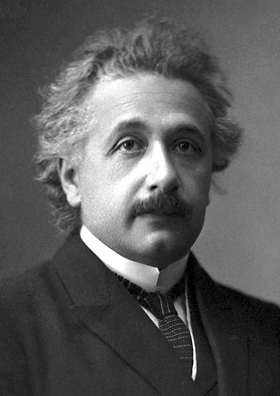
Who he was
Albert Einstein
- Nascimento
- 14 March 1879, Ulm
- Morte
- 18 April 1955, Princeton
- Origem
- Germany, Switzerland and the United States
- Áreas
- Relativity, quantum physics, statistical mechanics and cosmology
Reading guide
Biography
Discovery and proof
- The photoelectric effect: light comes in packets
- Brownian motion: counting the atoms
- Special relativity: a clock made of light
- E = mc²: the energy hidden in mass
- General relativity: from the lift to the Sobral eclipse