Mathematics is the queen of sciences, and number theory is the queen of mathematics.
— Carl Friedrich Gauss, according to his biographer Sartorius von Waltershausen
When Carl Friedrich Gauss (1777–1855) died, the King of Hannover had a medal struck in his tribute with the inscription Mathematicorum Principi: to the prince of mathematicians. The nickname caught it. Son of a poor family, Gauss transformed number theory, rediscovered a planet that astronomers had lost, measured an entire kingdom with triangles, helped invent the telegraph, and He left his name on the most famous curve in statistics.
In this chapter of the book History of Mathematics we tell the life of Gauss and redo it, with the sums view, ten of his discoveries. The figures are interactive: drag, click and move the controls.
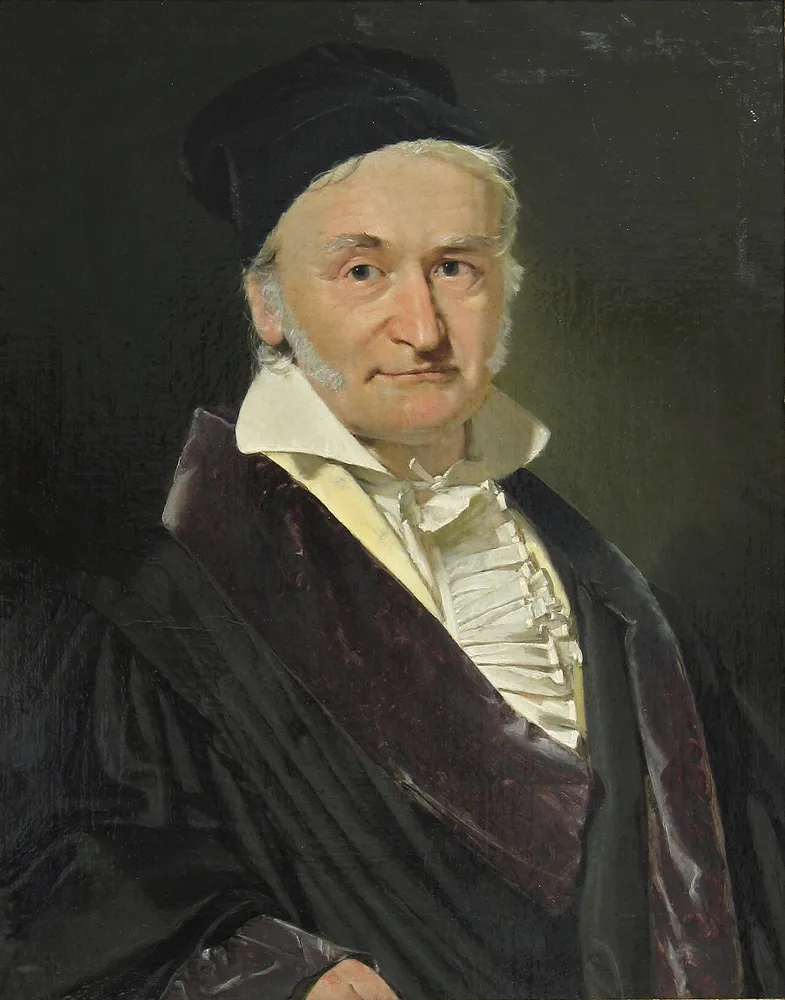
Who was it
Carl Friedrich Gauss
- Nascimento
- 30 April 1777, Braunschweig
- Morte
- 23 February 1855, Göttingen
- Origem
- Germany (duchy of Brunswick)
- Áreas
- Numbers, statistics, astronomy, geometry, physics
“Pauca sed matura: few, but ripe.”
Reading script
Biography and timeline
Discovery and demonstration
- The sum of 1 to 100
- The polygon of 17 sides
- The arithmetic of the clock
- The fundamental theorem of algebra
- Counting prime numbers
- Ceres and the least squares method
- The normal curve, Gaussian bell
- The Egregium Theorem and curvature
- Systems of equations: the determinant and Gaussian elimination
- Gaussian quadrature: integrate with two points