
Euler's Eyes
2026-10-11
angle bisectors Theorems
The angle bisector of an angle of a triangle divides the opposite side into parts proportional to the other two sides.
Who discovered
The internal angle bisector theorem is the proposition VI.3 of the The Elements of Euclid (c. 300 BC). The one with external angle bisector is not in the Greek text: it was added as “proposition A” of book VI by the Scotsman Robert Simson, in his edition of The Elements of 1756, which served as the basis for teaching geometry in the United Kingdom for more than a century. The two angle bisectors are linked to the circle of Apollonius, studied by Apollonius of Perga (3rd century BC).

The story
Apollonius showed that points whose ratio of distances to two fixed points is constant form a circle. The inner and outer angle bisectors cut the segment at the two points that divide the ratio, and these two points are the ends of a diameter of that circle.
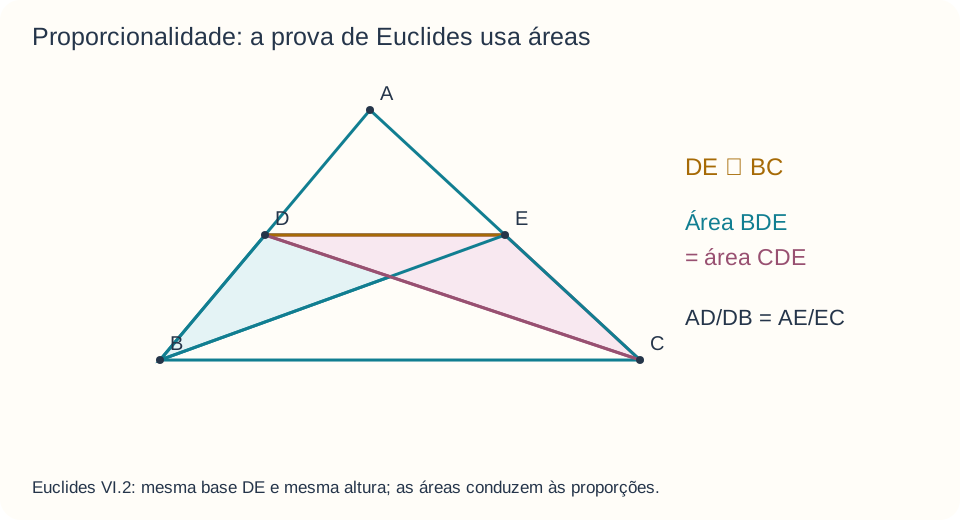
Euclid’s proof uses a parallel to angle bisector and falls back on Thales’ theorem from the previous topic. It’s another example of how the results of The Elements support each other.
In everyday life
- Persecutions. The circle of Apollonius responds to where a pursuer, with twice the speed of a fugitive, manages to catch up: the possible meeting points form this circle.
- Proportional division. A fence at angle bisector one corner divides the front of a triangular plot of land in proportion to the other sides.
- Lighting. In a square with two poles of different power, the points that receive the same light from each one form an Apollonius circle.
- Optics. In a mirror, the reflected ray forms equal angles with the normal, which works as angle bisector between the incoming and outgoing rays.
Sources: Elements, proposition VI.3 · Robert Simson (MacTutor) · Apollonius (MacTutor).
Theory and constructions
TeoremaInternal angle bisector theorem
An internal angle bisector of a triangle divides the opposite side into (additive) segments proportional to the adjacent sides. With $\overline{AD}$ being internal angle bisector, $DB = x$ and $DC = y$ (with $x + y = a$):
$$\frac{x}{c} = \frac{y}{b}.$$Demo
- Through $C$ we draw the parallel to angle bisector $\overline{AD}$, which cuts the straight line $AB$ at $E$.
- Let them be $\hat{1} = B\hat{A}D$, $\hat{2} = D\hat{A}C$, $\hat{3} = A\hat{E}C$ and $\hat{4} = A\hat{C}E$.
- $\overline{CE} \parallel \overline{AD}$: $\hat{1} \equiv \hat{3}$ (correspondents) and $\hat{2} \equiv \hat{4}$ (internal alternates).
- As $\hat{1} \equiv \hat{2}$, we have $\hat{3} \equiv \hat{4}$: $\triangle ACE$ is isosceles with base $\overline{CE}$, and $AE = AC = b$.
- By Thales’ theorem, with the transversals $BC$ and $BE$ and the beam $AD \parallel CE$: $\dfrac{x}{y} = \dfrac{c}{b}$, that is, $\dfrac{x}{c} = \dfrac{y}{b}$.
TeoremaExternal angle bisector theorem
If the angle bisector of an external angle of a triangle cuts the straight line of the opposite side, it divides this side externally into (subtractive) segments proportional to the adjacent sides. With $D$ being that point, $DB = x$ and $DC = y$ (with $x - y = a$):
$$\frac{x}{c} = \frac{y}{b}.$$If the triangle is isosceles with base $\overline{BC}$, the external angle bisector in $A$ is parallel to $\overline{BC}$, and vice versa.
The demonstration is the same as the previous one: through $C$ draw parallel to the external angle bisector, obtaining again a isosceles triangle $ACE$ with $AE = b$, and apply Thales.