
Euler's Eyes
2026-10-13
What is a sign? Saussure, Morris and the minus sign
The Portuguese word leviano, “frivolous”, comes from leve, “light”. A frivolous man is light in the sense of not weighing the consequences of what he does. Someone reading the word in a poem can hear both things at once: lightness and frivolity. The old texts on this site used it as an example of a “semiotically active” word: the word is one, the paths of reading are two, and that is exactly what makes it rich.
In mathematics something similar happens with much humbler signs. See how many jobs a simple horizontal stroke does:
$$12-5,\qquad -5,\qquad -(a+b),\qquad -x.$$In the first, the stroke is an operation between two numbers: take $5$ from $12$. In the second, it is part of the name of a number, negative five. In the third, it says “take the opposite of everything in the brackets”. In the fourth, it says “the opposite of $x$”, which may be positive if $x$ is negative. The shape is the same; what changes is the place it occupies and the neighbours it has. To read a sign, it is not enough to look at it.
That is what semiotics, the study of signs, is about: how one thing comes to mean another for someone.
Saussure: signifier and signified
The Swiss Ferdinand de Saussure (1857–1913) taught linguistics in Geneva and never wrote the book that made him famous. After his death, two colleagues gathered his students’ notes and published, in 1916, the Course in General Linguistics.
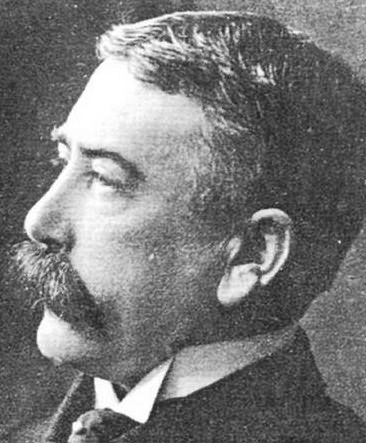
For Saussure a sign has two inseparable faces, like the two sides of a sheet of paper. On one side, the signifier: the form that is heard or seen, such as the sound “tree” or the letters t-r-e-e. On the other, the signified: the concept that this form evokes. And the link between the two has no natural reason:
The bond between the signifier and the signified is arbitrary.
— Ferdinand de Saussure, Course in General Linguistics (1916)
Nothing in the sound “tree” resembles a tree; in Portuguese it is árvore, in Japanese ki. The same is true of almost all mathematical signs. The $+$ does not look like a sum; the $7$ has seven of nothing. Recorde even tried to make $=$ look like equality, as we saw in chapter 1, but nobody needs to know that to use it.
Saussure insisted on a second point, even more important for mathematics: a sign is also worth its difference from the other signs in the system. $6$ means six partly because it is not $5$ or $7$; $<$ means “less” because it is opposed to $>$. A sign on its own, outside a system, means almost nothing.
Arbitrary, but not free
Arbitrary does not mean everyone uses it as they please. The community could have chosen another sign for addition, but once it chose $+$, nobody can change it in the middle of a calculation without warning. Freedom lies in the origin of the convention; using it demands discipline. That is why a mathematics book always begins by defining its signs, and why a new notation only catches on when many people learn to read it the same way.
Syntax, semantics and pragmatics
In 1938 the American philosopher Charles Morris proposed dividing the study of signs into three parts, a division the old texts on this site also used:
- Syntax: the relations of signs to one another. Which combinations are well formed? $3+\times4$ is not; $3+4\times2$ is, and the rules say multiplication comes first.
- Semantics: the relation of signs to what they represent. What object does $\pi$ refer to? The ratio of circumference to diameter, $3.14159\ldots$
- Pragmatics: the relation of signs to those who use them. What does the teacher want when writing $x^2-5x+6=0$ on the board? Probably for you to find the solutions, not to admire the equation.
Applied to the letter $x$, Morris’s division becomes clear. Syntactically, $x$ takes a number’s place in any expression. Semantically, it can be an unknown (in $x+1=4$), a variable ranging over a set (in $f(x)=x^2$) or a coordinate (on the $x$-axis). Pragmatically, “find $x$” and “let $x$ be any number” call for opposite attitudes: in the first case, search; in the second, search for nothing, just reason in general.
The three levels are always at work together, and many difficulties in mathematics arise when one of them fails. The pupil who reads $-3^2$ as $9$ has made a syntax error: the power comes before the minus sign, and $-3^2=-(3^2)=-9$. The pupil who thinks $\sqrt{9}$ could be $-3$ has made a semantic error, as we will see later. The pupil who solves the equation when the question was “how many solutions does it have?” has made a pragmatic error.
Exercise: the jobs of the minus sign
In $f(x-h)-f(x)$ there are two strokes. The one inside the brackets is an operation: take $h$ from $x$ before applying $f$. The one outside is also an operation, but between two values of the function. In $-x^2$, the stroke means the opposite, applied after the power: for $x=3$, $-x^2=-9$, whereas $(-x)^2=9$.
Exercise: the same x, three readings
In $2x+1=7$, $x$ is an unknown, and the question is which value makes the equality true ($x=3$). In $g(x)=2x+1$, $x$ is a variable: there is nothing to discover, just a rule that holds for each $x$. In “the line $2x+1=y$ cuts the $x$-axis at $-\tfrac12$”, $x$ is a coordinate and also names an axis. The syntax is similar in all three; the semantics and pragmatics change.
Chapter index · ← Chapter 1: references and credits · Peirce: icon, index and symbol →