It is by logic that we prove, but by intuition that we discover.
— Henri Poincaré, Science and Method (1908)
Henri Poincaré (1854–1912) is often called the last universalist: the last mathematician able to understand, and to advance, practically every branch of the mathematics and mathematical physics of his time. In little more than thirty years he published some five hundred papers and thirty books, on differential equations, complex functions, number theory, celestial mechanics, optics, electricity, thermodynamics and the philosophy of science.
He was short-sighted, clumsy with his hands, a hopeless draughtsman, and took no notes in lectures: he kept everything in his head. He worked only four hours a day, in two sessions, and left the rest to the unconscious, which, as he himself told it, sometimes handed him solutions ready-made at the most unexpected moment.
From him come the idea of chaos, modern topology, the Poincaré conjecture, solved only in 2003, and a formulation of relativity that arrived weeks before Einstein’s. He was also a mining engineer, a member of two academies and an expert witness in the Dreyfus affair.
In this series we tell Poincaré’s life and work through seven of his ideas, with the calculations in plain view.
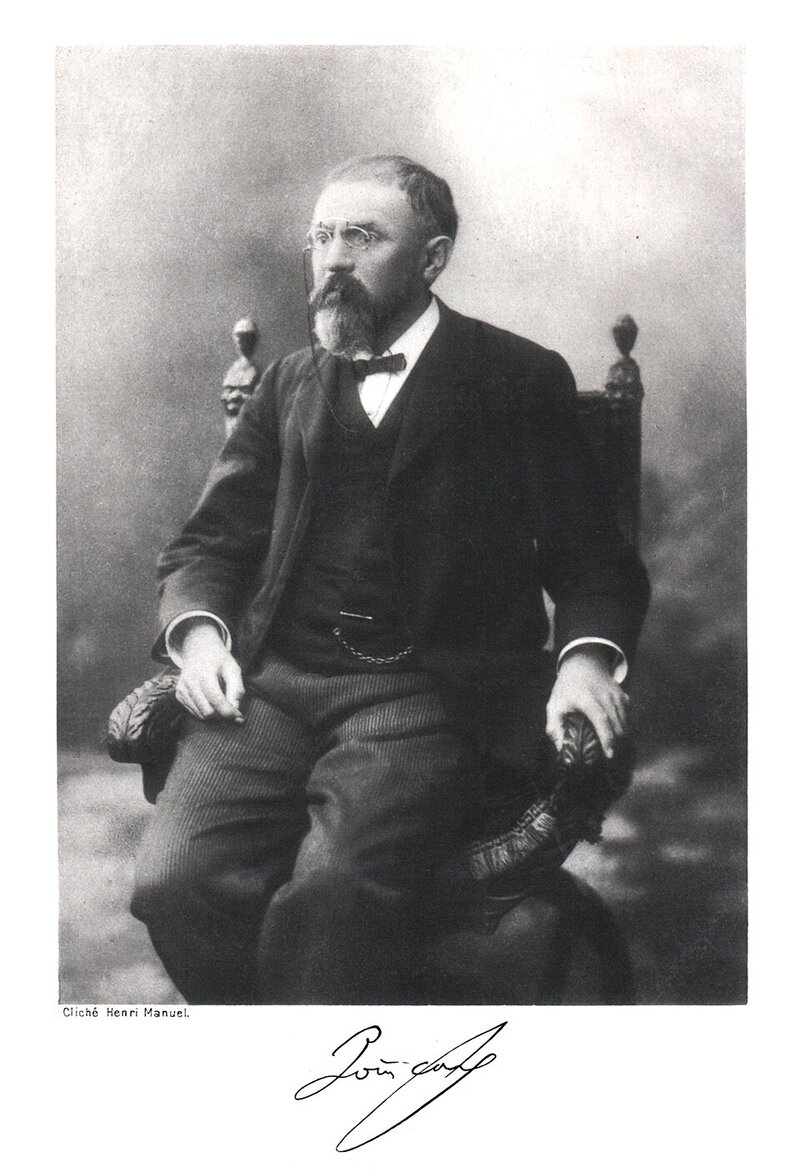
Who he was
Jules Henri Poincaré
- Nascimento
- 29 April 1854, Nancy, France
- Morte
- 17 July 1912, Paris, France
- Origem
- France
- Áreas
- Analysis, geometry, topology, celestial mechanics, mathematical physics, philosophy of science
Reading guide
Biography
Discoveries and proofs
- Fuchsian functions and hyperbolic geometry
- The three-body problem and chaos
- The recurrence theorem
- Topology: Analysis situs
- The Poincaré conjecture
- Time, clocks and relativity
- Probability in the Dreyfus affair