
Euler's Eyes
2026-10-11
Pascal's wager: a calculation, not a proof
Many people have heard that Pascal “proved that God exists”. He did not, and he said plainly that it could not be done. What he proposed is more curious: since reason cannot settle the question, change the question. Instead of “does God exist?”, ask “what is the better bet?”. And answer this second question with the mathematics he had just invented with Fermat, the mathematics of fair division.
A sheet full of scribbles
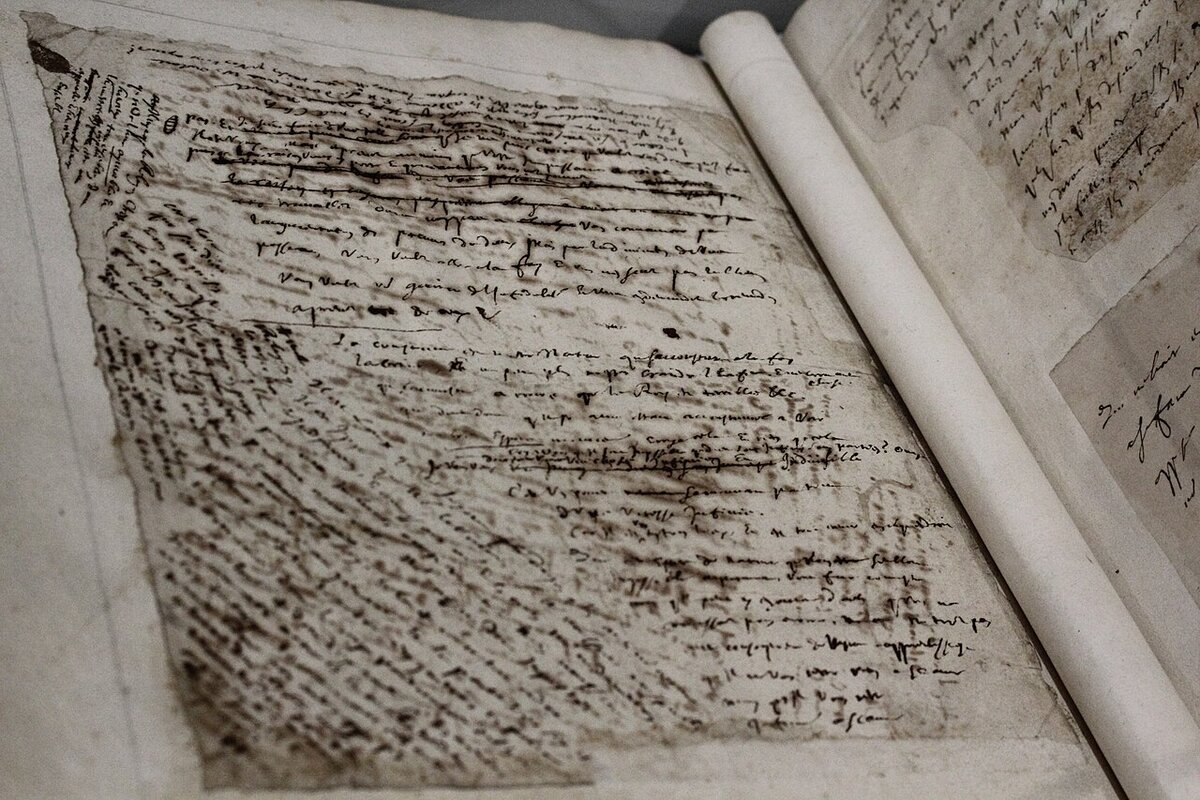
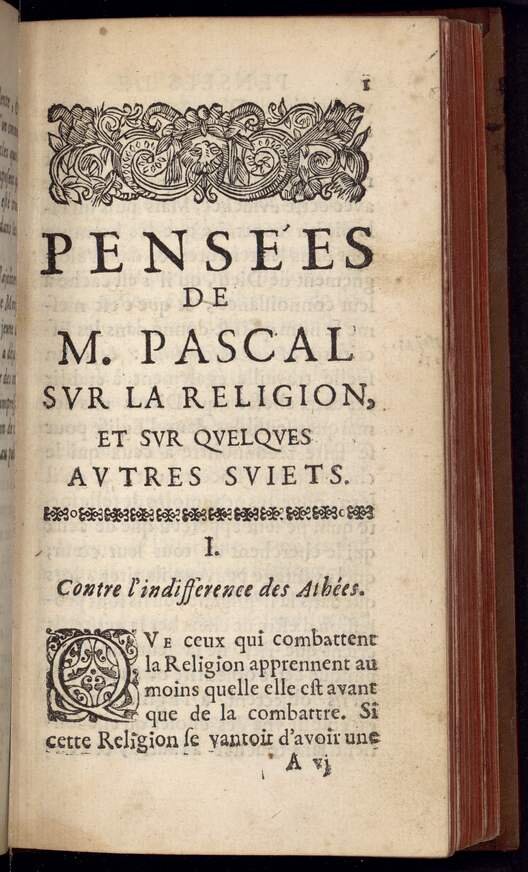
In the last years of his life, Pascal gathered notes for a book in defence of Christianity. He never wrote it. After his death, in 1662, his friends found hundreds of fragments, some cut out with scissors and strung together on threads, and published a selection in 1670 under the title Pensées (Thoughts).
The fragment of the wager is a folded sheet, written on both sides, with additions in the margins and upside down. Editors call it by its first words: “Infinite, nothing”. It is a dialogue between Pascal and an unbeliever, perhaps inspired by the gamblers he had met in the high society of Paris, such as the Chevalier de Méré.
Reason cannot decide
The starting point is an admission of powerlessness:
God is, or he is not. But to which side shall we lean? Reason can determine nothing here. There is an infinite chaos that separates us. A game is being played, at the far end of this infinite distance, where heads or tails will turn up. What will you wager?
— Blaise Pascal, Pensées, fragment “Infinite, nothing”
The other man answers that the right thing is not to bet at all. Pascal refuses the way out:
Yes, but you must wager. It is not optional: you are embarked.
— Blaise Pascal, Pensées, fragment “Infinite, nothing”
Living as a believer or living as an unbeliever is already a choice. Not choosing means choosing the second.
The four-cell table
Today the wager is written as a table. There are two choices and two states of the world:
| God exists | God does not exist | |
|---|---|---|
| Believe | infinite gain: “an infinity of infinitely happy life” | little is lost: a few pleasures |
| Not believe | everything is lost | little is gained: those same pleasures |
Pascal goes through the table in three steps, each stronger than the one before. The philosopher Ian Hacking, in a 1972 paper, showed that they are three different arguments, and that the third is a calculation of expected value.
First step: dominance. “If you win, you win everything; if you lose, you lose nothing. Wager, then, that he exists, without hesitation.” If believing were better or equal in every column, there would be nothing to calculate.
Second step: the calculation with even chances. The other man objects that he does lose something. Pascal grants it and does the sums as in a game of dice: with even chances of winning and losing, it would be worth staking one life to win two; it would be foolish not to stake one to win three.
Third step: infinity. And what if the chances are not even? Pascal answers that it does not matter:
Here there is an infinity of infinitely happy life to be won, one chance of winning against a finite number of chances of losing, and what you stake is finite.
— Blaise Pascal, Pensées, fragment “Infinite, nothing”
The calculation
Let $p$ be the chance you give to God’s existence, however small, but greater than zero. Let $c$ be the cost of a life of faith, a finite number, and $G$ the gain if God exists. The expected value of believing is
$$E(\text{believe})=p\cdot G-(1-p)\cdot c.$$With a finite $G$, the result could be anything: it depends on $p$, $G$ and $c$. But Pascal sets $G=\infty$. Then, for any $p>0$,
$$p\cdot\infty-(1-p)\cdot c=\infty,$$and no finite alternative can compete. It is the same idea as in the division of the stakes: what each bet is worth is the prize multiplied by the chance. The difference is that the prize is now infinite.
It is not a proof
Notice what the calculation does not say. It does not raise the chance $p$ at all. Someone who thought God had one chance in a thousand of existing still thinks, after the wager, that he has one chance in a thousand. The argument is about what to do, not about what is true.
Pascal knew this. Right after the calculation, the other man says: “I am made in such a way that I cannot believe.” And Pascal does not offer him a proof. He advises him to act like those who believe, “taking holy water, having masses said”, and to work at convincing himself “not by adding more proofs of God, but by lessening your passions”. For Pascal, faith came from the heart, not from a calculation; the wager only served to show the gambler that indifference was the worst of the choices.
The objections
The wager was criticised from the moment it appeared, and the criticisms also teach mathematics.
- Which gods? In 1746, Denis Diderot wrote that “an imam could say the same”. If every religion promises an infinite gain, the table does not have two rows but dozens, and infinity appears in all of them.
- Can one believe by decision? Nobody comes to believe something just because they have concluded it would pay to believe it. Pascal agreed, which is why he spoke of habits, not decisions.
- Infinity breaks the calculation. Someone who tosses a coin to decide whether to believe has a chance of $\frac12$ of believing, and their expected value is $\frac12\cdot p\cdot\infty=\infty$, the same as that of someone who believes for certain. With infinity in the table, every strategy that leaves some chance of believing comes out equal, and the calculation can no longer tell the choices apart.
- The tone. Voltaire, in 1734, found the idea “a little indecent and puerile”: treating salvation as a game of heads or tails seemed to him to cheapen the subject.
Exercise: staking one life to win two
With even chances, you stake 1 to win 2. Is it worth it? The expected value of the bet is
$$\frac12\cdot2-\frac12\cdot1=\frac12>0.$$It is. To win 3, the expected value is $\frac12\cdot3-\frac12\cdot1=1$, larger still. This is Pascal’s second step, done with numbers.
Exercise: the wager with a finite gain
Suppose the gain is not infinite but $G=1000$, that the cost is $c=5$ and the chance is $p=\frac1{1000}$. Is it worth believing?
$$E=\frac1{1000}\cdot1000-\frac{999}{1000}\cdot5=1-4.995=-3.995<0.$$It is not. With a finite gain, the answer depends on the numbers, and a very small chance can bring the argument down. Only infinity makes the calculation immune to every $p>0$, and it is precisely infinity that gives rise to the coin objection.
Sources: Blaise Pascal, Pensées, fragment “Infini rien” (Lafuma 418, Sellier 680) · Ian Hacking, “The logic of Pascal’s wager”, American Philosophical Quarterly, 9(2), 1972, pp. 186–192 · Pascal’s Wager, Stanford Encyclopedia of Philosophy.
All Pascal topics · ← The weight of air: the Puy de Dôme experiment · Pascal’s legacy →