
Euler's Eyes
2026-09-26
FUVEST 2022 – 2nd phase: Mathematics solved
Source: FUVEST – 2nd phase test, 2nd day (notebook with all the questions of the day), questions M01 to M06. FUVEST does not publish a template for the 2nd phase; the resolutions are ours.
On the 2nd day of the 2nd phase of FUVEST 2022 each candidate received 12 discursive questions of the specific disciplines of your career. Mathematics had 6 questions (M01 to M06). Those who only did 4 math questions received M01 to M04; who only did 3, M01 to M03. Each resolution below was checked by a second path (another method or account on the computer).
Template
| Question | Subject | Answers |
|---|---|---|
| M01 | Sequences defined by recurrence (Collatz) | a) 17; b) 12, 13 e 80; c) 4 |
| M02 | Functions defined by parts and area | a) $[0, 2]$ and $[5, 9]$; b) $\frac{9}{4}$, 4 and $\frac{11}{2}$; c) see resolution |
| M03 | Counting and probability in the Cartesian plane | a) 6 points; b) $\frac{19}{49}$; c) $\frac{10}{147}$ |
| M04 | Truncated pyramid: perimeter, volume and distance | a) $\frac{4 + 4\sqrt{2}}{3}$; b) $\frac{4\sqrt{2}}{27}$; c) $\frac{\sqrt{6}}{3}$ |
| M05 | Intersection of circle and parabola | a) $(0, 1)$; b) $(0, 1)$, $(\pm\sqrt{3}, 4)$; c) $a > \frac{1}{4}$ |
| M06 | Package count (integer solutions) | a) 101; b) 10 201; c) 506 |
Question M01: Sequence “3n + 1” (recurrence)
Statement
A sequence of natural numbers is constructed as follows: its first term $t_1$ is chosen as any natural number. If $t_1$ is even, then $t_2 = \frac{t_1}{2}$ and if $t_1$ is odd, then $t_2 = 3t_1 + 1$. The terms following $t_n$ are obtained according to this same rule. For example, if $t_1 = 3$, then $t_2 = 10$, $t_3 = 5$, $t_4 = 16$ and so on.
This way, from $t_1 \in \mathbb{N}$, for each $n \in \mathbb{N}$, $n \ge 2$, the sequence $t_n$ is defined as
a) For $t_1 = 22$, determine $t_4$.
b) Determine all possible $t_1$ for which $t_4 = 10$.
c) For $t_1 = 26$, determine $t_{2022}$.
Resolution
a) Just apply the rule three times:
- $t_1 = 22$ is even, so $t_2 = 11$;
- $t_2 = 11$ is odd, so $t_3 = 3 \cdot 11 + 1 = 34$;
- $t_3 = 34$ is even, so $t_4 = 17$.
Response (a): $t_4 = 17$.
b) Let’s go backward. If a term is worth $k$, the previous term can be:
- $2k$ (if the previous one was even, it was divided by 2), or
- $\frac{k-1}{3}$, but only if this number is natural and odd (if the previous one was odd, it became $3 \cdot (\text{anterior}) + 1$).
1. From $t_4 = 10$ to $t_3$: $2 \cdot 10 = 20$, or $\frac{10-1}{3} = 3$ (odd, worth). Then $t_3 \in$ {20, 3}.
2. From $t_3$ to $t_2$:
- $t_3 = 20$: $t_2 = 40$, or $\frac{19}{3}$ (not integer). Only $t_2 = 40$.
- $t_3 = 3$: $t_2 = 6$, or $\frac{2}{3}$ (not integer). Only $t_2 = 6$.
3. From $t_2$ to $t_1$:
- $t_2 = 40$: $t_1 = 80$, or $\frac{39}{3} = 13$ (odd, valid).
- $t_2 = 6$: $t_1 = 12$, or $\frac{5}{3}$ (not integer).
Checking forward: $13 \to 40 \to 20 \to 10$; $80 \to 40 \to 20 \to 10$; $12 \to 6 \to 3 \to 10$. ✓
Answer (b): $t_1 = 12$, $t_1 = 13$ or $t_1 = 80$.
c) Calculating the first terms from $t_1 = 26$:
| $n$ | 1 | 2 | 3 | 4 | 5 | 6 | 7 | 8 | 9 | 10 | 11 | 12 | 13 | 14 |
|---|---|---|---|---|---|---|---|---|---|---|---|---|---|---|
| $t_n$ | 26 | 13 | 40 | 20 | 10 | 5 | 16 | 8 | 4 | 2 | 1 | 4 | 2 | 1 |
From $n = 9$ the sequence enters the cycle $4, 2, 1, 4, 2, 1, \ldots$, which repeats every 3 terms. Like $t_9 = 4$, $t_{12} = 4$, $t_{15} = 4$, …, it is valid $t_n = 4$ whenever $n \ge 9$ and $n$ is a multiple of 3.
As $2022 = 3 \cdot 674$ is a multiple of 3 (the sum of the digits is 6),
Response (c): $t_{2022} = 4$.
Conference: we calculate by computer the 2022 first terms from 26 and we got $t_{2022} = 4$; we also test all $t_1$ from 1 to 10 000, and only 12, 13 and 80 give $t_4 = 10$.
Question M02: Function defined by parts and area of a rectangle
Statement
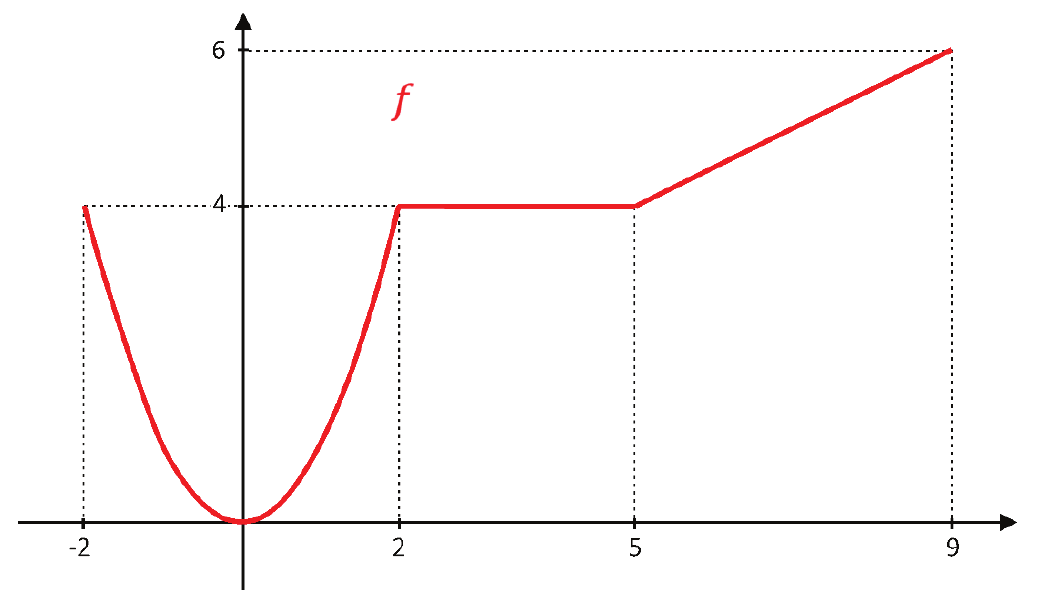
A function $f$ is defined in the range $[-2, 9]$ as follows: for $x \in [-2, 2]$, $f$ takes $x$ into $x^2$, and in the rest of the domain its graph is formed by two straight segments as shown in the figure.
a) Present all intervals in the domain of the function $f$ in which it is increasing.
b) Determine the values of $f$ at points $x = -\frac{3}{2}$, $x = \frac{7}{2}$ and $x = 8$.
c) For each value of $x \in \left]0, 9\right[$, consider the rectangle $R_x$ with vertices at points $A = (x, 0)$, $B = (9, 0)$, $C = (9, f(x))$ and $D = (x, f(x))$. Write the expression for the area of $R_x$, as a function of $x$, to $x$ in the interval $\left]0, 9\right[$.
Resolution
Law of $f$. From the figure, the first segment goes from $(2, 4)$ to $(5, 4)$ (horizontal) and the second goes from $(5, 4)$ to $(9, 6)$, with inclination $\frac{6-4}{9-5} = \frac{1}{2}$, i.e. $y = 4 + \frac{x-5}{2} = \frac{x+3}{2}$. Then
a) The parabola $y = x^2$ decreases in $[-2, 0]$ and increases in $[0, 2]$. In $[2, 5]$ the function is constant and in $[5, 9]$ it is a straight line with positive slope.
Answer (a): $f$ is increasing in $[0, 2]$ and $[5, 9]$. (In the range $[2, 5]$ she is constant. If “increasing” is understood in the broad sense of “not descending”, the range would be the entire $[0, 9]$.)
b)
- $x = -\frac{3}{2} \in [-2, 2]$: $f\left(-\frac{3}{2}\right) = \left(-\frac{3}{2}\right)^2 = \frac{9}{4}$.
- $x = \frac{7}{2} = 3{,}5 \in [2, 5]$: $f\left(\frac{7}{2}\right) = 4$.
- $x = 8 \in [5, 9]$: $f(8) = \frac{8+3}{2} = \frac{11}{2}$.
Answer (b): $\frac{9}{4}$, $4$ and $\frac{11}{2}$.
c) The rectangle $R_x$ has base $AB = 9 - x$ (on axis $x$) and height $AD = f(x)$ (which is always $\ge 0$). Therefore, the area is $(9 - x) \cdot f(x)$, and the expression changes according to the excerpt from $f$:
Answer (c): the above expression.
Conference: at the splice points the formulas give the same value, as they should: in $x = 2$, $9 \cdot 4 - 8 = 28 = 36 - 8$; in $x = 5$, $36 - 20 = 16 = \frac{-25 + 30 + 27}{2}$. We also compared, by computer, the formulas with $(9 - x) \cdot f(x)$ read directly from the graph at various points.
Question M03: Points with coordinates from 3 to 9 (count and probability)
Statement
Consider the set $C$ of points on the Cartesian plane of the form $(m, n)$, with $m$ and $n$ belonging to {3, 4, 5, 6, 7, 8, 9}.
a) Present all points $(m, n)$ of $C$ for which the product $m \cdot n$ is greater than 60.
b) By drawing a point $(m, n)$ from $C$, with equal probabilities for all points, what is the probability that the fraction $\frac{m}{n}$ is reducible?
c) Drawing, with equal probabilities, two distinct points from $C$, which is the probability that the distance between them is equal to $\sqrt{13}$?
Note and Adopt: A fraction $\frac{m}{n}$ is reducible when $m$ and $n$ have a divisor natural in common, in addition to 1.
Resolution
The set $C$ has $7 \cdot 7 = 49$ points.
a) For $m \cdot n > 60$ both numbers need to be large. With $m = 7$: $7 \cdot 9 = 63$ works, but $7 \cdot 8 = 56$ does not. With $m = 8$: $8 \cdot 8 = 64$ and $8 \cdot 9 = 72$ works, $8 \cdot 7 = 56$ does not. With $m = 9$: $9 \cdot 7 = 63$, $9 \cdot 8 = 72$ and $9 \cdot 9 = 81$ work, $9 \cdot 6 = 54$ does not. With $m \le 6$, the largest product is $6 \cdot 9 = 54$.
Answer (a): $(7, 9)$, $(8, 8)$, $(8, 9)$, $(9, 7)$, $(9, 8)$ and $(9, 9)$.
b) The fraction is reducible when $m$ and $n$ have a prime factor in common. The cousins possible are 2, 3, 5 and 7:
- both pairs ({4, 6, 8}): $3 \cdot 3 = 9$ points;
- both multiples of 3 ({3, 6, 9}): $3 \cdot 3 = 9$ points;
- both multiples of 5: only $(5, 5)$, 1 point;
- both multiples of 7: only $(7, 7)$, 1 point.
The point $(6, 6)$ was counted twice (it is even and a multiple of 3); no other if repeat. Total: $9 + 9 + 1 + 1 - 1 = 19$ points.
$$P = \frac{19}{49}$$Response (b): $\frac{19}{49}$.
Conference by complement: pairs with $\text{mdc}(m, n) = 1$ are 30 (count per computer), and $49 - 30 = 19$. ✓
c) 1. Total pairs of distinct points:
$$\binom{49}{2} = \frac{49 \cdot 48}{2} = 1176$$2. When the distance is $\sqrt{13}$? If the coordinate differences are $\Delta m$ and $\Delta n$ (integers), we need $(\Delta m)^2 + (\Delta n)^2 = 13$. The only way to write 13 as the sum of two squares is $4 + 9$, so $\lbrace |\Delta m|, |\Delta n| \rbrace = \lbrace 2, 3 \rbrace$.
3. Counting the pairs. Coordinates range from 3 to 9 (7 values).
- $|\Delta m| = 2$, $|\Delta n| = 3$, with both “up and down” offsets. right": the starting point has $m$ between 3 and 7 (5 options) and $n$ between 3 and 6 (4 options): 20 pairs. With scrolling “down and right”: more 20.
- $|\Delta m| = 3$, $|\Delta n| = 2$: similarly, $20 + 20 = 40$.
Total: 80 pairs.
$$P = \frac{80}{1176} = \frac{10}{147}$$Response (c): $\frac{10}{147}$.
Conference: a computer count of all 1176 pairs gave exactly 80 distance peers $\sqrt{13}$.
Question M04: Solid obtained by cutting the corners of a pyramid
Statement
A pyramid $\mathbf{P}$ has a square base $A_0B_0C_0D_0$ and a side measuring 1 u.m., supported on a plane $\Pi$, and four faces that are equilateral triangles, connecting the base to apex $E_0$ of $\mathbf{P}$. The sixteen points $A_1$, $A_2$, $A_3$, $B_1$, $B_2$, $B_3$, $C_1$, $C_2$, $C_3$, $D_1$, $D_2$, $D_3$, $E_1$, $E_2$, $E_3$ and $E_4$, indicated in the figure, divide each edge of the pyramid into three segments of equal measure.
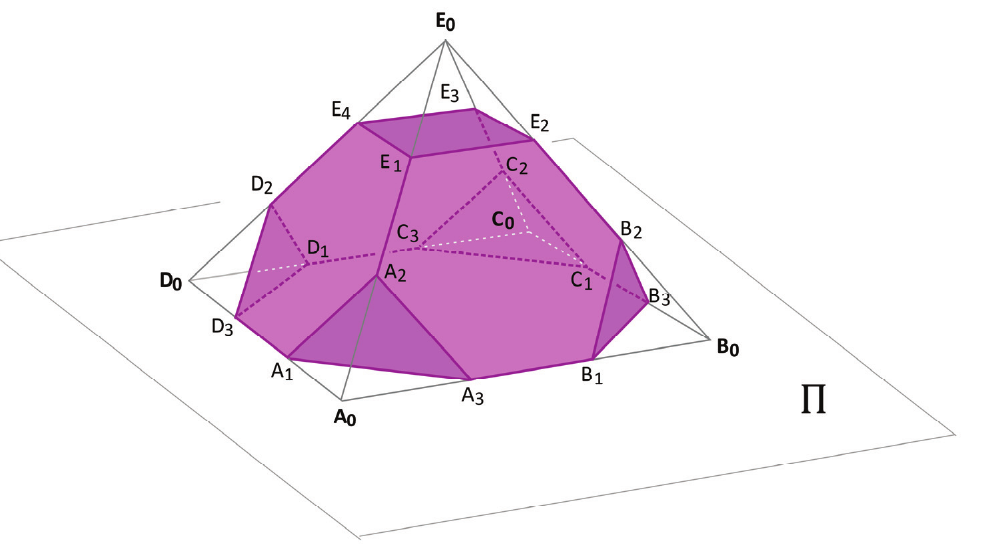
A new solid $\mathbf{S}$, highlighted in the figure, is produced by subtracting from $\mathbf{P}$ the five pyramids $A_0A_1A_2A_3$, $B_0B_1B_2B_3$, $C_0C_1C_2C_3$, $D_0D_1D_2D_3$ and $E_0E_1E_2E_3E_4$. Determine:
a) the perimeter of the face of $\mathbf{S}$ that rests on $\Pi$, whose vertices are $A_1$, $A_3$, $B_1$, $B_3$, $C_1$, $C_3$, $D_1$ e $D_3$.
b) the volume of $\mathbf{S}$.
c) the distance between $A_1$ and $E_2$.
Resolution
All 8 edges of $\mathbf{P}$ measure 1 (the base is a square of side 1 and the side faces are equilateral triangles), and each has been divided into three parts $\frac{1}{3}$.
a) The face of $\mathbf{S}$ in the plane $\Pi$ is the square of the base with the 4 corners cut: an octagon.
- On each side of the square there is the middle third, for example $A_3B_1 = \frac{1}{3}$ (4 sides like this).
- Each cut corner is the hypotenuse of an isosceles right triangle of legs $\frac{1}{3}$, for example $A_1A_3 = \sqrt{\left(\frac{1}{3}\right)^2 + \left(\frac{1}{3}\right)^2} = \frac{\sqrt{2}}{3}$ (4 sides like this).
Response (a): $\frac{4 + 4\sqrt{2}}{3}$ u.m. $\approx 3{,}22$ u.m.
b) 1. Volume of $\mathbf{P}$. The foot of the height is the center of the square, which is the half diagonal, $\frac{\sqrt{2}}{2}$, of each vertex. With the side edge 1, by Pythagoras:
$$h = \sqrt{1 - \left(\frac{\sqrt{2}}{2}\right)^2} = \sqrt{\frac{1}{2}} = \frac{\sqrt{2}}{2}$$$$V_{\mathbf{P}} = \frac{1}{3} \cdot 1^2 \cdot \frac{\sqrt{2}}{2} = \frac{\sqrt{2}}{6}$$2. Top pyramid, $E_0E_1E_2E_3E_4$. It is similar to $\mathbf{P}$ with good reason $\frac{1}{3}$, then its volume is $\left(\frac{1}{3}\right)^3 V_{\mathbf{P}} = \frac{V_{\mathbf{P}}}{27}$.
3. Base corner pyramids, such as $A_0A_1A_2A_3$. The plane passing through $B_0$, $D_0$ and $E_0$ cut $\mathbf{P}$ in half; the tetrahedron $A_0B_0D_0E_0$ has volume $\frac{V_{\mathbf{P}}}{2}$. The tetrahedron $A_0A_1A_2A_3$ has three edges that come out of $A_0$ equal to $\frac{1}{3}$ from $A_0B_0D_0E_0$ (in the same directions), then it is similar to it with reason $\frac{1}{3}$:
$$V_{A_0A_1A_2A_3} = \frac{1}{27} \cdot \frac{V_{\mathbf{P}}}{2}$$They are 4 equal corners: together they add up to $\frac{4}{27} \cdot \frac{V_{\mathbf{P}}}{2} = \frac{2V_{\mathbf{P}}}{27}$.
4. Volume of $\mathbf{S}$.
$$V_{\mathbf{S}} = V_{\mathbf{P}} - \frac{V_{\mathbf{P}}}{27} - \frac{2V_{\mathbf{P}}}{27} = \frac{24}{27} V_{\mathbf{P}} = \frac{8}{9} \cdot \frac{\sqrt{2}}{6} = \frac{4\sqrt{2}}{27}$$Answer (b): $V_{\mathbf{S}} = \frac{4\sqrt{2}}{27}$ u.v. $\approx 0{,}210$ u.v.
c) Let’s use coordinates. From the figure, $A_1$ is on the edge $A_0D_0$ and $E_2$ on the edge $E_0B_0$. Taking
$$A_0 = (0, 0, 0), \quad B_0 = (1, 0, 0), \quad D_0 = (0, 1, 0), \quad E_0 = \left(\tfrac{1}{2}, \tfrac{1}{2}, \tfrac{\sqrt{2}}{2}\right),$$we have:
- $A_1$ to $\frac{1}{3}$ from $A_0$ towards $D_0$: $A_1 = \left(0, \frac{1}{3}, 0\right)$;
- $E_2$ to $\frac{1}{3}$ from $E_0$ towards $B_0$: $E_2 = E_0 + \frac{1}{3}(B_0 - E_0) = \left(\frac{2}{3}, \frac{1}{3}, \frac{\sqrt{2}}{3}\right)$.
Then
$$A_1E_2 = \sqrt{\left(\frac{2}{3}\right)^2 + 0^2 + \left(\frac{\sqrt{2}}{3}\right)^2} = \sqrt{\frac{4}{9} + \frac{2}{9}} = \frac{\sqrt{6}}{3}$$Response (c): $A_1E_2 = \frac{\sqrt{6}}{3}$ u.m. $\approx 0{,}816$ u.m.
Conference: with the same coordinates, we calculated the volumes of the tetrahedrons (by the determinant) and we obtained again $V_{\mathbf{S}} = \frac{4\sqrt{2}}{27} \approx 0{,}2095$ and the perimeter $\approx 3{,}2190$. For item c, another way to see it: $A_1$ and $E_2$ are in the same vertical plane $y = \frac{1}{3}$. In this plane, the horizontal distance between them is $\frac{2}{3}$ and the height difference is $\frac{2}{3} h = \frac{\sqrt{2}}{3}$ ($E_2$ is $\frac{2}{3}$ from the path between the base and the apex). By Pythagoras, $\sqrt{\frac{4}{9} + \frac{2}{9}} = \frac{\sqrt{6}}{3}$. ✓
Question M05: Circumference and parabolas with 3 points in common
Statement
Consider, in the Cartesian plane, the circle with center at the point $(0, 3)$ and with radius 2 and, for each $a \in \mathbb{R}$, $a \ne 0$, the parabola whose equation is $y = ax^2 + 1$.
a) For $a = -1$, find the common point between the circle and the parabola.
b) For $a = 1$, present 3 common points between the circle and the parabola.
c) Find all values of $a$ for which the circle and parabola have exactly 3 points in common.
Resolution
General equation. The circumference is $x^2 + (y - 3)^2 = 4$ and the parabola gives $x^2 = \frac{y - 1}{a}$. Replacing $x^2$ in the circle:
$$\frac{y - 1}{a} + (y - 3)^2 - 4 = 0$$As $(y-3)^2 - 4 = (y - 3 - 2)(y - 3 + 2) = (y - 5)(y - 1)$, the equation factors:
$$(y - 1)\left[\frac{1}{a} + y - 5\right] = 0 \quad\Rightarrow\quad y = 1 \quad\text{ou}\quad y = 5 - \frac{1}{a}$$Each value of $y$ only generates a point if $x^2 = \frac{y-1}{a} \ge 0$.
- $y = 1$ gives $x^2 = 0$: the point $(0, 1)$, which is the lowest point of the circumference and vertex of all parabolas.
- $y = 5 - \frac{1}{a}$ gives $x^2 = \frac{4 - \frac{1}{a}}{a} = \frac{4a - 1}{a^2}$.
a) $a = -1$: $y = 1$ or $y = 5 + 1 = 6$. For $y = 6$, $x^2 = \frac{6-1}{-1} = -5 < 0$: there is no point. (In fact, $y = 6$ is above the circumference, which goes from $y = 1$ to $y = 5$.) Remains $y = 1$, $x = 0$.
Response (a): $(0, 1)$.
b) $a = 1$: $y = 1$ or $y = 5 - 1 = 4$. For $y = 4$, $x^2 = 3$, $x = \pm\sqrt{3}$.
Checking $(\sqrt{3}, 4)$: on the circumference, $3 + (4-3)^2 = 4$ ✓; in the parable, $1 \cdot 3 + 1 = 4$ ✓.
Answer (b): $(0, 1)$, $(\sqrt{3}, 4)$ and $(-\sqrt{3}, 4)$.
c) The point $(0, 1)$ is always common. To have exactly 3 points, the second root needs to give two new points, $(\pm x, y)$ with $x \ne 0$, that is,
$$x^2 = \frac{4a - 1}{a^2} > 0 \quad\Leftrightarrow\quad 4a - 1 > 0 \quad\Leftrightarrow\quad a > \frac{1}{4}$$If $a = \frac{1}{4}$, the second root is $y = 5 - 4 = 1$ again, and there is only the point $(0, 1)$. If $a < \frac{1}{4}$ (with $a \ne 0$), $x^2 < 0$ and also there is only the point $(0, 1)$. There are never 2 or 4 points.
Response (c): $a > \frac{1}{4}$.
Conference: by computer, we parameterize the circumference by $(2\cos\theta, 3 + 2\sin\theta)$ and we count the points at which it crosses the parabola for various values of $a$ (e.g. $-1$; $0{,}1$; $0{,}2$; $0{,}3$; $1$; $5$): we obtained 1 point for $a \le 0{,}2$ and 3 points for $a \ge 0{,}3$, according to $a > \frac{1}{4}$.
Question M06: Packages of pea and corn cans (count)
Statement
A food distribution company has cans of peas (E) and cans of corn (M), in two weights, 1 kg and 2kg, totaling 4 (four) types of cans: E1 and E2 (peas, in weights of 1kg and 2kg, respectively) and M1 and M2 (corn, in weights of 1kg and 2kg, respectively). These cans are grouped into packages for shipment to traders. Two packages of cans are considered equal if they contain the same number of cans of each type, regardless of how they are organized in the package.
a) How many different packages each weighing exactly 200kg (two hundred kilos) can be assembled using only cans of types E1 and E2? In count, you must also take into account packets formed by only 1 type of these cans.
b) How many different packages each weighing exactly 200kg (two hundred kilos) can be assembled using only cans of types E1, E2 and M1? In count, you must also take into account packets formed by only 1 or 2 types of these cans.
c) How many different packages each weighing exactly 20kg (twenty kilos) Can they be assembled using cans of types E1, E2, M1 and M2? When counting, one must also take into account packages formed by only 1, 2 or 3 types of these cans.
Resolution
A package is determined by the number of cans of each type. Let $e_1$, $e_2$, $m_1$ and $m_2$ these quantities (integers $\ge 0$). The weight is $e_1 + 2e_2 + m_1 + 2m_2$.
a) We want $e_1 + 2e_2 = 200$. Choosing $e_2$, the value $e_1 = 200 - 2e_2$ is determined, and needs to be $\ge 0$: $e_2$ can be $0, 1, 2, \ldots, 100$.
Response (a): 101 packets.
b) We want $e_1 + m_1 + 2e_2 = 200$. Fixed $e_2 = k$ ($0 \le k \le 100$), there remains $e_1 + m_1 = 200 - 2k$, which has $201 - 2k$ solutions ($e_1$ from 0 to $200 - 2k$). Adding:
$$\sum_{k=0}^{100} (201 - 2k) = 201 + 199 + 197 + \cdots + 3 + 1$$It is the sum of the first 101 odd numbers, which is worth $101^2$:
$$101^2 = 10\thinspace 201$$Answer (b): 10 201 packets.
c) We want $(e_1 + m_1) + 2(e_2 + m_2) = 20$. Let $k = e_2 + m_2$ be the number of 2 kg cans ($0 \le k \le 10$).
- $e_2 + m_2 = k$ has $k + 1$ solutions;
- $e_1 + m_1 = 20 - 2k$ has $21 - 2k$ solutions.
For every $k$ there are $(k + 1)(21 - 2k)$ packages:
| $k$ | 0 | 1 | 2 | 3 | 4 | 5 | 6 | 7 | 8 | 9 | 10 |
|---|---|---|---|---|---|---|---|---|---|---|---|
| $(k+1)(21-2k)$ | 21 | 38 | 51 | 60 | 65 | 66 | 63 | 56 | 45 | 30 | 11 |
Sum: $21 + 38 + 51 + 60 + 65 + 66 + 63 + 56 + 45 + 30 + 11 = 506$.
Response (c): 506 packets.
Conference: a computer count, testing all possible quantities of each type of can, gave 101, 10 201 and 506 packages for items a, b and c.