I have discovered a truly marvellous proof of this, which this margin is too narrow to contain.
— Pierre de Fermat, in the margin of Diophantus's Arithmetica
Pierre de Fermat (c. 1607–1665) was never a professional mathematician. He was a judge in the Parlement of Toulouse, in the south of France, and did mathematics in his spare time, for pleasure. He published almost nothing. His discoveries travelled in letters, often as challenges: “I have proved this; now you try.”
Even so, or perhaps because of it, Fermat invented analytic geometry at the same time as Descartes, found maxima and minima before Newton and Leibniz, founded probability theory with Pascal and practically created modern number theory. And he left in the margin of a book a sentence that defied mathematicians for 358 years.
In this trail we tell Fermat’s life and rework, with all the steps shown, eight of his discoveries. The figures are interactive: change the sides of a rectangle, compute remainders of powers and divide the stakes of an interrupted game.
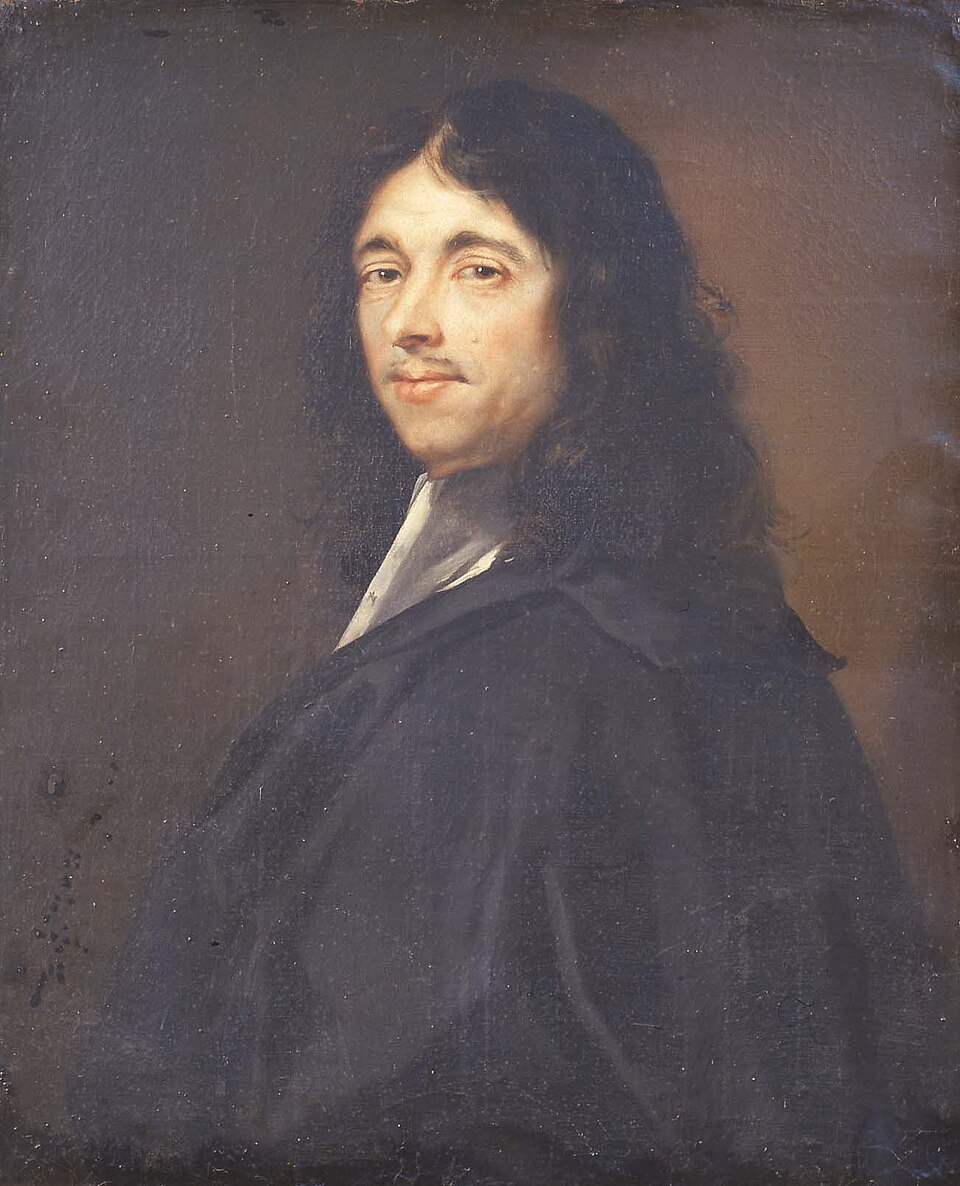
Who he was
Pierre de Fermat
- Nascimento
- Early 17th century (probably 1607), Beaumont-de-Lomagne
- Morte
- 12 January 1665, Castres
- Origem
- France
- Áreas
- Number theory, geometry, probability and optics
Reading guide
Biography
Discovery and proof
- Fermat and analytic geometry: a curve in an equation
- Maxima and minima: the rectangle with the largest area
- Fermat’s little theorem: powers and remainders
- Fermat numbers: a conjecture and a counterexample
- Fermat and Pascal: fairly dividing an interrupted game
- Fermat’s principle: light takes the fastest path
- Infinite descent: a smaller solution leads to a contradiction
- Fermat’s last theorem: from the margin to Wiles’s proof