There is no royal road to geometry.
— Euclid to King Ptolemy, according to Proclus (5th century)
Of Euclid of Alexandria, who lived around 300 BC, we know almost nothing: not where he was born, not when he died, not what he looked like. But the book he wrote, the Elements, was copied by hand for eighteen centuries, translated into Arabic, Latin and almost every language in the world, and taught in schools until the twentieth century. Abraham Lincoln, already a lawyer, studied its first six books to learn how to argue; Einstein, at 12, called it the “holy little book”.
What the Elements teach is not only geometry. It is a method: state exactly where you start from, construct the objects you need and prove each claim from the previous ones, skipping no step. It has been the method of all mathematics ever since.
In this track we tell the little that is known about Euclid and redo seven proofs from the Elements, from the first proposition of the book to the postulate that, two thousand years later, gave rise to new geometries.
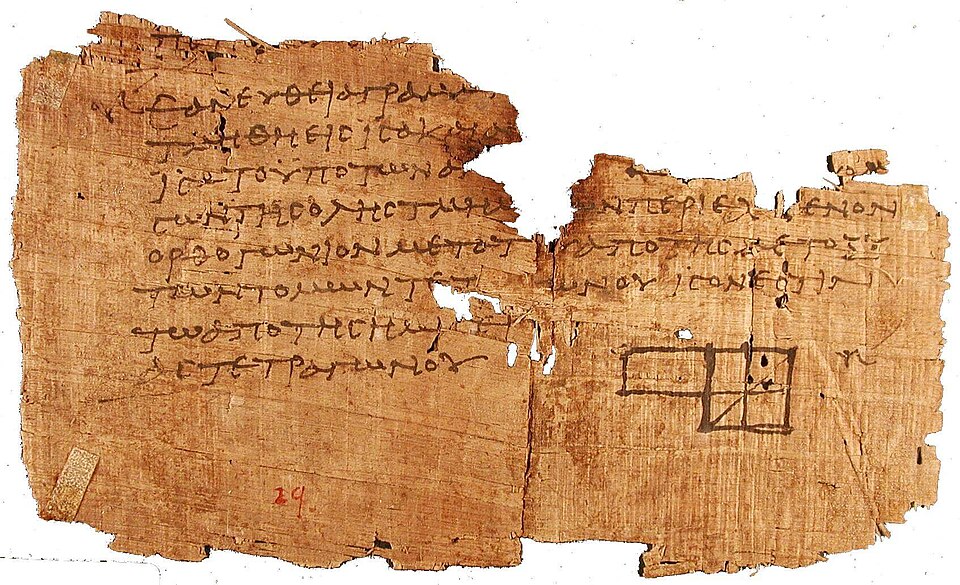
Who he was
Euclid of Alexandria
- Nascimento
- Around 325 BC, place unknown
- Morte
- Around 265 BC, probably Alexandria
- Origem
- Ptolemaic Egypt (Greek world)
- Áreas
- Geometry, number theory, optics and astronomy
Reading guide
Biography
Discovery and proof
- The Elements: definitions, postulates and common notions
- The first proposition: the equilateral triangle
- Pythagoras’s theorem, Euclid’s way
- Algebra done with squares and rectangles
- Euclid’s algorithm: the greatest common divisor
- The primes never run out
- The fifth postulate and the other geometries