
Euler's Eyes
2026-10-15
The legacy of Niels Henrik Abel
Abel has left mathematicians enough work for a hundred and fifty years.
— Saying attributed to Charles Hermite
Abel worked as a mathematician for less than eight years. In that time he settled the oldest question in algebra, brought rigour to series, created elliptic functions and wrote a memoir that was only fully understood decades after his death. His name is now found in more places in mathematics than that of almost anyone else: abelian groups, abelian integrals, abelian functions, abelian varieties, Abel’s theorem, Abel summation, Abel’s test.
The Paris memoir
The work Abel handed to the Paris Academy in 1826, and that Cauchy lost, contained an enormous result. It shows that, for any algebraic curve, sums of certain integrals along the curve can be reduced to a fixed number of them, which depends only on the curve. That number is what Riemann, thirty years later, would call the genus of the curve, the number of “holes” in the corresponding surface. Today the result is called Abel’s theorem, and algebraic geometry and the theory of Riemann surfaces grew out of it. It is said that Legendre, on learning of it, called it monumentum aere perennius, “a monument more lasting than bronze”, in the words of the Latin poet Horace.
The story of the manuscript is almost a novel. After Abel’s death the Norwegian consul in Paris asked the Academy to look for the text. Cauchy found it, and it was published in 1841, with errors. During printing the original disappeared again. It was only found in 1952, by the Norwegian mathematician Viggo Brun, in a library in Florence, among the papers of an Italian collector.
The monument and the prize
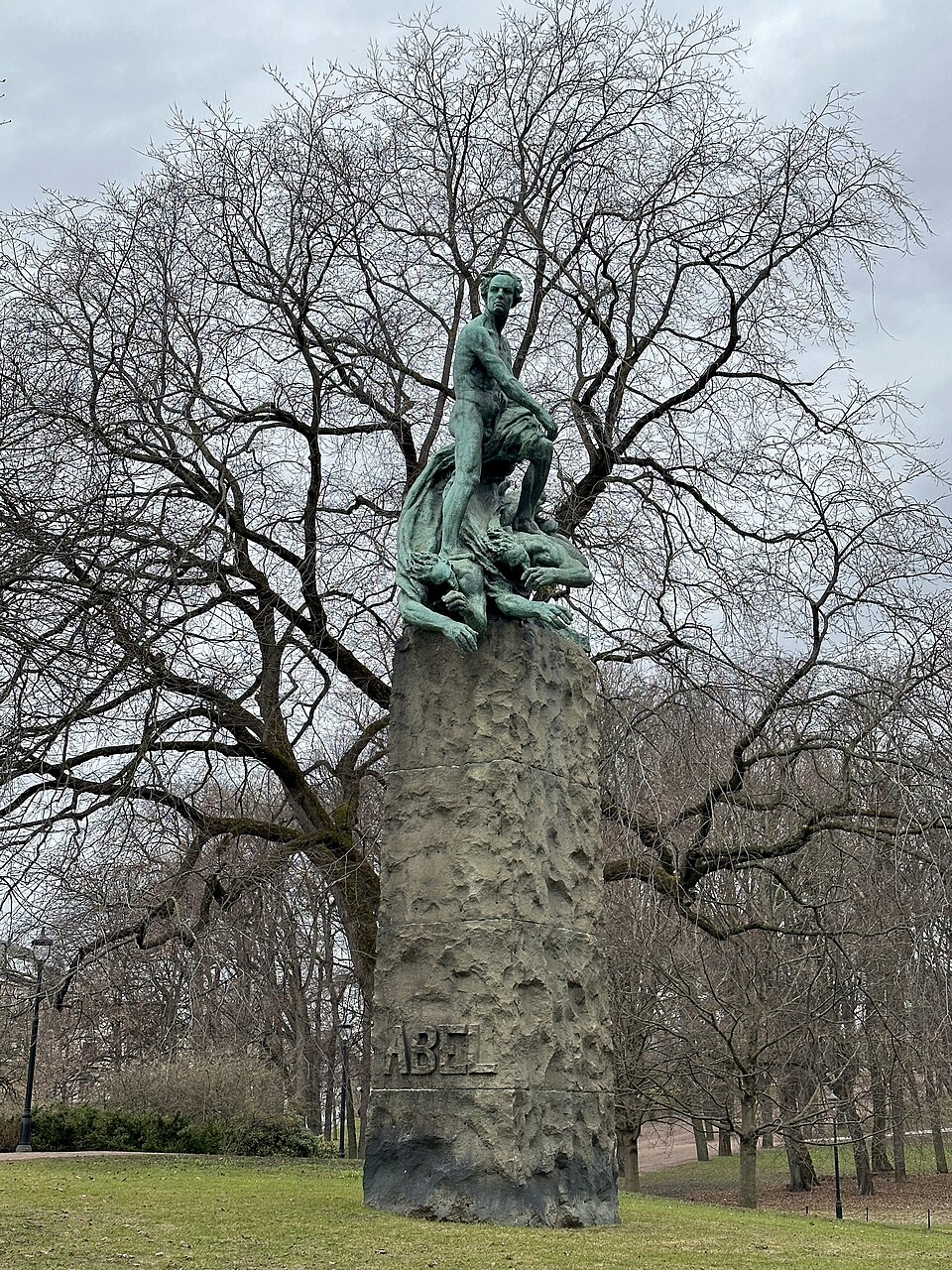
At the end of the nineteenth century, when he learned that the Nobel Prize would have no category for mathematics, the Norwegian Sophus Lie proposed creating a prize in Abel’s name. The idea lost momentum with Lie’s death in 1899 and with the separation of Norway and Sweden in 1905. It was taken up again at the bicentenary of Abel’s birth, in 2002: the Norwegian government created the Abel Prize, first awarded in 2003, to the Frenchman Jean-Pierre Serre. Today it is regarded as the equivalent of the Nobel in mathematics. In 2015 it went to John Nash and Louis Nirenberg.
What remained
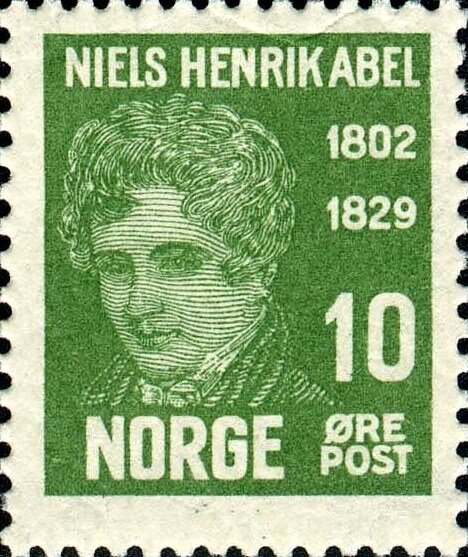
- Algebra. The impossibility of a general formula for degree 5, abelian equations and commutative groups.
- Analysis. Rigour in series, the binomial series for any exponent and Abel’s theorem on power series.
- Elliptic functions. The inversion of integrals, double periodicity and the addition formulas, together with Jacobi.
- Algebraic geometry. Abel’s theorem on the integrals of algebraic functions, the root of Riemann’s theory.
- Classical geometry. The division of the lemniscate with ruler and compass, for the same numbers as the circle.
To remember
- Niels Henrik Abel lived from 1802 to 1829. He did all his work between the ages of 19 and 26.
- There is no formula with radicals for the general equation of degree 5 or higher: this is the Abel-Ruffini theorem.
- The binomial series $(1+x)^m=1+mx+\cdots$ converges for $|x|<1$; Abel was the first to prove this for any $m$.
- Inverting the integral $\int\frac{dt}{\sqrt{1-t^4}}$ gives the lemniscatic sine, a function with two periods, one real and one imaginary.
- The point that halves each quarter of the lemniscate is at $\sqrt{\sqrt2-1}$ from the centre, a constructible number.
- A group is abelian when the order of the operations does not matter; equations with an abelian group can be solved by radicals.
Sources: Arild Stubhaug, Niels Henrik Abel and his Times (Springer, 2000) · the Abel Prize, Norwegian Academy of Science and Letters · Abel biography, MacTutor.
All topics on Niels Henrik Abel · ← Abelian groups: when order does not matter · Image credits →