
Euler's Eyes
2026-10-11
Chapter exercises 9 — Polygons
Exercises and resolutions
Determine, preferably without using the formula, the sum of the internal angles of a: a) convex pentagon; b) convex hexagon.
Ver resposta
a) $540^{\circ}$ · b) $720^{\circ}$ — decomposing into 3 and 4 triangles, respectively.
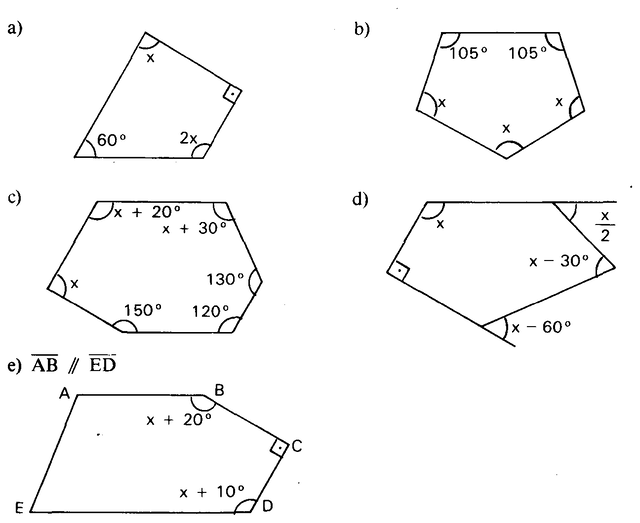
Determine the value of $x$ in cases (in and), $\overline{AB} \parallel \overline{ED}$):
Ver resposta
a) $70^{\circ}$ · b) $110^{\circ}$ · c) $90^{\circ}$ · d) $120^{\circ}$ · e) $120^{\circ}$
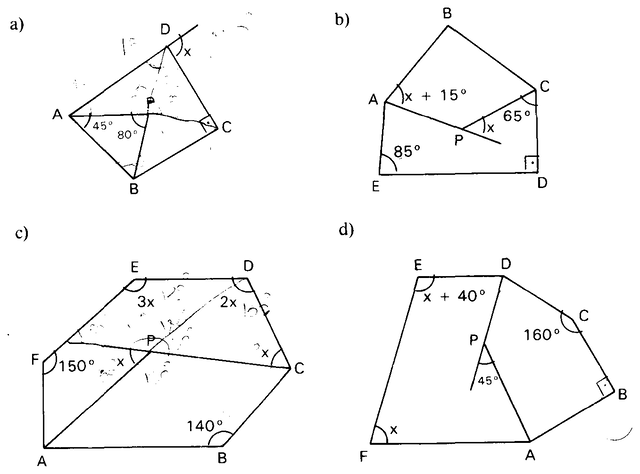
In the cases below, determine $x$, knowing that the segments $\overline{AP}$, $\overline{BP}$, $\overline{CP}$ and $\overline{DP}$, in the figures in which they appear, are angle bisectors.
Ver resposta
a) $110^{\circ}$ · b) $52^{\circ}30^{\prime}$ · c) $50^{\circ}$ · d) $60^{\circ}$
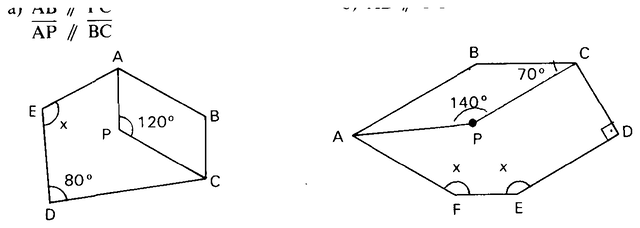
Being $\overline{AP}$ and $\overline{CP}$ angle bisectors from $\hat{A}$ and $\hat{C}$, determine $x$. In a), $\overline{AB} \parallel \overline{PC}$ and $\overline{AP} \parallel \overline{BC}$; in b), $\overline{AB} \parallel \overline{PC}$.
Ver resposta
a) $100^{\circ}$ · b) $150^{\circ}$
Determine the internal angle and external angle of one: a) equilateral triangle; b) square; c) regular pentagon; d) regular hexagon.
Ver resposta
a) $60^{\circ}$ e $120^{\circ}$ · b) $90^{\circ}$ e $90^{\circ}$ · c) $108^{\circ}$ e $72^{\circ}$ · d) $120^{\circ}$ e $60^{\circ}$
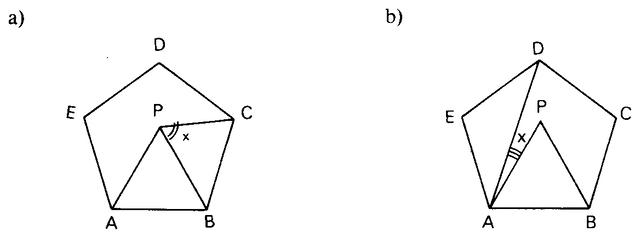
If the triangle $ABP$ is equilateral and $ABCDE$ is a regular pentagon, determine $x$ in the cases:
Ver resposta
a) $66^{\circ}$ · b) $12^{\circ}$
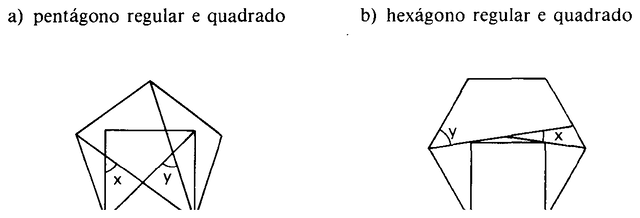
Determine the values of $x$ and $y$ in the cases: a) regular pentagon and square; b) regular and square hexagon.
Ver resposta
a) $x = 54^{\circ}$ e $y = 63^{\circ}$ · b) $x = 30^{\circ}$ e $y = 45^{\circ}$
Calculate the sum of the interior angles of a nonagon.
Ver resposta
$1\,260^{\circ}$
Calculate the sum of the interior angles of a decagon.
Ver resposta
$1\,440^{\circ}$
Calculate the sum of the interior angles of an icosagon.
Ver resposta
$3\,240^{\circ}$
What is the polygon whose interior angles add up to $1\,800^{\circ}$?
Ver resposta
Dodecagon
Calculate the number of diagonals in a decagon.
Ver resposta
35
Calculate the number of diagonals of an icosagon.
Ver resposta
170
Find the polygon whose number of diagonals is three times the number of sides.
Ver resposta
Eneagon
Determine the polygon whose number of diagonals is four times the number of sides.
Ver resposta
Undecagon
Determine the polygon that has 9 distinct diagonals.
Ver resposta
Hexagon
Determine the largest angle of a pentagon whose interior angles are in the ratio $3 : 3 : 3 : 4 : 5$.
Ver resposta
$150^{\circ}$
A regular polygon has, from one of its vertices, as many diagonals as there are diagonals of a hexagon. Find: a) the polygon; b) the total number of diagonals; c) the sum of the internal angles; d) the sum of the external angles; e) the measure of each internal angle and each external angle.
See the resolution of the book
- The hexagon has $d = \dfrac{6 \cdot 3}{2} = 9$ diagonals.
- From each vertex $n - 3$ diagonals depart: $n - 3 = 9 \Rightarrow n = 12$.
a) dodecagon; b) $d = \dfrac{12 \cdot 9}{2} = 54$; c) $S_i = 10 \cdot 180^{\circ} = 1\,800^{\circ}$; d) $S_e = 360^{\circ}$; e) $a_e = \dfrac{360^{\circ}}{12} = 30^{\circ}$ and $a_i = 150^{\circ}$.
How many diagonals can we draw starting from a vertex of a convex polygon with 20 sides?
Ver resposta
17
Determine the number of sides of a convex polygon, knowing that diagonals depart from one of its vertices 25.
Ver resposta
28
Determine the convex polygon whose sum of internal angles is equal to the number of diagonals multiplied by $180^{\circ}$.
Ver resposta
Quadrilateral
Can the internal and external angles of a regular polygon have equal measurements? In what case does this occur?
Ver resposta
Yes, in the square ($90^{\circ}$ and $90^{\circ}$).
Determine the number of diagonals of a regular convex polygon whose exterior angle is $24^{\circ}$.
Ver resposta
90
The ratio of the interior angle to the exterior angle of a regular polygon is 9. Determine the number of sides of the polygon.
Ver resposta
20
The internal angle of a regular polygon is 1,5 times its external angle. Determine the number of sides of the polygon.
Ver resposta
5
The exterior angle of a regular polygon is equal to twice its interior angle. Determine the number of diagonals in this polygon.
Ver resposta
Zero (this is equilateral triangle: $a_e = 120^{\circ} = 2 \cdot 60^{\circ}$).
The sum of the internal angles and the external angles of a regular polygon is $1\,800^{\circ}$. Determine the number of diagonals in the polygon.
Ver resposta
35
Determine the number of sides of a regular convex polygon whose interior angle is five times the exterior.
Ver resposta
12
Determine the number of sides of a regular polygon $ABCDE\ldots$, knowing that the angle bisectors $\overline{AP}$ and $\overline{CP}$ of the angles $\hat{A}$ and $\hat{C}$ form an angle that is worth $\dfrac{2}{9}$ of its internal angle.
Ver resposta
20
Determine the measure of the angle formed by the extensions of the sides $\overline{AB}$ and $\overline{CD}$ of a regular polygon $ABCD\ldots$ with 20 sides.
Ver resposta
$36^{\circ}$ or $144^{\circ}$
The perpendicular bisectors of two consecutive sides of a regular polygon form an angle of $24^{\circ}$. Determine the number of diagonals in this polygon.
Ver resposta
90
By increasing the number of sides of a polygon by 3, its number of diagonals increases by 21. Determine the number of diagonals in this polygon.
Ver resposta
14
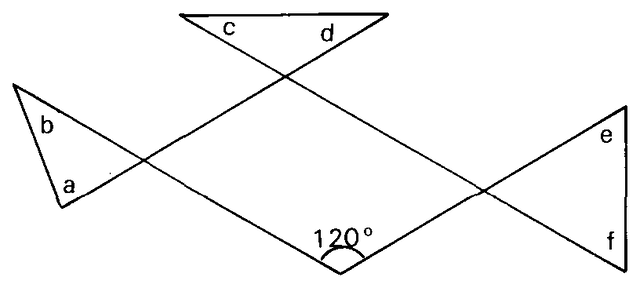
In the figure below, determine the sum of the measures of the angles $\hat{a} + \hat{b} + \hat{c} + \hat{d} + \hat{e} + \hat{f}$.
Ver resposta
$300^{\circ}$
Given two polygons with $n$ and $n + 6$ sides, respectively, calculate $n$, knowing that one of the polygons has 39 more diagonals than the other.
Ver resposta
$n = 5$
Three convex polygons have $n$, $n + 1$, and $n + 2$ sides, respectively. Since $2\,700^{\circ}$ is the sum of all the internal angles of the three polygons, determine the value of $n$.
Ver resposta
$n = 6$
The numbers that express the number of sides of three polygons are $n - 3$, $n$ and $n + 3$. Determine the number of diagonals of each of the polygons, knowing that the sum of all their internal angles is $3\,240^{\circ}$.
See the resolution of the book
Polygons have 5, 8, and 11 sides, and therefore $d_1 = 5$, $d_2 = 20$, and $d_3 = 44$ diagonals.
Three polygons have the number of sides expressed by consecutive integers. Knowing that the total number of diagonals of the three polygons is equal to 28, determine the polygon with the greatest number of diagonals.
Ver resposta
Heptagon
Two convex polygons have the number of sides expressed by the numbers $n$ and $n + 4$. Determine the value of $n$, knowing that one of the polygons has 34 more diagonals than the other.
Ver resposta
$n = 8$
A convex polygon has 5 more sides than another. Knowing that the total number of diagonals is 68, determine the number of diagonals of each polygon.
Ver resposta
14 e 54
Given two regular polygons, with $n + 1$ sides and $n$ sides, respectively, determine $n$, knowing that the interior angle of the first polygon exceeds the interior angle of the second by $5^{\circ}$.
Ver resposta
$n = 8$
A regular polygon has 30 diagonals that do not pass through its center. How long is each internal angle?
See the resolution of the book
A regular polygon only has diagonals through the center if $n$ is even, and then $\dfrac{n}{2}$ is theirs.
- $n$ odd: $d = 30 \Rightarrow n^2 - 3n - 60 = 0$, no natural root. It doesn’t work.
- $n$ par: $d = \dfrac{n}{2} + 30 \Rightarrow \dfrac{n(n-3)}{2} = \dfrac{n}{2} + 30 \Rightarrow n^2 - 4n - 60 = 0 \Rightarrow n = 10$.
It is the regular decagon: $a_e = 36^{\circ}$ and $a_i = 144^{\circ}$.
What is the regular polygon that has 6 diagonals passing through its center?
Ver resposta
Dodecagon
A regular polygon has 170 diagonals. How many pass through the center?
Ver resposta
10
The interior angle of a regular polygon measures $140^{\circ}$. How many diagonals pass through the center?
Ver resposta
None (it is the nonagon, with an odd number of sides).