
Euler's Eyes
2026-10-16
Frege and the morning star: what a = b says
Compare two sentences:
$$1024=1024\qquad\text{and}\qquad 2^{10}=1024.$$Both are true, and both say that a number is equal to itself: $2^{10}$ is $1024$. Even so, nobody learns anything from the first, and the second is a small discovery that costs ten multiplications. If the equals sign only said “these two things are the same”, the two sentences would say exactly the same thing. So what does the second one have that the first lacks?
The evening star and the morning star
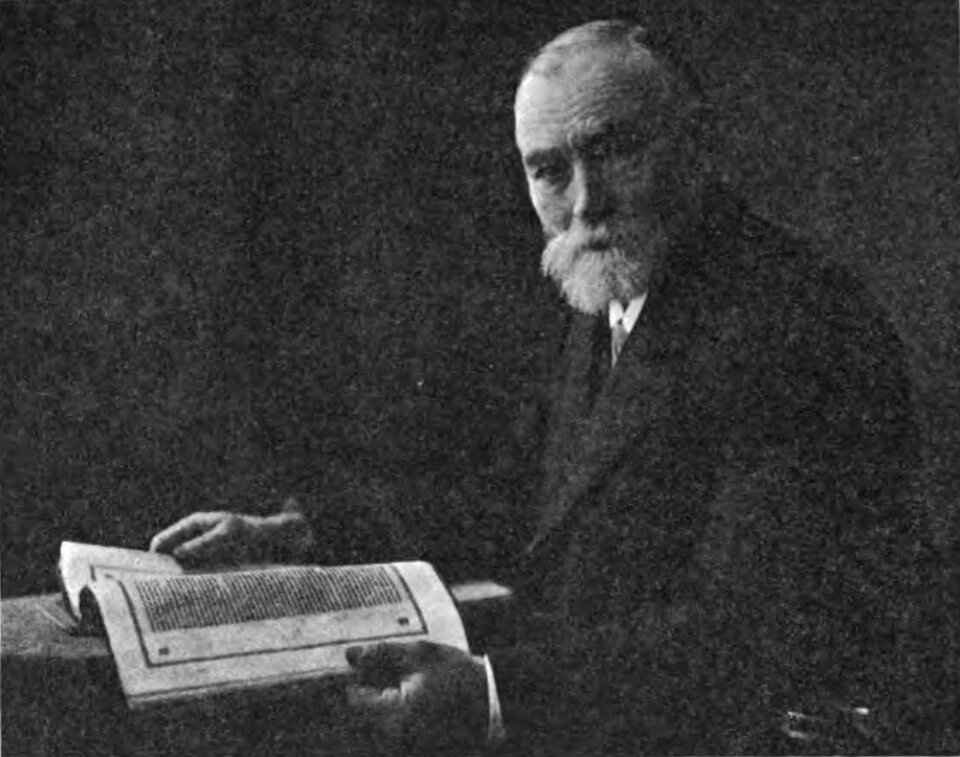
This question troubled the German mathematician Gottlob Frege, who answered it in 1892 in a short paper, On Sense and Reference. His example comes from astronomy. The ancient Greeks called the bright star that appears in the west at dusk Hesperus, and the one that appears in the east before dawn Phosphorus. Finding out that the two were the same heavenly body, the planet Venus, was an achievement. “Hesperus is Hesperus” teaches nothing; “Hesperus is Phosphorus” does.
Frege’s solution was to separate two things a name carries:
- the reference (Bedeutung): the object the name points to, in this case the planet Venus;
- the sense (Sinn): the way the name presents that object, “the body that shines at dusk” or “the body that shines at dawn”.
An equality $a=b$ is true when $a$ and $b$ have the same reference. And it is informative when they have different senses, when they reach the same object by different routes.
Sense and reference in numbers
Mathematics is full of different names for the same number:
$$4,\qquad 2+2,\qquad 2^2,\qquad \sqrt{16},\qquad \tfrac{8}{2},$$and also “the only even prime number, added to itself”. All have the same reference. But each one presents it in its own way, and each way tells a story: $2+2$ says how to put together, $2^2$ says how to multiply, $\sqrt{16}$ says which square it is the side of. This is what chapter 2 called the difference between the signifier and the object: the sign is not the thing, and the same thing has many signs.
This has an important consequence for anyone who writes calculations. Calculating means replacing one piece of writing by another with the same reference and a more useful sense. In
$$\frac{x^2-9}{x-3}=\frac{(x-3)(x+3)}{x-3}=x+3\qquad(x\neq3),$$the three expressions point to the same value, but the third is the easiest to use. A notation is active, in the sense of this book, when its sense already shows the way to other forms of writing: $2^{10}$ shows that $2^{10}=2^5\cdot2^5=32\cdot32$, and $1024$ shows nothing.
Leibniz’s law
If two pieces of writing point to the same object, it should be possible to replace one by the other in any sentence without changing its truth. Gottfried Leibniz put this idea into a Latin formula, which Frege quotes with approval:
Those things are the same which can be substituted for one another salva veritate, without loss of truth.
— Leibniz, quoted by Frege in The Foundations of Arithmetic (1884), §65
This is the rule used all the time in algebra without anyone naming it. If $x=3$, then $x^2+x=3^2+3=12$. If $y=2x$, then $x+y=x+2x=3x$. Replacing equals by equals is the engine of every calculation.
But Frege noticed that the rule fails in a special kind of sentence. Consider:
The student knows that $2^{10}=2^{10}$.
This is true of any student. Now replace the second $2^{10}$ by $1024$, which is the same number:
The student knows that $2^{10}=1024$.
This may be false. When a sentence is about what someone knows, believes or wrote, what matters is the sense, not just the reference. Logicians call these places opaque contexts. Inside a calculation, the equals sign lets you swap freely; inside a sentence about what is known of the calculation, it does not.
Exercise: which equality teaches more?
Order from least to most informative: $7=7$, $7=\frac{14}{2}$, $2^{10}=1024$, $e^{i\pi}=-1$.
$7=7$ teaches nothing: same sense, same reference. $7=\frac{14}{2}$ teaches little, one division. $2^{10}=1024$ takes ten multiplications. $e^{i\pi}=-1$, Euler’s formula, links the exponential, imaginary numbers and the geometry of the circle, and it took a century of mathematics to write it down. All four have the same form, $a=b$; what changes is the distance between the two senses.
Exercise: replace equals by equals
If $x=2y$ and $y\neq0$, what is $\dfrac{x+y}{x-y}$? By Leibniz’s law, replace $x$ by $2y$:
$$\frac{x+y}{x-y}=\frac{2y+y}{2y-y}=\frac{3y}{y}=3.$$The result does not depend on $y$. The replacement made $x$ disappear and revealed that the expression is constant, something that could not be seen in its original form.
Chapter index · ← One sign, many equals · Equation, identity, definition: three jobs for the same sign →