
Euler's Eyes
2026-10-15
Napier's two points: the definition of the logarithm
Napier did not have the exponent notation we use today. To define logarithms he used an image of motion, long before Newton and Leibniz created the calculus.
The definition
Imagine two points that start together. The first, $P$, moves along a segment $AB$ of length $10^7$, and its speed at each instant equals the distance still left to $B$: it starts fast and keeps slowing down, never arriving. The second, $Q$, moves along an endless line, always at $P$’s initial speed.
When $P$ is at a distance $x$ from $B$, the distance travelled by $Q$ is the logarithm of $x$.
Why $10^7$? Napier wanted the logarithms of sines, which were used in astronomy and navigation. At the time the sine was not a number between 0 and 1 but the length of a half-chord in a circle of large radius, to avoid fractions. Napier took the radius equal to $10^7$, and the sines were whole numbers of up to eight digits.
Today’s calculation
With calculus the definition becomes a differential equation. The distance left for $P$ is $x(t)$, and its speed is $-x'(t)=x(t)$, with $x(0)=10^7$. The solution is
$$x(t)=10^7e^{-t}.$$The point $Q$ moves at constant speed $10^7$, so it has covered $y=10^7t$. Eliminating $t$:
$$\boxed{\operatorname{NapLog}(x)=10^7\ln\frac{10^7}{x}.}$$For example, when $P$ is halfway, $x=5{,}000{,}000$ and
$$\operatorname{NapLog}(5{,}000{,}000)=10^7\ln2\approx6{,}931{,}472.$$Note that Napier’s logarithm decreases as $x$ grows, and that $\operatorname{NapLog}(10^7)=0$. Hidden in the formula is the number $e\approx2.71828$, which would only be named by Euler more than a century later. Napier never wrote it down, but his logarithms are, up to scale, logarithms to base $1/e$.
Products that become sums
From the formula comes the property that made the tables useful. Since $\ln$ turns products into sums,
$$\operatorname{NapLog}\!\left(\frac{xy}{10^7}\right)=\operatorname{NapLog}(x)+\operatorname{NapLog}(y).$$The factor $10^7$ was a nuisance: one had to remember to divide by it at every multiplication. It was one of the reasons why Napier and Briggs decided in 1615 to make a new table, with $\log1=0$ and $\log10=1$.
How Napier calculated
Napier did not have the formula. He built the tables by repeatedly multiplying by $1-10^{-7}$: the numbers
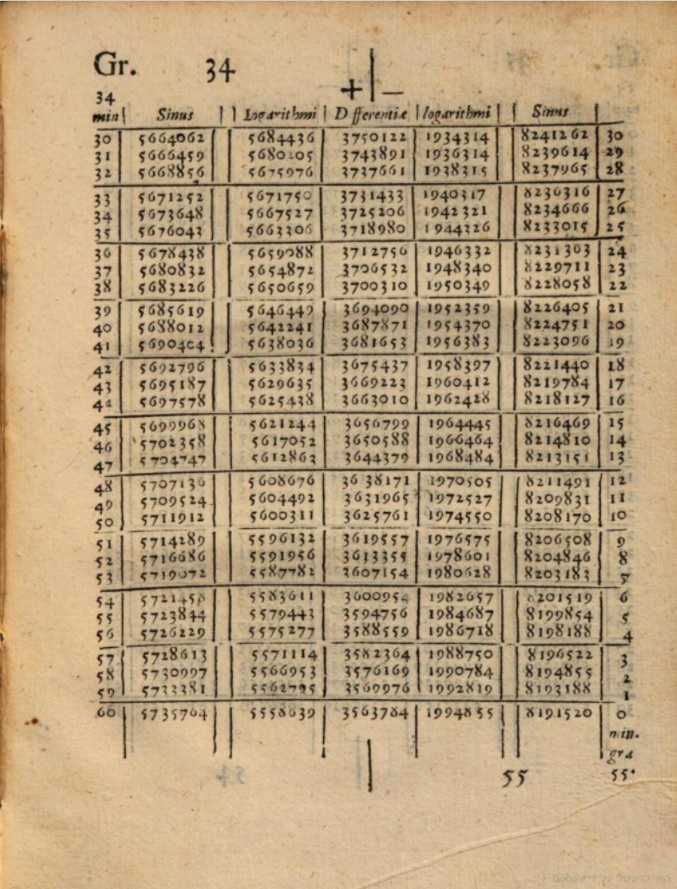
$$10^7,\quad10^7\left(1-10^{-7}\right),\quad10^7\left(1-10^{-7}\right)^2,\quad\dots$$have logarithms very close to $0, 1, 2,\dots$ Since multiplying by $0.9999999$ is just subtracting the number shifted seven places, each step required only one subtraction. Then, with auxiliary tables with bigger steps, $1-10^{-5}$ and $1-\frac1{2000}$, he reached all the sines minute by minute of arc. The Construction, published by his son in 1619, explains the method.
Exercise: compute NapLog(10⁷/e) and NapLog(2,500,000).
For $x=10^7/e$: $\operatorname{NapLog}=10^7\ln e=10^7$. For $x=2{,}500{,}000=10^7/4$: $\operatorname{NapLog}=10^7\ln4=2\times10^7\ln2\approx13{,}862{,}944$, twice the logarithm of the half, as the product property requires.
Exercise: why, at the first step of the table, is NapLog(9,999,999) almost exactly 1?
$\operatorname{NapLog}(9{,}999{,}999)=10^7\ln\frac{10^7}{9{,}999{,}999}=10^7\ln\frac1{1-10^{-7}}$. For small $h$, $\ln\frac1{1-h}\approx h+\frac{h^2}2$, so the logarithm is $1+5\times10^{-8}$, practically 1. Napier used exactly this approximation, with an estimate of the error.
Sources: John Napier, Mirifici logarithmorum canonis descriptio (1614) and Mirifici logarithmorum canonis constructio (1619) · Julian Havil, John Napier: Life, Logarithms, and Legacy (2014) · Eli Maor, e: The Story of a Number (Princeton, 1994).
All topics on John Napier · ← Multiplying by adding: the two progressions · Briggs and base-10 logarithms →