
Euler's Eyes
2026-10-11
The laws of motion: forces and changes in velocity
For Aristotle, a body moves only while something pushes it. Stop pushing the cart and it stops. It seems obvious, and it was accepted for almost two thousand years.
Galileo had his doubts. Rolling balls down inclined planes, he noticed that the smoother the surface, the further the ball went. With no friction at all, it would never stop. Descartes reached a similar idea. Newton put these clues together and, in the Principia of 1687, wrote three laws that became the foundation of all mechanics.
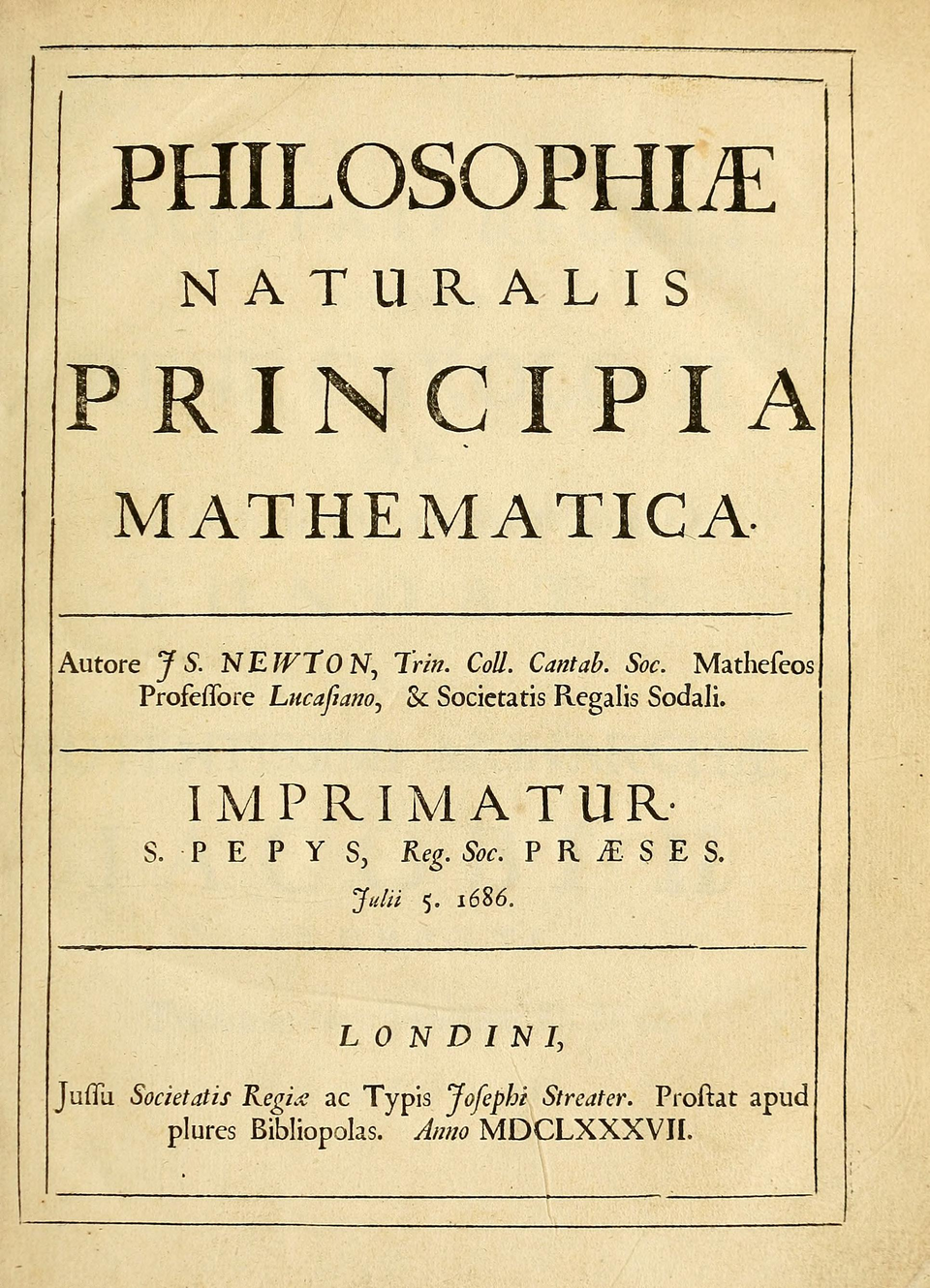
The book was written in Latin, and its proofs use almost nothing but geometry, in the style of Euclid. Newton already had fluxions, but he preferred the language his readers would accept without argument. The laws appear right at the start, as axioms.
First law: inertia
Every body perseveres in its state of rest, or of uniform motion in a straight line, unless it is compelled to change that state by forces impressed upon it.
— Principia, Law I
The cart stops because friction slows it down, not because it “gets tired” of moving. In space, far from everything, a probe with its engines off travels in a straight line for millions of kilometres. That is the case of the Voyager probes, launched in 1977 and still moving away from the Sun.
The lesson is counter-intuitive: force is not what keeps motion going; it is what changes motion.
Second law: force and acceleration
The change of motion is proportional to the motive force impressed, and takes place along the straight line in which that force is impressed.
— Principia, Law II
By “motion” Newton meant what we now call momentum: mass times velocity. When the mass does not change, the law becomes the familiar formula:
$$\sum\vec F=m\,\vec a.$$The $\sum$ is a reminder that what counts is the sum of all the forces. If a 10 N force pushes a 2 kg block to the right and 4 N of friction pulls it to the left, the net force is 6 N to the right, and
$$a=\frac{6}{2}=3\ \text{m/s}^2.$$In the language of fluxions, acceleration is $\ddot x$, the fluxion of the fluxion of position. The second law then says that $m\ddot x=F$: a differential equation. Knowing the forces, we can compute the whole motion, instant by instant. That is what makes Newton’s mechanics a prediction machine.
Third law: action and reaction
To every action there is always opposed an equal reaction.
— Principia, Law III
When you push a wall, the wall pushes you back with the same force. When a swimmer pushes water backwards, the water pushes the swimmer forwards. A rocket works the same way: it expels gas downwards, and the gas pushes the rocket upwards.
A common confusion: if the forces are equal and opposite, why don’t they cancel? Because they act on different bodies. The force you exert is on the wall; the force the wall exerts is on you. To know whether you accelerate, count only the forces acting on you.
The reach of the three laws
With these three sentences, plus the law of gravitation, the Principia explained falling bodies, the motion of projectiles, the tides, the orbit of the Moon and the flattening of the Earth at the poles. They are still the laws used to design bridges, compute satellite trajectories and simulate car crashes.
Exercise: the net force on a body is zero. Must its velocity be zero?
No. By the first law, it may be at rest or moving in a straight line at constant velocity. Zero net force means zero acceleration, not zero velocity.
Exercise: a 1000 kg car goes from 0 to 20 m/s in 10 s. What is the average net force?
The average acceleration is $\dfrac{20}{10}=2$ m/s². By the second law, $F=1000\cdot2=2000$ N.
Sources: timeline and publication of the Principia, Newton Project · MacTutor biography.
All Isaac Newton topics · ← Newton’s method: approximating roots with tangents · Gravitation: from the apple to the Moon →