
Euler's Eyes
2026-10-22
Arcs and arc measurements
Before talking about sine or cosine, we need to know how to measure a piece of circumference. There are two rulers for this: the degree, inherited from the Babylonians, and the radian, which measures the arc with the radius itself.
The story
The division of the circumference into 360 parts comes from the astronomy of Mesopotamia, which counted based on 60 and followed the Sun, which covered the sky in about 360 days. In the second century BC, Hipparchus of Nicaea adopted the 360 degrees in his chord tables, and Ptolemy, in Almagest (c. 150 AD), divided each degree into 60 minutes and each minute into 60 seconds — the minutae primae and secundae parts that gave their names to the minute and the second.
The idea of measuring an arc by length, taking the radius as the unit, is much more recent. The Englishman Roger Cotes realized in 1714 that this was the “natural” unit of angles, and Leonhard Euler used it systematically in Introductio in analysin infiniterum (1748), working on a circle of radius 1. The word radian only appeared in print in 1873, in exam questions prepared by the engineer James Thomson, brother of Lord Kelvin.
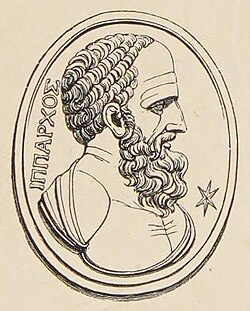
- c. 1800 a.C.The Babylonians do the math in base 60, an inheritance that was left in 60 minutes and 60 seconds.
- century. II BCHiparchus uses the 360 degrees in the first chord tables.
- c. 150Ptolemy, in Almagest, divides the degree into minutes and seconds.
- 1714Roger Cotes realizes that the radius is the natural unit of angles.
- 1748Euler works on a circle of radius 1 in Introductio.
- 1873The word radian appears in print, in James Thomson’s proofs.
The words. Trigonometry joins the Greek trígōnon, “triangle”, and metron, “measure”. Ptolemy called each of the 360 parts of the circumference moîra (μοῖρα, “portion”); the sixtieth part of a moîra was the proton hexēkostón, “first sixtieth”, and the sixtieth of this, the deuteron hexēkostón, “second sixtieth”. The Latin translators rendered these names as gradus (“step”), pars minuta prima (“first small part”) and pars minuta secunda — and from there came, shortened, the degree, the minute and second.
| Portuguese | English | Latin | Ptolemy’s Greek |
|---|---|---|---|
| degree | degree | gradus | moîra |
| minute | minute | pars minuta prima | proton hexēkostón |
| second | second | second minute | deuteron hexēkostón |
The signals $^\circ$, $'$ and $''$ took a while to become fixed. During the 16th century, each author wrote degrees, minutes and seconds in their own way: there are different forms in a calendar by Regiomontanus (1473), in Arithmetica practica by Oronce Finé (1535), in the arithmetic books of Gemma Frisius (1539) and in De nova stella by Tycho Brahe (1573), about the nova star he observed in 1572.
Sources: Roger Cotes (MacTutor) · Hiparchus (MacTutor) · Ptolemy (MacTutor) · F. Cajori, A History of Mathematical Notations, vol. II (1929).
In everyday life
- Navigation and maps. Latitudes and longitudes are given in degrees, minutes and seconds: $23^\circ 33'$ S is the approximate latitude of São Paulo.
- Wheels and gears. A wheel of radius $r$ that rotates an angle of $\theta$ radians makes a point on the edge go exactly $\theta \cdot r$.
- Calculators and computers. The functions
sin,cosandtanof programming languages work in radians; on calculators, theDEGmode uses degrees and theRADmode uses radians.
Sources: Roger Cotes (MacTutor) · Hiparchus (MacTutor) · Ptolemy (MacTutor).
Theory
Circumference arcs
DefiniçãoCircumference arc
Two distinct points $A$ and $B$ on a circle divide it into two parts. Each of these parts, including $A$ and $B$, is a circle arc $\overset{\frown}{AB}$.
If $A$ and $B$ coincide, they also determine two arcs: one of them is the point itself, called null arc; the other is the entire circumference, called one-turn arc.
Measurement of an arc
To compare the “sizes” of two arcs $\overset{\frown}{AB}$ and $\overset{\frown}{CD}$, we need a method to measure arcs.
DefiniçãoMeasurement of an arc
The measurement of an arc $\overset{\frown}{AB}$ in relation to a unitary arc $u$ (non-null and with the same radius as $\overset{\frown}{AB}$) is the real number that expresses how many times the arc $u$ fits in the arc $\overset{\frown}{AB}$.
If $u$ fits 6 times in $\overset{\frown}{AB}$, we write $\overset{\frown}{AB} = 6 \cdot u$, and the measure of $\overset{\frown}{AB}$ is 6.
Units: degree and radian
If each person chose their unit $u$, the same arc would have different measurements. That’s why we only use two arc units.
DefiniçãoDegree and radian
- Degree (symbol $^\circ$) is the unit arc equal to $\dfrac{1}{360}$ of the circle containing the measured arc.
- Radian (rad symbol) is the unit arc whose length is equal to the radius of the circle containing the measured arc.
Saying that $\overset{\frown}{AB}$ measures 1 rad means that, by “stretching” the arc, we obtain a segment of length equal to the radius.
How many radians are in a circle?
It is evident that the circumference measures $360^\circ$. How many radians it measures is no longer so obvious. A construction gives the idea:
- In a circle with center $O$ and radius $r$, we inscribe a regular hexagon $ABCDEF$. Each side measures $r$: $\overline{AB} = \overline{BC} = \cdots = \overline{FA} = r$.
- The circle is divided into 6 equal arcs, $\overset{\frown}{AB} = \overset{\frown}{BC} = \cdots = \overset{\frown}{FA}$. Since the arc is always longer than the string, each of these arcs measures more than 1 rad.
- Each of them “fits” 1 rad — $\overset{\frown}{AB'} = \overset{\frown}{BC'} = \cdots = \overset{\frown}{FA'} = 1$ rad — and there is still a fraction of a radian left.
- Therefore, the radian fits 6 times in the circumference, and there is still the sum of these six “leftovers”.
More precisely, it is shown that the circumference measures $6{,}283185\ldots$ rad. This number is $2\pi$, where $\pi = 3{,}14159\ldots$ is the ratio of the length of any circle to its diameter: the length is $2\pi r$, and the radius fits within it exactly $2\pi$ times.
ResumoUnit conversion
$$360^\circ \;\longleftrightarrow\; 2\pi \text{ rad} \qquad\qquad 180^\circ \;\longleftrightarrow\; \pi \text{ rad}$$To convert, just a rule of three starting from $180^\circ \leftrightarrow \pi$ rad:
$$x \text{ (rad)} = \frac{\pi}{180} \cdot g \text{ (graus)} \qquad\qquad g \text{ (graus)} = \frac{180}{\pi} \cdot x \text{ (rad)}.$$In particular, $1 \text{ rad} = \dfrac{180^\circ}{\pi} \approx 57^\circ 17' 44''$.
| Degrees | $0^\circ$ | $30^\circ$ | $45^\circ$ | $60^\circ$ | $90^\circ$ | $180^\circ$ | $270^\circ$ | $360^\circ$ |
|---|---|---|---|---|---|---|---|---|
| Radians | $0$ | $\dfrac{\pi}{6}$ | $\dfrac{\pi}{4}$ | $\dfrac{\pi}{3}$ | $\dfrac{\pi}{2}$ | $\pi$ | $\dfrac{3\pi}{2}$ | $2\pi$ |
AtençãoMinutes and seconds
The degree is divided into $60'$ (minutes) and the minute into $60''$ (seconds): $1^\circ = 60'$ and $1' = 60''$. Thus, $30' = 0{,}5^\circ$. To convert an arc like $22^\circ 30'$ to radians, write everything in the smallest unit ($1350'$) and compare it to $180^\circ = 10\,800'$.
The exercises in this section are numbers 1 to 10 from chapter list.