
Euler's Eyes
2026-11-04
EJU 2017 (1st session) – Mathematics Course 2 solved
Source: JASSO – Mathematics paper in English, in Japanese and official answer key. Files on the page for the 1st session of 2017.
Course 2 is the advanced mathematics paper of the EJU. Each letter $\boxed{\text{A}}$, $\boxed{\text{B}}$, … is a digit from 0 to 9 or the minus sign; in some blanks the answer is the number of a choice. The statements below are summarized from the official English version.
Answer key
| Question | Topic | Answers |
|---|---|---|
| I | Same as Question I of Course 1 | A=3, BC=12, DE=14, F=2, G=8, H=3, I=2, J=6, K=1, L=1, M=5; NO=90, PQ=12, RS=33, T=4, UV=15, WX=13, YZ=30 |
| II Q1 | Centroid on a segment | A=2, B=1, C=4, D=3, E=2, F=5, G=6, H=1, I=6, JK=39, L=6 |
| II Q2 | Triangle in the complex plane | M=2, N=7, O=1, P=2, Q=3, R=1, S=2, T=1, U=6 |
| III | $2^{x^2}/5^{3x}$ | A=2, B=3, C=5, D=3, E=2, F=2, G=2, H=2, I=2, J=3, K=5, L=3, M=7, NO=89, P=2, Q=9 |
| IV | $x\sin^2x$ and a tangent | A=0, B=3, C=5, D=6, E=0, F=8, G=9, H=1, IJ=16, K=2, L=1, M=4 |
Question I
Question I of Course 2 is identical to that of Course 1 (translation and reflection of parabolas, and colored cards). The full solution is in the Course 1 post.
Answers: A=3, BC=12, DE=14, F=2, G=8, H=3, I=2, J=6, K=1, L=1, M=5; NO=90, PQ=12, RS=33, T=4, UV=15, WX=13, YZ=30.
Question II
Q1: the centroid on a segment
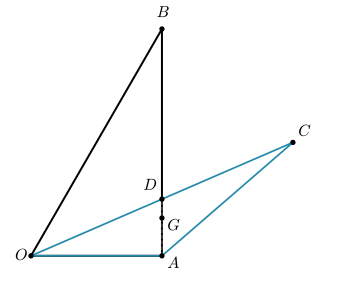
Statement. Triangles $OAB$ and $OAC$ share side $OA$ and satisfy (i) $\vec{OC} = x\vec{OA} + \frac12\vec{OB}$ and (ii) the centroid $G$ of triangle $OAC$ lies on segment $AB$. We want $x$ and $\vec{OG}$ in terms of $\vec{OA}$ and $\vec{OB}$. Let $D$ be the intersection of segments $OC$ and $AB$. Then
$$\vec{OD} = \frac{x}{\boxed{\text{A}}}\vec{OA} + \frac{\boxed{\text{B}}}{\boxed{\text{C}}}\vec{OB}.$$Since $D$ lies on $AB$, $x = \dfrac{\boxed{\text{D}}}{\boxed{\text{E}}}$, and $\vec{OG} = \dfrac{\boxed{\text{F}}}{\boxed{\text{G}}}\vec{OA} + \dfrac{\boxed{\text{H}}}{\boxed{\text{I}}}\vec{OB}$. In particular, with $OA = 1$, $OB = 2$ and $\angle AOB = 60^\circ$, $OG = \dfrac{\sqrt{\boxed{\text{JK}}}}{\boxed{\text{L}}}$.
Solution.
1. $D$ is the midpoint of $OC$. The centroid of $OAC$ lies on the median from $A$ to the midpoint of $OC$. Since $G$ and $A$ are on line $AB$, that median is line $AB$ itself, and it meets $OC$ at its midpoint. So $\vec{OD} = \frac12\vec{OC} = \frac x2\vec{OA} + \frac14\vec{OB}$.
2. $x$. $D$ is on line $AB$ when the coefficients add up to 1: $\frac x2 + \frac14 = 1$, $x = \frac32$.
3. $\vec{OG}$. $\vec{OG} = \frac{\vec{OA} + \vec{OC}}{3} = \frac{\frac52\vec{OA} + \frac12\vec{OB}}{3} = \frac56\vec{OA} + \frac16\vec{OB}$. (Indeed the coefficients add up to 1.)
4. The length. With $\vec a\cdot\vec b = 1\cdot2\cos60^\circ = 1$:
$$|\vec{OG}|^2 = \frac{|5\vec a + \vec b|^2}{36} = \frac{25 + 4 + 10}{36} = \frac{39}{36}, \qquad OG = \frac{\sqrt{39}}{6}.$$Answers: A=2, B=1, C=4, D=3, E=2, F=5, G=6, H=1, I=6, JK=39, L=6.
Q2: a triangle in the complex plane
Statement. Let $z$ be a complex number with $|z| = 2$. In the complex plane, $A$ and $B$ represent $1 + z$ and $1 - \frac12z$. Write $z = \boxed{\text{M}}(\cos\theta + i\sin\theta)$, $-\pi \le \theta < \pi$.
- If $z$ is not real, the area of triangle $OAB$ is $S = \boxed{\text{N}}$ (choose from ⓪ $\frac12|\sin(\theta + \frac\pi3)|$, ① $\frac12|\sin\theta|$, ② $\frac12|\sin(\theta - \frac\pi3)|$, ③ $|\sin(\theta + \frac\pi3)|$, ④ $|\sin\theta|$, ⑤ $|\sin(\theta - \frac\pi3)|$, ⑥ $\frac32|\sin(\theta + \frac\pi3)|$, ⑦ $\frac32|\sin\theta|$, ⑧ $\frac32|\sin(\theta - \frac\pi3)|$). $S$ is largest at $\theta = \pm\dfrac{\boxed{\text{O}}}{\boxed{\text{P}}}\pi$.
- If $OA = OB$, then $|1 + z| = \left|1 - \frac12z\right| = \sqrt{\boxed{\text{Q}}}$, and $\arg(1 + z) = \pm\dfrac{\boxed{\text{R}}}{\boxed{\text{S}}}\pi$, $\arg\left(1 - \frac12z\right) = \mp\dfrac{\boxed{\text{T}}}{\boxed{\text{U}}}\pi$ (opposite signs), with arguments in $[-\pi, \pi)$.
Solution.
1. The area. The area of the triangle with vertices $0$, $u$, $v$ is $\frac12|\operatorname{Im}(\bar u v)|$. With $u = 1 + z$, $v = 1 - \frac z2$ and $z\bar z = 4$:
$$\bar u v = (1 + \bar z)\left(1 - \frac z2\right) = 1 - \frac z2 + \bar z - 2,$$whose imaginary part is $-\sin\theta - 2\sin\theta = -3\sin\theta$. So $S = \frac32|\sin\theta|$ (⑦), largest at $\theta = \pm\frac\pi2$.
2. $OA = OB$. $|1 + z|^2 = 5 + 4\cos\theta$ and $\left|1 - \frac z2\right|^2 = 2 - 2\cos\theta$. Equating: $\cos\theta = -\frac12$, and both squares equal $3$. With $\theta = \pm\frac{2\pi}{3}$, $z = -1 \pm\sqrt3\,i$: $1 + z = \pm\sqrt3\,i$, with argument $\pm\frac\pi2$; and $1 - \frac z2 = \frac32 \mp \frac{\sqrt3}{2}i$, with argument $\mp\frac\pi6$.
Answers: M=2, N=7, O=1, P=2, Q=3, R=1, S=2, T=1, U=6.
Question III: the minimum of 2^(x²)/5^(3x)
Statement. Consider $y = \dfrac{2^{x^2}}{5^{3x}}$, with $x \ge 0$.
- Differentiating, $\dfrac{dy}{dx} = \dfrac{2^{x^2}}{5^{3x}}\left(2x\log_e\boxed{\text{A}} - \boxed{\text{B}}\log_e\boxed{\text{C}}\right)$. With common logarithms, $y$ is smallest at $x = \dfrac{\boxed{\text{D}}\left(1 - \log_{10}\boxed{\text{E}}\right)}{\boxed{\text{F}}\log_{10}\boxed{\text{G}}}$.
- The smallest positive integer $x$ with $y > 1000$. From $y > 1000$: $x^{\boxed{\text{H}}}\log_{10}\boxed{\text{I}} - \boxed{\text{J}}\,x\log_{10}\boxed{\text{K}} - \boxed{\text{L}} > 0$ ①. Using $\log_{10}2 \approx 0.3$, $x > \dfrac{\boxed{\text{M}} + \sqrt{\boxed{\text{NO}}}}{\boxed{\text{P}}}$, and the smallest integer is $\boxed{\text{Q}}$.
Solution.
1. $\ln y = x^2\ln2 - 3x\ln5$, so $y' = y\,(2x\ln2 - 3\ln5)$, which vanishes at $x = \frac{3\ln5}{2\ln2}$ (negative before, positive after). A ratio of logarithms does not depend on the base, and $\log_{10}5 = 1 - \log_{10}2$: $x = \frac{3(1 - \log_{10}2)}{2\log_{10}2} \approx 3.48$.
2. $\log_{10}y > 3$ gives $x^2\log_{10}2 - 3x\log_{10}5 - 3 > 0$. With $\log_{10}2 = 0.3$ and $\log_{10}5 = 0.7$: $0.3x^2 - 2.1x - 3 > 0$, or $x^2 - 7x - 10 > 0$, that is, $x > \frac{7 + \sqrt{89}}{2} \approx 8.22$. The smallest integer is $9$.
(With the exact values: at $x = 8$, $\log_{10}y \approx 2.49$; at $x = 9$, $\approx 5.51$. The approximation does not change the answer.)
Answers: A=2, B=3, C=5, D=3, E=2, F=2, G=2, H=2, I=2, J=3, K=5, L=3, M=7, NO=89, P=2, Q=9.
Question IV: x·sin²x and the tangent through the origin
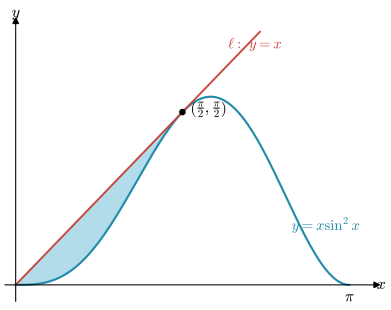
Statement. Let $f(x) = x\sin^2x$ on $0 \le x \le \pi$, and let $\ell$ be the tangent to the graph through the origin, other than the $x$-axis. We want the area $S$ between the curve and $\ell$.
- Choose $\boxed{\text{A}}$ to $\boxed{\text{D}}$ from ⓪ $f(t) = tf'(t)$, ① $f'(t) = tf(t)$, ② $\sin t$, ③ $\sin^2t$, ④ $\cos^2t$, ⑤ $\sin t\cos t$, ⑥ $\frac\pi2$, ⑦ $\frac\pi3$, ⑧ $\frac\pi4$, ⑨ $\frac\pi6$. If the point of tangency is $(t, f(t))$, then $\boxed{\text{A}}$ holds, because $\ell$ passes through the origin. Since $f'(t) = \boxed{\text{B}} + 2t\,\boxed{\text{C}}$, the point of tangency has $t = \boxed{\text{D}}$.
- Choose $\boxed{\text{E}}$ to $\boxed{\text{G}}$ from ⓪ $\frac18$, ① $\frac14$, ② $\frac12$, ③ $2$, ④ $4$, ⑤ $8$, ⑥ $\sin x$, ⑦ $\cos x$, ⑧ $\sin2x$, ⑨ $\cos2x$: $\int f(x)\,dx = \boxed{\text{E}}\left(2x^2 - 2x\,\boxed{\text{F}} - \boxed{\text{G}}\right) + C$.
- The area is $S = \dfrac{\boxed{\text{H}}}{\boxed{\text{IJ}}}\pi^{\boxed{\text{K}}} - \dfrac{\boxed{\text{L}}}{\boxed{\text{M}}}$.
Solution.
1. The tangent. The tangent at $t$ is $y = f'(t)(x - t) + f(t)$; passing through the origin means $f(t) = tf'(t)$ (⓪). With $f'(t) = \sin^2t + 2t\sin t\cos t$ (③, ⑤):
$$t\sin^2t = t\sin^2t + 2t^2\sin t\cos t \iff t^2\sin t\cos t = 0.$$$t = 0$ and $\sin t = 0$ give horizontal tangents (the $x$-axis). What remains is $\cos t = 0$: $t = \frac\pi2$ (⑥). There $f'\left(\frac\pi2\right) = 1$, and $\ell: y = x$.
2. The antiderivative. $x\sin^2x = \frac x2 - \frac{x\cos2x}{2}$. By parts, $\int x\cos2x\,dx = \frac{x\sin2x}{2} + \frac{\cos2x}{4}$. So
$$\int x\sin^2x\,dx = \frac{x^2}{4} - \frac{x\sin2x}{4} - \frac{\cos2x}{8} = \frac18\left(2x^2 - 2x\sin2x - \cos2x\right) + C \quad (\text{⓪}, \text{⑧}, \text{⑨}).$$3. The area. On $[0, \frac\pi2]$, $x\sin^2x \le x$, with equality at the endpoints:
$$S = \int_0^{\pi/2}x\,dx - \frac18\Big[2x^2 - 2x\sin2x - \cos2x\Big]_0^{\pi/2} = \frac{\pi^2}{8} - \frac18\left(\frac{\pi^2}{2} + 1 + 1\right) = \frac{\pi^2}{16} - \frac14.$$Answers: A=0, B=3, C=5, D=6, E=0, F=8, G=9, H=1, IJ=16, K=2, L=1, M=4.