
Euler's Eyes
2026-10-11
Right, acute and obtuse angles — measurement
Why does a complete turn have 360 degrees, and not 100? The answer lies in Mesopotamian astronomy.
Who discovered
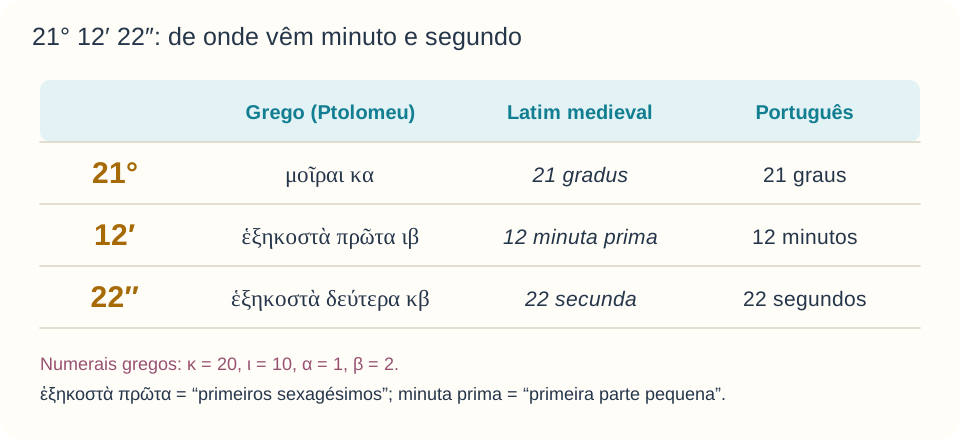
The names straight, acute and obtuse come from Euclid, who defines them in The Elements (definitions I.10 to I.12): straight is the angle equal to its supplementary adjacent; acute, smaller than the straight; obtuse, the biggest. The measurement in degrees has another origin, Babylonian astronomy, as explained in the curiosity “Why 360 degrees?”, below. The words minute and second come from the Latin translations of Claudius Ptolemy (2nd century AD).

The story
Euclid never measured angles in degrees. For him, the right angle was the natural unit: an angle was “equal to two right angles” or “less than a right angle”, and his fourth postulate states that all right angles are equal. The numerical measurement came from astronomers, who needed to locate stars and planets in the sky.
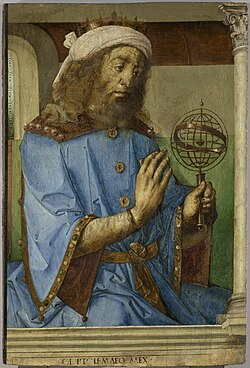
In Almagest, Ptolemy subdivided each degree into base fractions 60. In Latin translations, they became partes minutae primae and partes minutae secundae — “first small parts” and “second small parts” —, where minute and second come from.
In the French Revolution, along with the meter, an attempt was made to divide the right angle into 100 parts, the grad. The unit survives in the “GRAD” mode of scientific calculators, but the degrees have expired.
In everyday life
- Bricklayer’s square. Ensures that walls and floors meet at right angles.
- Geographical coordinates. Latitude and longitude are angles measured in degrees, minutes and seconds.
- Maneuvers. “To give 180” is to reverse the meaning; a “360” on a skateboard is a complete turn.
- Compass. The heading of a plane or ship is given in degrees from North: 90° is East, 180° is South.
Sources: Elements, postulate 4 · Ptolemy (MacTutor) · Elements, definition I.10.
Theory and constructions
DefiniçãoAdjacent supplementary; straight, acute and obtuse
Given the angle $A\hat{O}B$, the ray $\overrightarrow{OC}$ opposite $\overrightarrow{OA}$ and the ray $\overrightarrow{OB}$ determine the angle $B\hat{O}C$, called adjacent supplementary (or adjacent supplement) of $A\hat{O}B$.
- Right angle is any angle congruent to its adjacent supplementary.
- Acute angle is an angle smaller than a right angle.
- Obtuse angle is an angle greater than a right angle.
Return to the protractor figure and use the “Supplementary adjacent” button: when $A\hat{O}B$ and $B\hat{O}C$ are equal, each measures $90^{\circ}$ — it is the right angle.

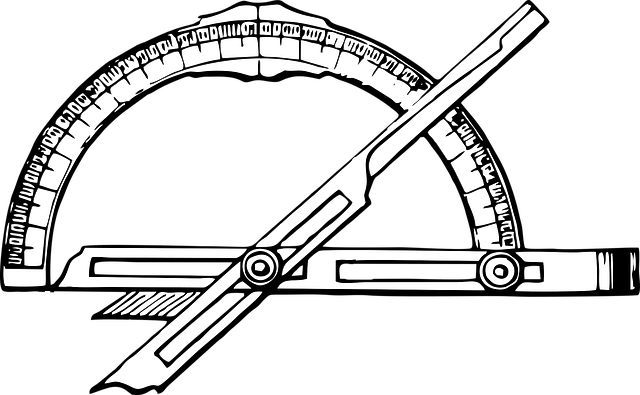
DefiniçãoMeasure of an angle (amplitude)
The measure of an angle $A\hat{O}B$, indicated by $m(A\hat{O}B)$, is a positive real number such that:
- congruent angles have equal measures and vice versa;
- if one angle is greater than another, its measure is greater;
- the sum of the measures corresponds to the angle sum: $\widehat{rt} = \widehat{ab} + \widehat{cd} \Rightarrow m(\widehat{rt}) = m(\widehat{ab}) + m(\widehat{cd})$.
The measurement of an angle is also called amplitude.
Units: degree, minute, second and grade


| Unit | Definition | Relationship |
|---|---|---|
| degree ($1^{\circ}$) | submultiple of the right angle second 90 | right angle $= 90^{\circ}$ |
| minute ($1^{\prime}$) | submultiple of the second degree 60 | $1^{\circ} = 60^{\prime}$ |
| second ($1^{\prime\prime}$) | submultiple of minute second 60 | $1^{\prime} = 60^{\prime\prime}$ |
| degree ($1\,\text{gr}$) | submultiple of the right angle second 100 | right angle $= 100\,\text{gr}$ |
An acute angle measures less than $90^{\circ}$; an obtuse, more than $90^{\circ}$. The measure $\alpha$ of an angle satisfies $0^{\circ} < \alpha < 180^{\circ}$. Of the grado, the centigrade ($0{,}01\,\text{gr}$, “minute of grado”) and the decimilligrade ($0{,}0001\,\text{gr}$, “second of grado”) stand out.
DefiniçãoComplementary and supplementary
- Two angles are complementary if the sum of their measures is $90^{\circ}$. One is the complement of the other: the complement of $x$ is $90^{\circ} - x$.
- Two angles are supplementary if the sum of their measures is $180^{\circ}$. One is the supplement of the other: the supplement of $x$ is $180^{\circ} - x$.
Extending the concept, we have the null angle (coinciding sides, $0^{\circ}$) and the shallow angle (opposite sides, $180^{\circ}$). With them, $0^{\circ} \leq \alpha \leq 180^{\circ}$.
TeoremaAngles opposite the vertex
If two angles are vertex-opposed, then they are congruent.
Demo
- Hypothesis: $A\hat{O}B$ and $C\hat{O}D$ are o.p.v. Thesis: $A\hat{O}B \equiv C\hat{O}D$.
- Let $x$ be the measure of $A\hat{O}B$, $y$ be the measure of $C\hat{O}D$ and $z$ be the measure of $B\hat{O}C$.
- $A\hat{O}B$ and $B\hat{O}C$ are adjacent and their non-common sides are opposite: $x + z = 180^{\circ}$.
- Likewise, $C\hat{O}D$ and $B\hat{O}C$: $y + z = 180^{\circ}$.
- Then $x + z = y + z$, that is, $x = y$ and $A\hat{O}B \equiv C\hat{O}D$.