
Euler's Eyes
2026-10-11
Diagonals, interior angles and exterior angles
How many diagonals does a polygon have? How much do your angles add up? The answers come from a simple idea: dividing the polygon into triangles.
Who discovered
The sum of the internal angles of a polygon is an extension of the proposition I.32 of The Elements of Euclid, which deals with the triangle. Proclus (5th century AD) recorded the two consequences for convex polygons: the sum of the interior angles of a polygon with $n$ sides is equal to $2n - 4$ right angles, and the sum of the exterior angles is always equal to four right angles. In 1619, Johannes Kepler used these sums to figure out which regular polygons can tile the plane.


The story
The proof divides the polygon into triangles based on a vertex or an interior point — the same method as in this topic. The diagonal count, $\tfrac{n(n-3)}{2}$, is a combinatorial problem: each vertex connects to all the others, except itself and its two neighbors.
In Harmonices Mundi (1619), Kepler showed that, among regular polygons, only the triangle, the square and the hexagon cover the plane without holes: its internal angles (60°, 90° and 120°) are the only ones that divide 360° exactly.
In everyday life
- Floors and tiles. Tiles with a single type of regular polygon are only useful if they are triangles, squares or hexagons — a direct consequence of the sums of angles.
- Walking around a block. Whoever goes around a polygonal square and returns to the starting point has turned, in total, 360°: it is the sum of the external angles.
- Robots and turtles. In kid-friendly programming languages like Logo and Scratch, drawing a regular polygon with $n$ sides requires rotating $360°/n$ at each corner.
- Handshakes. In a group of $n$ people, the number of handshakes is the number of sides plus the diagonals of a polygon with $n$ vertices.
Sources: Elements, proposition I.32 · Proclus (MacTutor) · Kepler (MacTutor).
Theory and constructions
TeoremaNumber of diagonals
Diagonal is a segment whose ends are non-consecutive vertices. The number of diagonals of a $n$ sided polygon ($n \geq 3$) is
$$d = \frac{n(n-3)}{2}.$$Deduction. From each vertex $n - 3$ diagonals depart (they do not go to itself nor to the two neighbors). With $n$ vertices, we counted $n(n-3)$ — but each diagonal was counted twice, once at each end. Logo $d = \dfrac{n(n-3)}{2}$.
TeoremaSum of interior angles
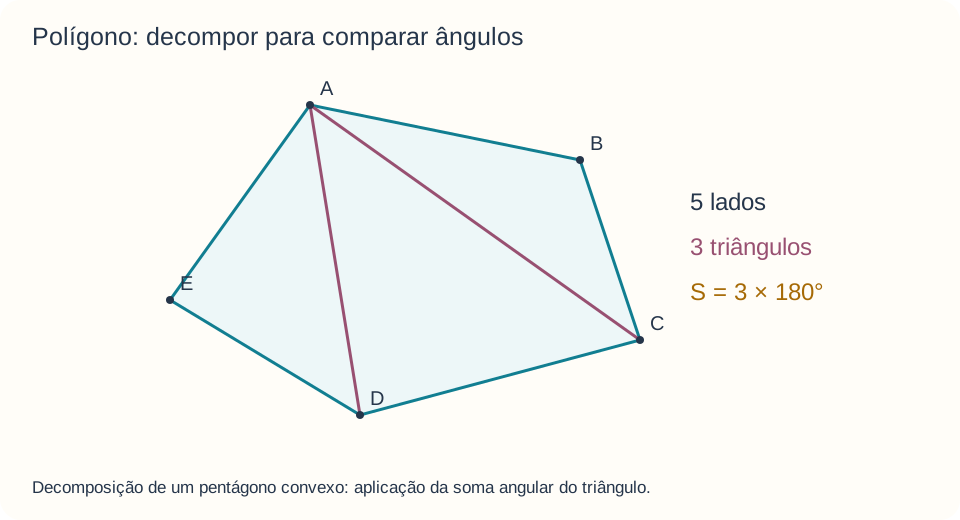
The sum of the interior angles of a convex polygon with $n$ sides is
$$S_i = (n - 2) \cdot 180^{\circ}.$$Deduction. The $n - 3$ diagonals that start from a vertex divide the polygon into $n - 2$ triangles, and the sum of the polygon’s internal angles is the sum of the angles of these triangles.
TeoremaSum of exterior angles
External angle of a convex polygon is the adjacent supplementary of an internal angle. The sum of the exterior angles of a convex polygon is
$$S_e = 360^{\circ}.$$Deduction. At each vertex, $e_k + i_k = 180^{\circ}$. Adding the $n$ equalities: $S_e + S_i = n \cdot 180^{\circ}$. As $S_i = (n-2)\cdot 180^{\circ}$, comes $S_e = 360^{\circ}$.
PropriedadeAngles of a regular polygon
In a regular polygon, the interior angles are congruent and the exterior angles are congruent:
$$a_e = \frac{360^{\circ}}{n}, \qquad a_i = \frac{(n-2)\cdot 180^{\circ}}{n}, \qquad a_i + a_e = 180^{\circ}.$$In practice, it is easier to calculate $a_e$ first and then the supplement $a_i$.