
Euler's Eyes
2026-10-19
Arcs and angles: the mathematics of turns
In the interactive book: complete chapter I, with all demonstrations and exercises.
Start with a turn
Stand facing a wall and turn until you are facing the opposite wall. You turned around. Another half turn and you are in the starting position. An angle measures the opening between two rays of the same origin. We can also follow the rotation that takes one of them to the other.
Take a paper disk. Mark the center O and two points A and B on the edge. Segments OA and OB are rays. The curved path from A to B is an arc. There are two paths along the edge between different points: say which one you are using. The straight segment AB is a chord, different from the arc.
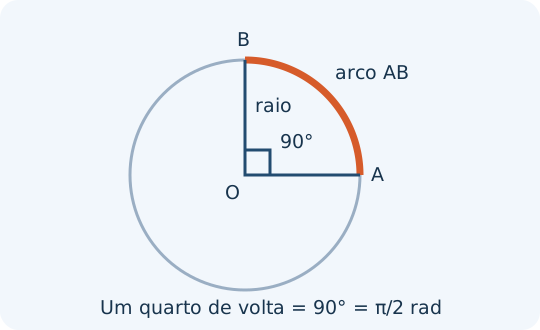
Degrees: divide around
One turn has $360°$. Half a turn has $180°$ and a quarter has $90°$. An angle between $0°$ and $90°$ is acute; between $90°$ and $180°$, obtuse. The angle of $90°$ is right.
Each degree has 60 arc minutes, and each minute has 60 arc seconds. The angle units are: $1°=60'$ and $1'=60''$. For example, $12°30'=12{,}5°$ because $30/60=1/2$.
Demonstration: measuring the arch with string
Use a circle of radius $r$ and length $2\pi r$. Here $\pi$ is the ratio between the length of a circle and its diameter; approximately $3{,}14159$.
An arc that occupies the fraction $\alpha/360°$ of the turn has length
$$s=\frac{\alpha}{360°}\,2\pi r.$$There is another unit: a radian is the central angle that cuts an arc of length equal to the radius. The measurement in radians is $\theta=s/r$. Since a revolution has length $2\pi r$, it measures $2\pi$ radians. Therefore:
$$180°=\pi\text{ rad},\qquad s=r\theta.$$In the last formula, $\theta$ needs to be in radians. A wheel of radius 3 cm that rotates $60°=\pi/3$ rad makes a point on its edge travel $3\cdot\pi/3=\pi$ cm. We do not confuse the measurement of the angle with the length of the arc.
Return with address
The trigonometric cycle is a circle of radius 1, centered at the origin of the plane. We start at $(1,0)$. Positive rotations go counterclockwise; Negatives follow the direction of the hands.
The axes divide the cycle into four quadrants, numbered in the positive direction. The axis points do not belong to any quadrant. $30°$ and $390°$ reach the same point as $390°=30°+360°$. In general, $\alpha+360°k$, for any integer $k$, represents the same end position. The spin may be different.
In everyday life
- Bicycle. A wheel of about 74 cm in diameter advances $\pi \cdot 0{,}74 \approx 2{,}3$ m with each complete revolution.
- Pizza. Cutting a pizza into 8 equal slices gives $360^\circ \div 8 = 45^\circ$ for each slice.
- Steering wheel. “One and a half turns of the steering wheel” is $540^\circ$ of rotation.
Try it
Fold the disc into four parts and then into eight. Every eighth measures $360°/8=45°$. Scroll through three parts with your finger: $135°$. Before using the protractor, estimate whether a turn is less or more than a quarter of a turn.
Exercises
Try solving it in your notebook before opening the solution. Exercises 1 and 2 are input; 3 and 4, for practice; 5 and 6, for deepening.
1. How many degrees are there in three-quarters of a turn?
See resolution 1
$3\cdot360°/4=270°$.
2. Convert $150°$ to radians.
See resolution 2
$150\cdot\pi/180=5\pi/6$ rad.
3. Convert $3\pi/4$ rad to degrees.
See resolution 3
$(3\pi/4)\cdot180°/\pi=135°$.
4. A circle of radius 8 cm has an arc of $45°$. What is the arc length?
See resolution 4
$45°=\pi/4$ rad. Logo $s=8\cdot\pi/4=2\pi$ cm.
5. In which quadrant does the rotation of $-60°$ end?
See resolution 5
In the bedroom: $-60°+360°=300°$.
6. Add $18°45\prime$ and $7°30\prime$.
See resolution 6
$25°75\prime=26°15\prime$, because 60 minutes form a degree.