Nature and Nature’s laws lay hid in night: God said, “Let Newton be!” and all was light.
— Alexander Pope, epitaph intended for Newton
Isaac Newton (1643–1727) was born premature, so small that, as his mother later said, he could have fitted into a quart pot. He grew up apart from her, was a hopeless farmer, and entered Cambridge as a poor student who paid his way by serving wealthier classmates. At 23, cut off in the countryside by the plague, he invented calculus, split white light into colours and began to wonder why the Moon does not fall.
In this trail we tell Newton’s life and rework, with all the steps shown, seven of his discoveries: from the binomial with a fractional exponent to the proof that a prism does not create colours. The figures are interactive: move the controls to watch a secant turn into a tangent, a root appear in a few steps, and larger orbits become slower.
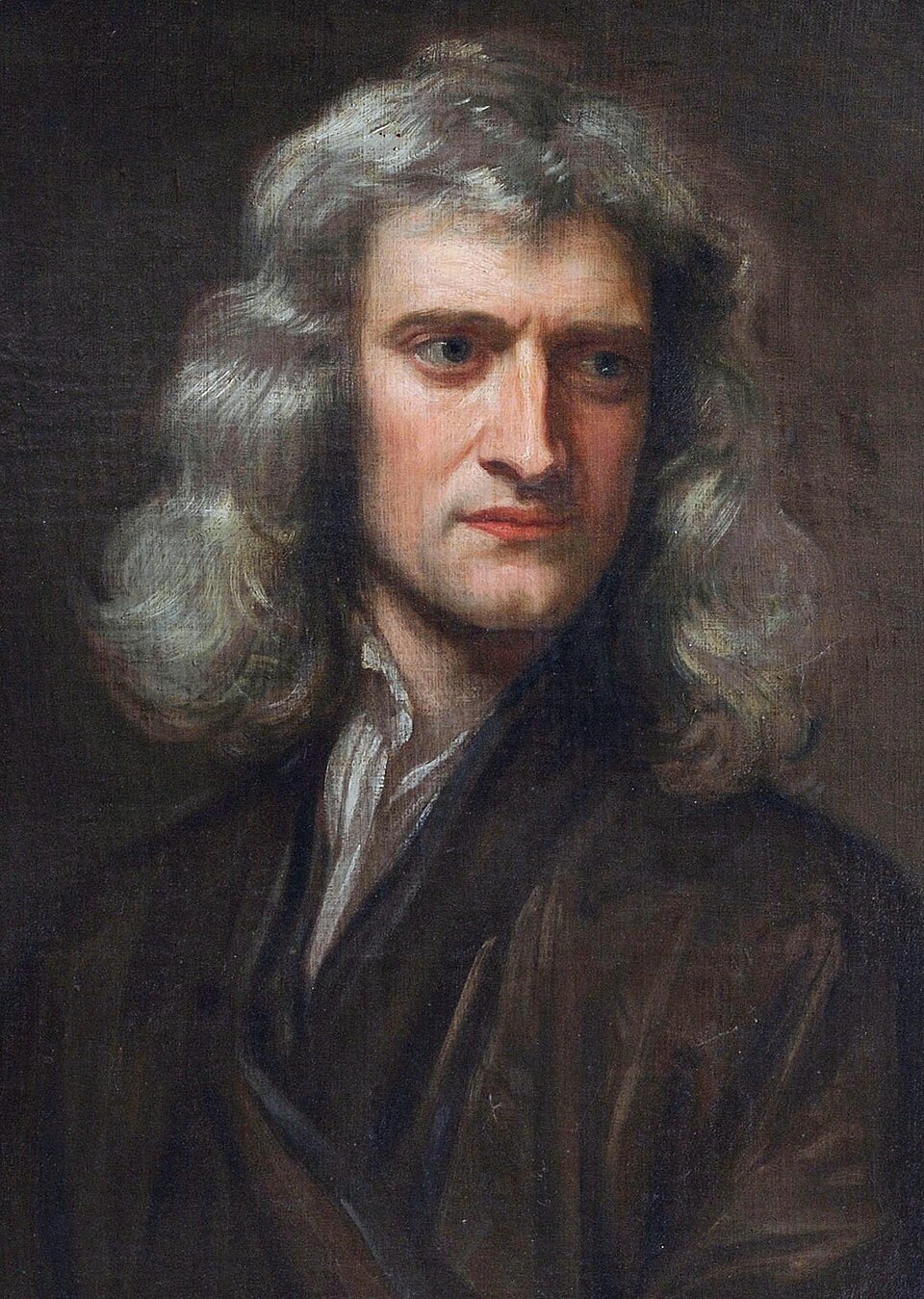
Who he was
Isaac Newton
- Nascimento
- 4 January 1643, Woolsthorpe (Gregorian calendar)
- Morte
- 31 March 1727, London (Gregorian calendar)
- Origem
- England
- Áreas
- Calculus, series, mechanics, gravitation and optics
Reading guide
Biography
Discovery and proof
- The generalized binomial: beyond whole-number powers
- Fluxions: how to measure an instantaneous change
- Areas and integration: the inverse of fluxions
- Newton’s method: approximating roots with tangents
- The laws of motion: forces and changes in velocity
- Gravitation: from the apple to the Moon
- Light and colours: the prism does not make the rainbow