
Euler's Eyes
2026-10-13
Leibniz against the dots: active and sterile notation
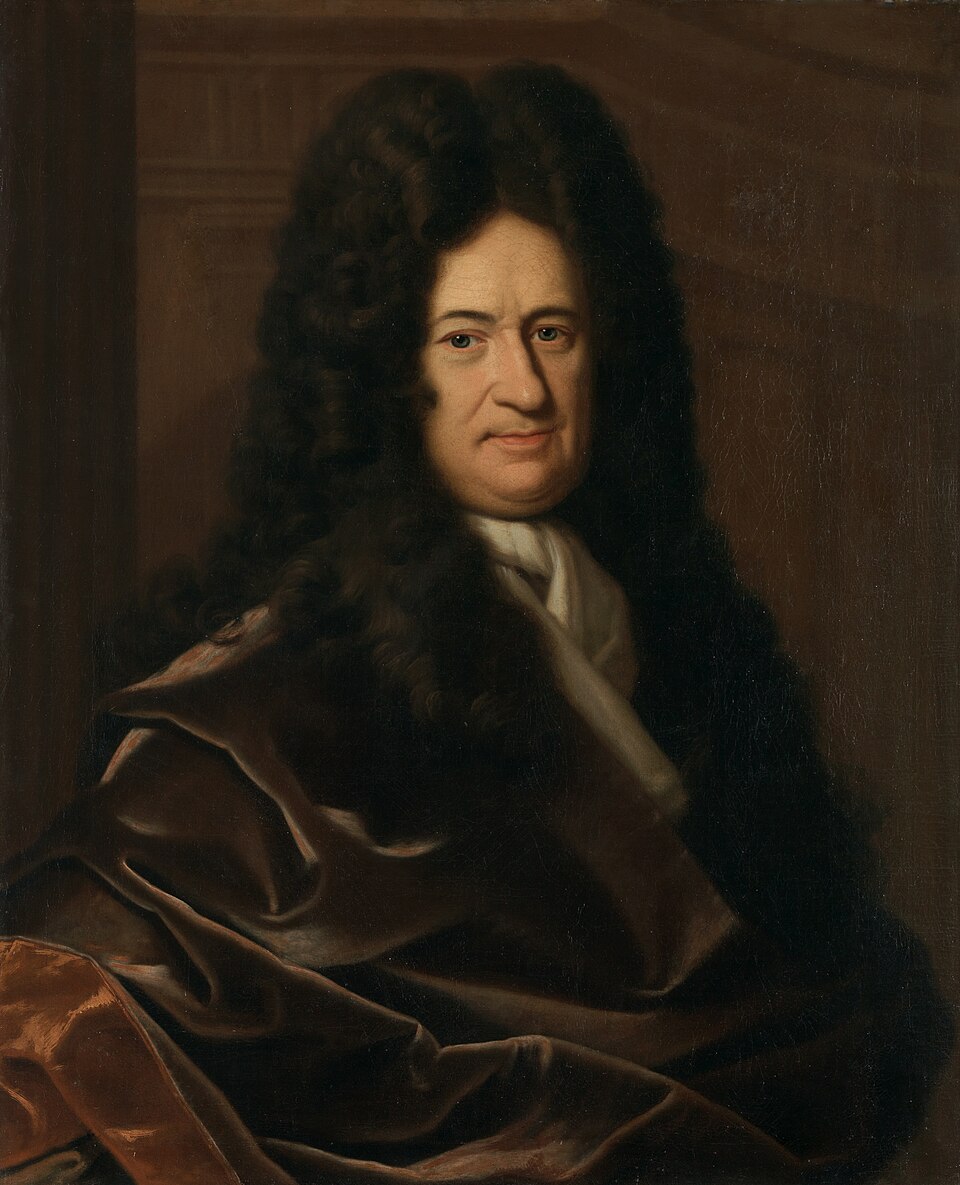
On 29 October 1675, in Paris, Leibniz was adding up infinitely many thin slices under a curve and got tired of writing omnia, “all”, in front of each sum. He noted in his notebook:
Utile erit scribi ∫ pro omnia. (It will be useful to write ∫ instead of “all”.)
— Leibniz, manuscript of 29 October 1675
The $\int$ is a stretched S, for summa. Two weeks later, in the same notebook, the $d$ appeared, for differentia, to denote infinitely small differences. With these two signs Leibniz had in his hands a language for the whole of calculus. Isaac Newton had reached the same ideas ten years earlier, in Cambridge, but wrote them differently. This is history’s best case for seeing how the shape of a sign changes what can be done with it.

Two scripts for the same idea
Newton thought of quantities that flow in time, like the position of a moving body. He called the quantity a fluent and its rate of change a fluxion, and took to marking the fluxion with a dot over the letter: if the fluent is $x$, the fluxion is $\dot{x}$; the fluxion of the fluxion is $\ddot{x}$.
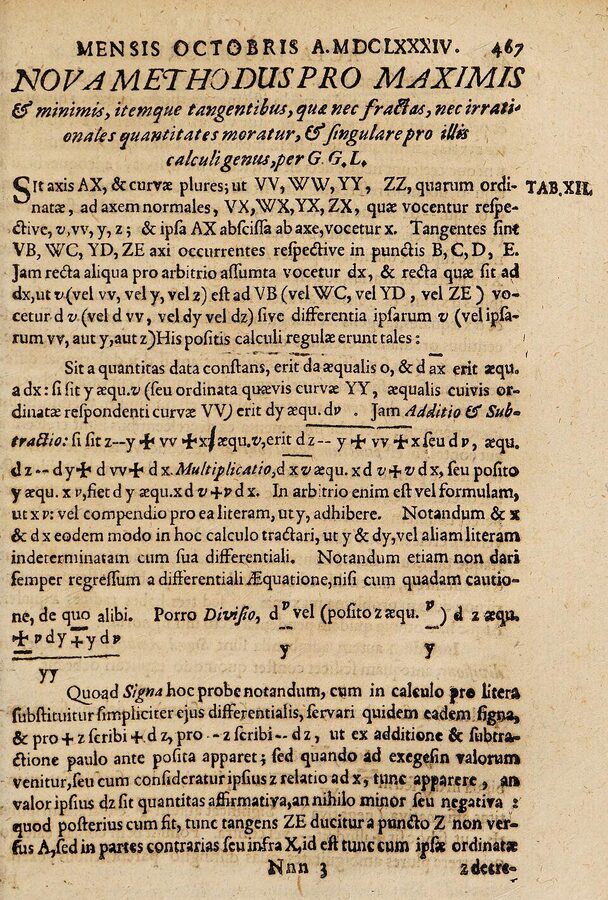
Leibniz thought of tiny differences between neighbouring values. The difference of $x$ is $dx$, that of $y$ is $dy$, and the rate of change is the ratio between them, $\dfrac{dy}{dx}$. Side by side:
| What we want to say | Newton | Leibniz |
|---|---|---|
| rate of change of $y$ | $\dot y$ | $\dfrac{dy}{dx}$ |
| with respect to what? | time (implicit) | $x$ (written) |
| second derivative | $\ddot y$ | $\dfrac{d^2y}{dx^2}$ |
| sum of slices | no settled sign | $\displaystyle\int y\,dx$ |
| chain rule | remember the rule | $\dfrac{dz}{dx}=\dfrac{dz}{dy}\cdot\dfrac{dy}{dx}$ |
Newton’s dot is shorter. But notice what it hides: the variable with respect to which you differentiate. For Newton it was always time, and that was right for his physics. When a quantity depends on something other than time, or on several things at once, the dot has nowhere to say so.
The words behind the signs
The names of this calculus also hold images. Derive comes from the Latin derivare, from de (from) and rivus (stream): to divert water from a river into a channel. The derivative is what “flows off” a function. Tangent comes from tangere, to touch: it is the line that just touches the curve at one point. Leibniz’s differentia comes from differre, to carry apart: it is the small distance between two neighbouring values. And Newton’s fluxion is, literally, flow, that which flows. In 1704, in the Tractatus de quadratura curvarum, Newton announced his dots like this:
Let x, y, z be fluent quantities; their fluxions will be designated by these marks: ẋ, ẏ, ż.
— Isaac Newton, De quadratura curvarum (1704)
After Newton and Leibniz, other authors created scripts of their own, and each brings into view a different part of the same idea:
| Author | Writing | What it shows | What it hides |
|---|---|---|---|
| Newton (1690s) | $\dot y$ | change in time | the variable |
| Leibniz (1675) | $\dfrac{dy}{dx}$ | the ratio of changes; the chain rule | that it is not an ordinary fraction |
| Lagrange (1797) | $f'(x)$ | that the derivative is another function | the variable of differentiation |
| Arbogast (1800) | $Df$ | that differentiating is an operation on functions | the point and the variable |
None of them won on its own. Today a single book uses $f'(x)$ to talk about the derivative function, $\frac{dy}{dx}$ to do sums with the chain rule and $\dot x$ for velocity. Knowing how to switch notation according to the problem is part of knowing calculus.
The notation that does sums by itself
Leibniz chose signs that behave like fractions. They are not real fractions (the rigorous meaning of $dy$ and $dx$ was only clarified in the nineteenth century, with limits), but the writing was designed so that fraction manipulations give the right result in the cases where they should. The chain rule is the classic example: $\dfrac{dz}{dy}\cdot\dfrac{dy}{dx}$ “cancels” the $dy$ and gives $\dfrac{dz}{dx}$. The rule is drawn into the very shape of the symbol.
Here is a calculation the old texts on this site used as an example. To differentiate $f=(x^5-2x)^{\pi}$, call what is inside the brackets $u$:
$$u=x^5-2x,\qquad f=u^{\pi}.$$Then
$$\frac{df}{dx}=\frac{df}{du}\cdot\frac{du}{dx}=\pi\,u^{\pi-1}\cdot(5x^4-2)=\pi\,(x^5-2x)^{\pi-1}(5x^4-2).$$Whoever writes in Leibniz’s notation does not need to remember to multiply by the derivative of the inside. The writing asks for it: a $du$ is missing to cancel, and the only way to get it is to write $\frac{du}{dx}$. To see the fraction game up close, with numbers, see the chapter on Leibniz’s notation.
This is what, since the first text, we have called active notation. Leibniz knew very well what he was doing:
In signs one observes an advantage for discovery which is greatest when they express the exact nature of a thing briefly and, as it were, picture it; then indeed the labour of thought is wonderfully diminished.
— Leibniz, letter to Tschirnhaus (1678)
The same goes for the $dx$ inside the integral. It looks like decoration, but it works. To compute $\int 2x\,(x^2+1)^3\,dx$, set $u=x^2+1$. Then $\frac{du}{dx}=2x$, and Leibniz’s writing invites you to “move the $dx$ to the other side”: $du=2x\,dx$. The integral becomes
$$\int u^3\,du=\frac{u^4}{4}+C=\frac{(x^2+1)^4}{4}+C.$$This is the substitution rule, and once again it is drawn into the writing.
England stuck with the dots
After the bitter dispute over who had invented calculus first, the English mathematicians closed ranks: out of loyalty they would use Newton’s dots. The Continent used Leibniz’s $d$. Throughout the eighteenth century almost all the great advances in analysis came from the Continent: the Bernoullis, Euler, Lagrange, Laplace. The English, with a notation that suggested nothing, fell behind for more than a hundred years. The old texts on this site summed it up: Newton’s notation was sterile.
It would be unfair to say that Newton’s dot died. In physics, when the variable is time, it is short and clear, and to this day we write $\dot x$ for velocity and $\ddot x$ for acceleration. The dot is sterile as a language for the whole of calculus, not as an abbreviation for one particular case. That, incidentally, is a good test: a notation is active when it keeps working when taken to new problems.
Exercise: the chain rule written by Leibniz
Differentiate $z=(3x^2+1)^4$. With $y=3x^2+1$ we have $z=y^4$, and
$$\frac{dz}{dx}=\frac{dz}{dy}\cdot\frac{dy}{dx}=4y^3\cdot6x=24x\,(3x^2+1)^3.$$Exercise: when the dot is not enough
A body moves so that its position $x$ depends on time, and a quantity $y=x^2$ depends on position. If at the instant considered $x=3$ and $\dot x=2$, what is $\dot y$?
In Leibniz’s notation: $\dfrac{dy}{dt}=\dfrac{dy}{dx}\cdot\dfrac{dx}{dt}=2x\cdot\dot x=2\cdot3\cdot2=12$. Newton’s writing gives the same number, $\dot y=2x\dot x$, but to get there you had to know the rule already. Leibniz’s shows why it holds, and also lets you write $\dfrac{dy}{dx}=2x$, the rate with respect to position, which the dots cannot name.
Chapter index · ← Napier and the logarithm: the marvellous abbreviation · From exhaustion to the integral: Σ, ∫ and the number π →