
Euler's Eyes
2022-10-15
2° degree equation
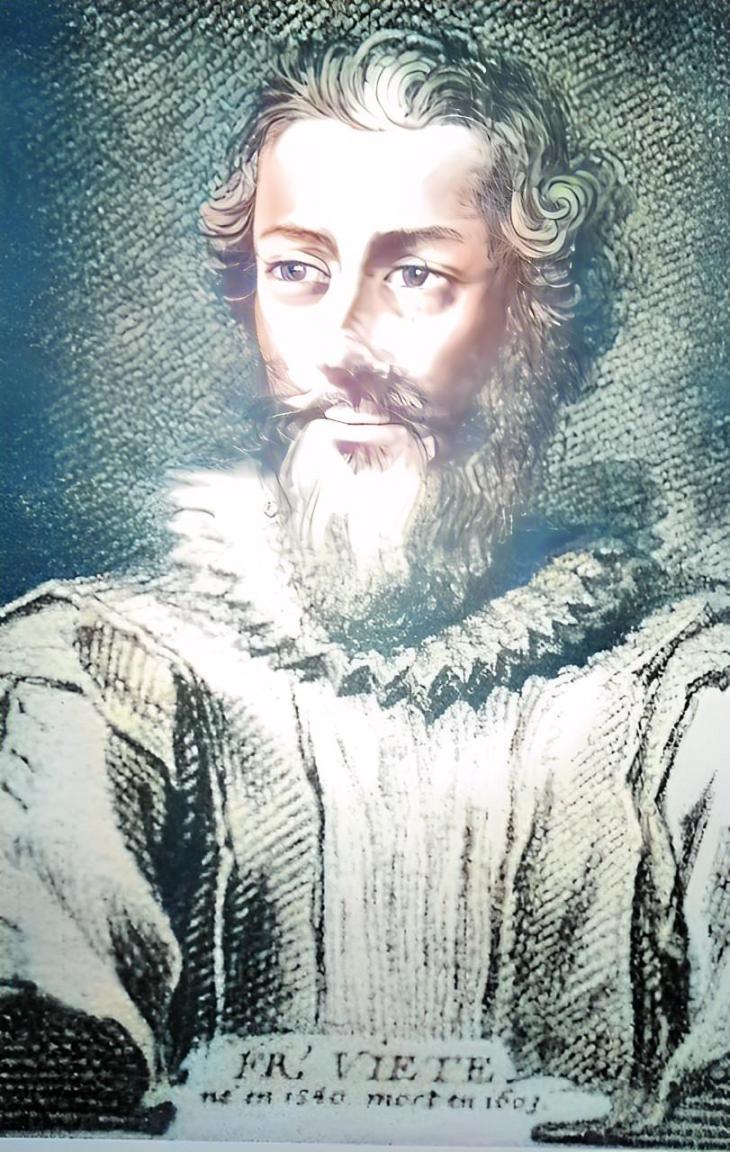
In the previous post, the technique used by Bhãskara to solve 2th degree equations was shown. Many mathematicians between the 15th and 17th centuries developed different forms for 2th degree equations. One of them was François Viète (1540-1603).

Proposal by François Viète
François Viète, inspired by Bhãskara, used the shared scarf method, which we will demonstrate in the next topic.
| François Viète |
|---|
|
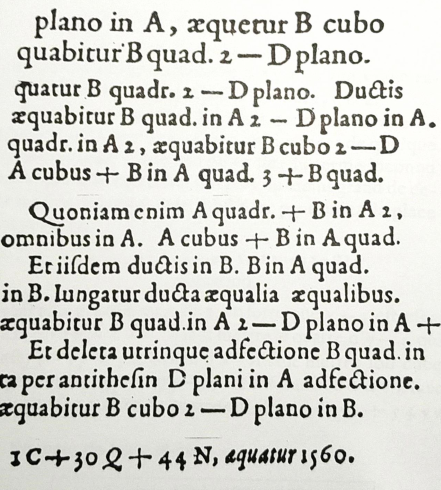
Excerpt from some of the topics studied by François Viète.
| Year | Author | Article | Notation |
|---|---|---|---|
| 1593 | Francis Vieta |
|
$$1x^3 + 30x^2+44x = 1560$$ |
Demonstration of the modern-day method
Here, we will use features such as notable product and square area. Let the following equation be 2th degree.
$$ax^2 + bx+ c =0$$The first step is to isolate $x^2$, for this we will use the scale.
Now, let’s add $\dfrac{b^2}{4a^2}$ on both sides according to the geometric figure, which is the result of the multiplication in the cross table below.

People call it $\Delta = \sqrt{b^2 - 4ac }$. With this, we obtain:
Therefore, we have to
Example 1
The following equation represents the division of goods used in Bhãskara’s time.

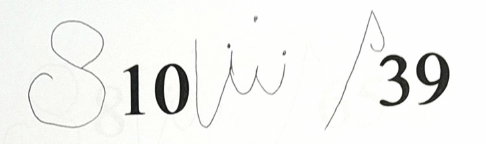
In current terms we have:
$$x^2+10x -39 = 0$$- $a=1$
- $b=10$
- $c=-39$

In the previous post we calculated in detail.
It is worth remembering that the example is about sharing of assets. In this case, the negative value does not make sense for this application. However, in others we can use the other solution.
Property
Cardano-Viète Theorem: Let the equation be in the form $ax^2 + bx+ c =0$, with $a\neq 0,$ with real roots $x_1$ and $x_2$. So we have
$$\text{Soma} = S = x_1+x_2 = \dfrac{-b}{a}$$$$\text{Produto} = P = x_1 ~.~ x_2 = \dfrac{c}{a}$$
Demo:
Let the roots of the equation be:
The sum of the roots is given by:
The product of the roots is given by:
$\square$
Example 2
What is the sum and product of the roots of the equation
$$2x^{2}-3x-6=0$$without the need for the roots of the equation.
Solution:
$$S=x_{1}+x_{2}={\frac {-b}{a}}={\frac {-(-3)}{2}}={\frac {3}{2}}$$$$P=x_{1}~.~x_{2}={\frac {c}{a}}={\frac {-6}{2}}=-3$$
Discriminant analysis
Definition (Discriminant): The term $\Delta=b^{2}-4ac$ is called the discriminant.
Let the equation be in the form $ax^2 + bx+ c =0$, with $a\neq 0,$
Results:
- $\Delta >0$ there are two real and distinct roots;
- $\Delta =0$ there are two real and equal roots;
- $\Delta <0$ there are no real roots.
Example 3
What is the value of $m$ so that the equation
$$2x^{2}+x+m=0$$So that it has real and distinct roots.
Solution:
In this case,
$$\Delta =b^{2}-4ac>0$$then
Example 4
What is the value of $m$ so that the equation
$$x^{2}+mx+4=0$$So that it has real and equal roots.
Solution:
In this case,
$$\Delta =b^{2}-4ac=0$$then
Example 5
What is the value of $m$ so that the equation
$$mx^{2}+2x+3=0$$So that she has no real roots.
Solution:
In this case,
$$\Delta =b^{2}-4ac=0$$then
These are the results for quadratic equations. Wait for the next posts.